
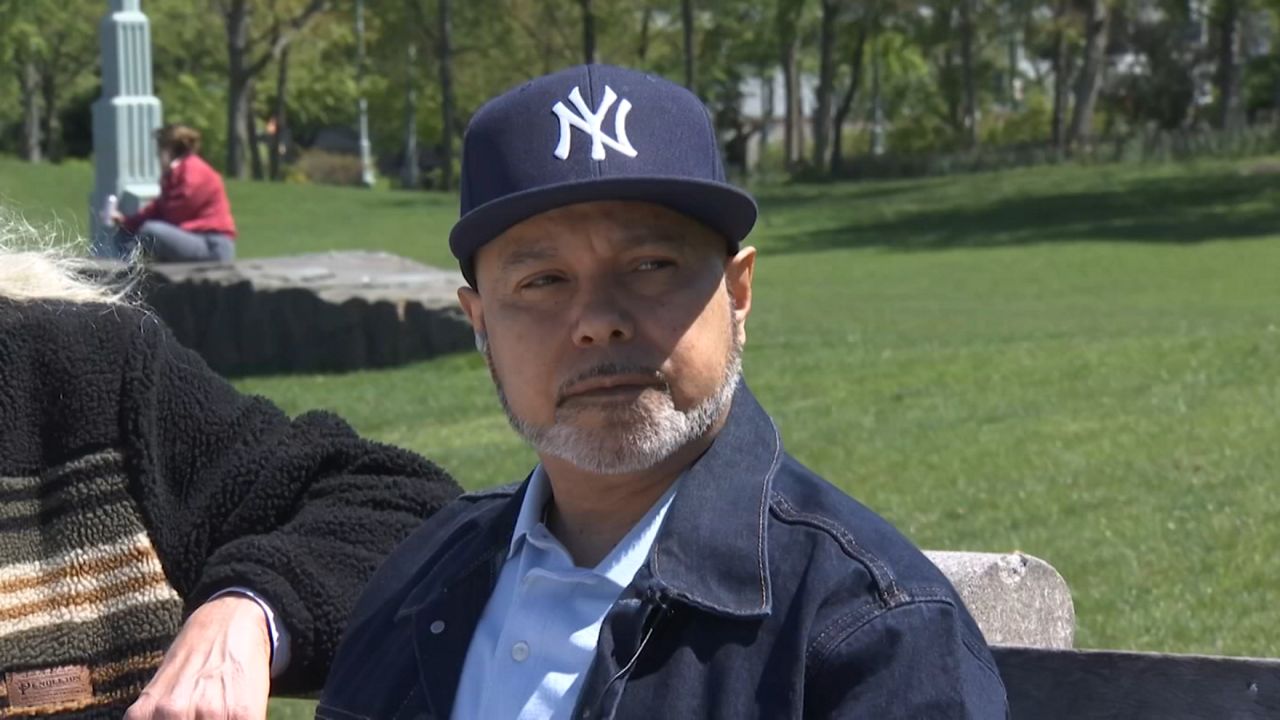
Bronx native Harry Ruiz served 25 years in prison for a murder he did not commit.
“I’m breathing fresh air. I’m looking around. Everything looks so beautiful. The trees, the water, everything,” he said.
What You Need To Know
Bronx native Harry Ruiz served 25 years in prison for a murder he did not commit
Police arrested Ruiz, charging him with second-degree murder. The only evidence was a testimony from a 13-year-old girl who first pointed to a different man in the courtroom before identifying Ruiz. Two other witnesses with her that night never identified him
He was convicted on Nov. 16, 1994
It had been less than two weeks since Ruiz stepped into criminal court in Lower Manhattan.
“Harry Ruiz should not have been convicted. That tragic injustice ends today. The indictment is dismissed,” Judge Robert Mandelbaum said in April.
April 27 — 32 years after the summer night in Harlem when 23-year-old Felix Emmanuel was shot and killed as he walked on Amsterdam Avenue. A single gunshot to the back of the head.
Police arrested Ruiz, charging him with second-degree murder. The only evidence was a testimony from a 13-year-old girl who first pointed to a different man in the courtroom before identifying Ruiz. Two other witnesses with her that night never identified him.
“There was no motive ever established. The young woman, the children that she was actually with that night, couldn’t identify Harry, didn’t identify Harry,” Ron Kuby, Ruiz’s defense attorney, said.
“I was like, ‘Why are they doing this? Why are they lying about me?’” Ruiz said.
Ruiz was convicted on Nov. 16, 1994.
“I even spoke to the family. I said, ‘I’m sorry for your loss, but it wasn’t me,‘“ he said.
Ruiz was sentenced to the maximum: 25 years to life.
“I’m not gonna lie. It was scary. You know, one day you’re thinking it could be your day,” he said.
When NY1 asked how he survived, Ruiz said, “Staying humble with everyone. Staying real. Being quiet. Didn’t speak very much.”
In 2019, after a quarter century in prison, Ruiz was released on parole.
“I was happy [because] there [were] no bars in front of me. But knowing that I came home on certain conditions to report to a parole officer, that still was a realization [that] you’re not free,” he said.
Ruiz’s mother lived to see him released, but not to see his exoneration.
“I haven’t grieved. I’m still learning how to grieve. She pops in [my] mind most every day, and sometimes I just find myself, tears flowing down,” he said about his mom.
Kuby took on Ruiz’s case in 2002.
“The question wasn’t whether he was innocent. I had no doubt about that. The question was, how can we prove this, and to whom? And Harry had already exhausted almost all of his legal avenues,” he said.
But a new Manhattan district attorney, Alvin Bragg, had a new mission.
“Which was, let’s just not assume we’ve always been right about everything all the time. Let’s have a look,” Kuby said.
A reinvestigation by Bragg’s Post Conviction Justice Unit uncovered evidence prosecutors say was never turned over to the defense, including more than $17,000 in benefits given to that key teenage witness’s family, and testimony indicating a murder-for-hire plot with no connection to Ruiz.
“It was all, you know, one of these kinds of classic setups for a wrongful conviction,” Kuby said.
A prosecutor who had tried his case in 1994 refused to speak with the current prosecutors investigating Ruiz’s conviction. And the judge said “very” exculpatory evidence appears to have been withheld from the defense.
When asked how common cases like Ruiz’s are, Kuby said. “There are a lot of cases like Harry’s and we still have no good sense of how many there actually are.”
“I look forward to the future. I look forward to doing things that I wasn’t able to do, you know, due to the circumstances and everything. I think I still have time to do a lot of things,” Ruiz said.