
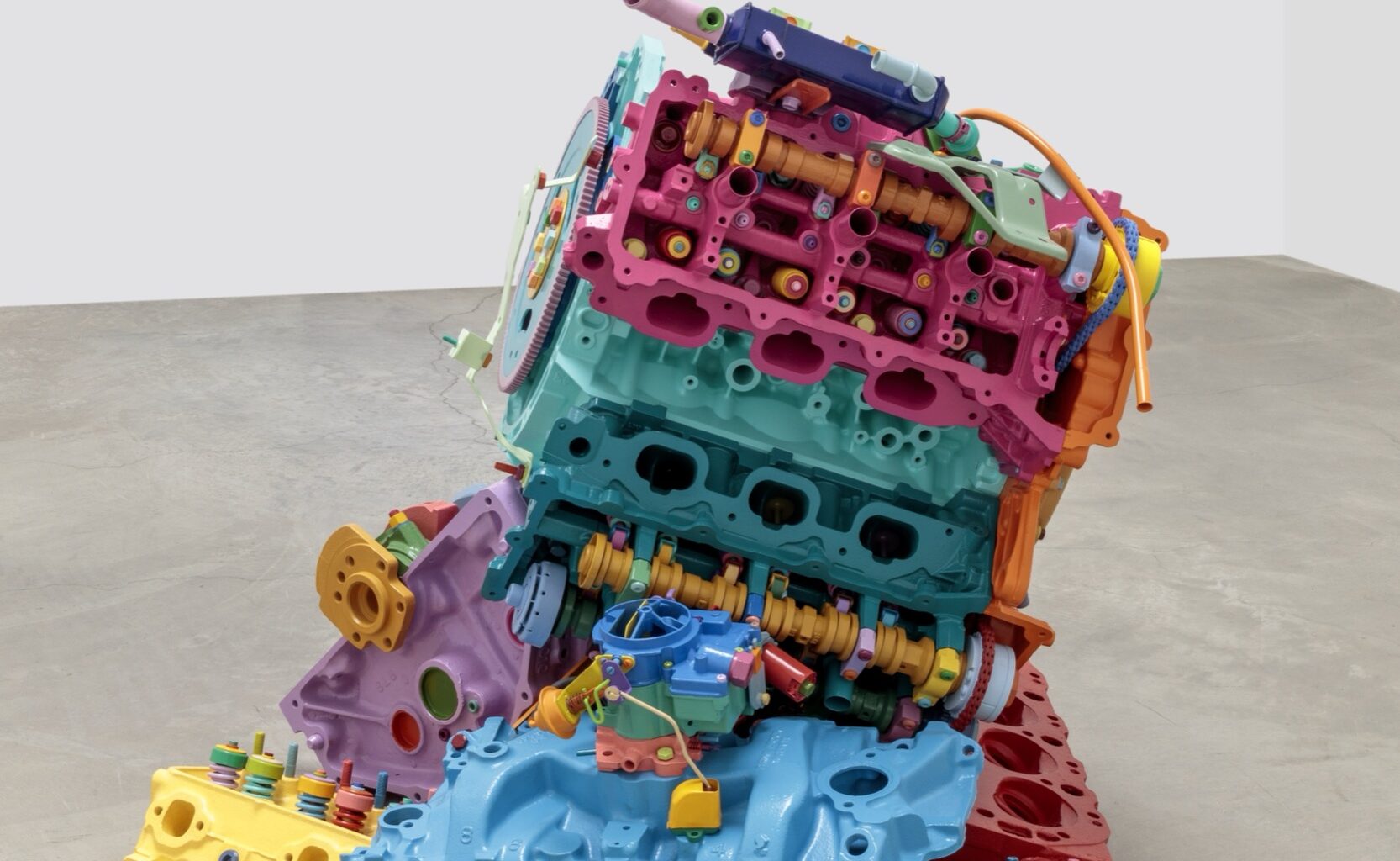
Charles Ray
Jeffrey Deitch
April 18–June 6, 2026
Los Angeles
Charles Ray
Matthew Marks
April 18–June 13, 2026
Los Angeles
Charles Ray is a rare and important artist for several critical reasons, one of which is his skill at having meaningful things to say—with openness and concision—about his own sculptures. A text comprised of just a few sentences concerning each work accompanies this two-venue exhibition, with new works at Marks and exceptional works from 1988, 1990, and 1993 at Deitch. Less explanation than expansion, in it, Ray makes clear that he hopes that the two exhibitions are a “continuous body of work descending across decades […] a single mereology.” Nonetheless, these particular pieces, when considered within the entirety of his mature work (started just a few years before the earliest work on view, Pepto-Bismol in a Marble Box [1988]), are each rather remarkably complete in and of themselves. They are whole parts, but they are anything but contradictions.
Ray’s statement is effective because like his sculptures, it holds both weight and space in exacting and peculiar ways: for example, the idea of “descending across decades” is neither expected nor static but gravitational and momentous, adding a sort of turbo boost to the purring “engine” of the half-century of his enterprise. Not unexpectedly, what Ray has to say about his work (and, from what I’ve witnessed often, that of others across all of art history) speaks to the essential role of gravity in the creation and maintenance of form. And then, of course, there is also entropy…
The aforementioned Pepto-Bismol in a Marble Box can be seen as the most transitory of all the works on view in both locations, as even the steadfastness of its rather elegant marble box doesn’t completely neutralize the bodily functionality and transformation of the copious amount of the glowing pink and unappetizing medicine that comes right up to its brim. That it is “over the counter” doesn’t seem incidental, as it is the threat of overflow that enlivens its solidity.
The enlivening of solidity has remained a clear goal of much of Ray’s work ever since. Take, for example (at Marks), The Animation of Pandora (2026), a larger-than-life–sized white-painted bronze of three figures enacting the myth of the creation of the first human woman, upon whom the so-called evils of the world would be blamed. Continuing Ray’s interest in the most traditional forms of figurative sculpture, the work embodies the frozen motion we come to expect from the genre while alluding to the other consequential moment of the myth: Pandora’s—you guessed it—box.