
No Still Waters
IRL Gallery
April 24–May 22, 2026
New York
In Phuong Nguyen’s current exhibition at IRL Gallery, No Still Waters, three small, oil still lifes of ceramic objects, framed with intricate woodwork, hang on one wall (all works 2026). From Toronto with Vietnamese roots, Nguyen paints through the lens of the diaspora. Referencing the 1919 French colonial publication L’Art à Hué, which catalogued Vietnamese culture with clinical distance, each of the works is titled Planche [plate] alongside a Roman numeral of the publication’s matching illustration. Nguyen further reinvents the colonial source’s illustrations in three-dimensional forms by pulling from its corresponding imagery to construct the frames. Pink freshwater pearls hang from rough edges while painted fingernails and silky fabric surround porcelain. The shadows of women linger, imbuing the inanimate with life.
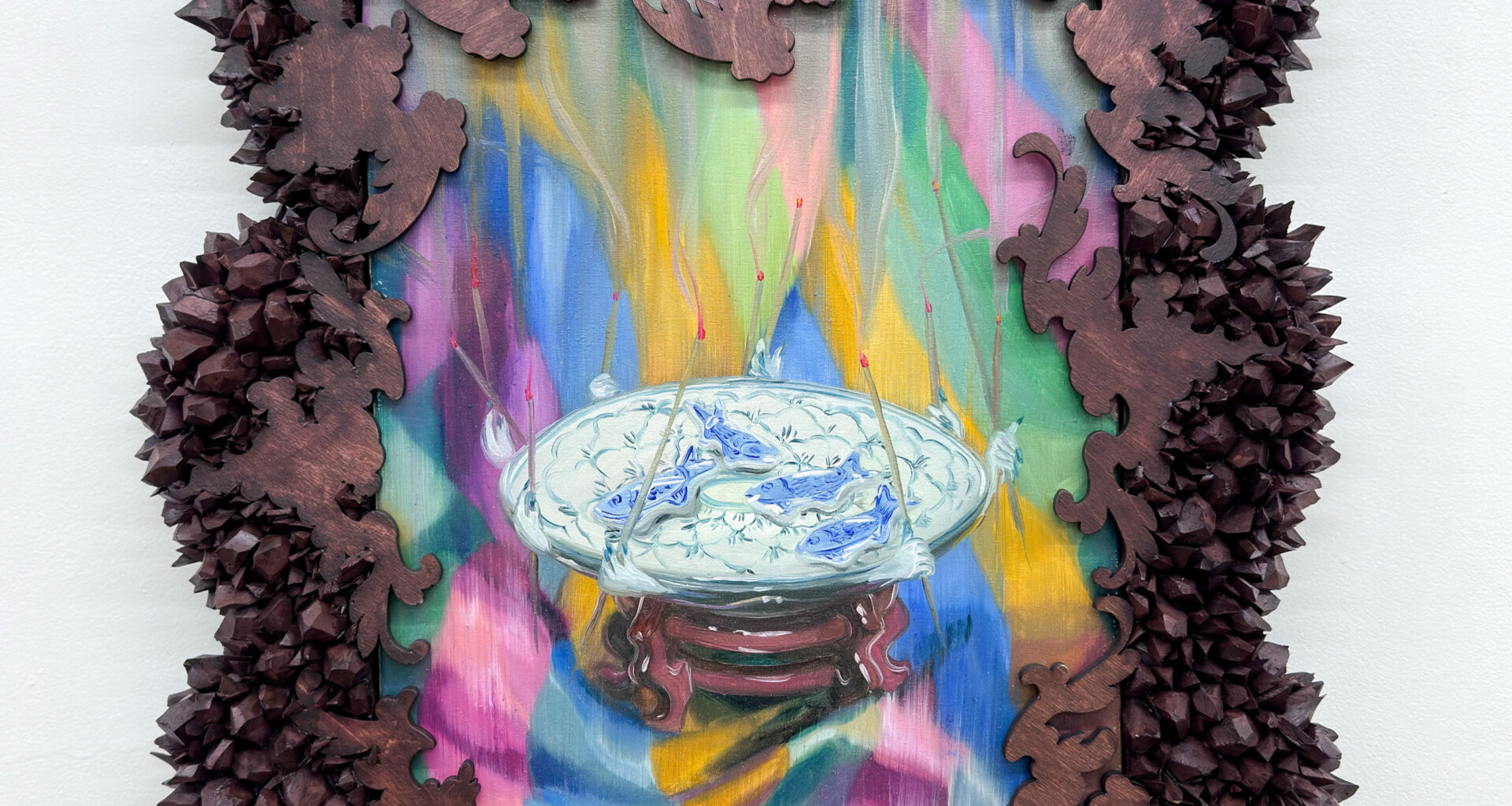
Swatches of vibrant color background a glistening, white porcelain plate with teal decorative linework in the central painting, Planche CLXXXVII. Four light blue fish rest upon it, outlined in white to create the appearance of shallow water while dark blue lines form their unique facial expressions. Only one fish’s eyes are open, creating ambiguity as to whether they are alive or merely part of the plate’s design. Eight small white hands emerge from the rim, the fingernails painted in the same teal as the plate’s linework, making them appear as extensions of the porcelain. Each hand holds a long stick of burning incense, a Vietnamese tradition grounded in the desire to communicate with the spiritual realm. In muted tones, smoke drifts up from the burning tips. Pale coral smoke swirls within a bright pistachio green while muddy yellow overlaps sky blue. The plate exists in the spiritual realm, becoming a messenger between the visible and unseen worlds—context that L’Art à Hué stripped from objects. Fabric is delineated in paint through subtle shadows within the curved paths of pinks, purples, yellows, blues, and greens. Within the folds of the fabric, arms leading to more arms emerge holding the plate. Easy to miss, women are constructing the scene; Nguyen gives the objects back to the hands of the imagined creators.
The frame that contains Planche CLXXXVII acts as a protective shell, with spiky points of wood jutting from it like a cave wall studded with gems, which prevents the viewer from getting too close to the canvas’s warmth. However, the frame is gentle with the artwork, with pockets of space visible between it and the canvas. Physical distance replaces the manufactured emotional distance of L’Art à Hué. Referencing an illustration in the book, Nguyen has carved abstract flying bats, which partially and deliberately obstruct the canvas, to form the inner lining of the frame.