
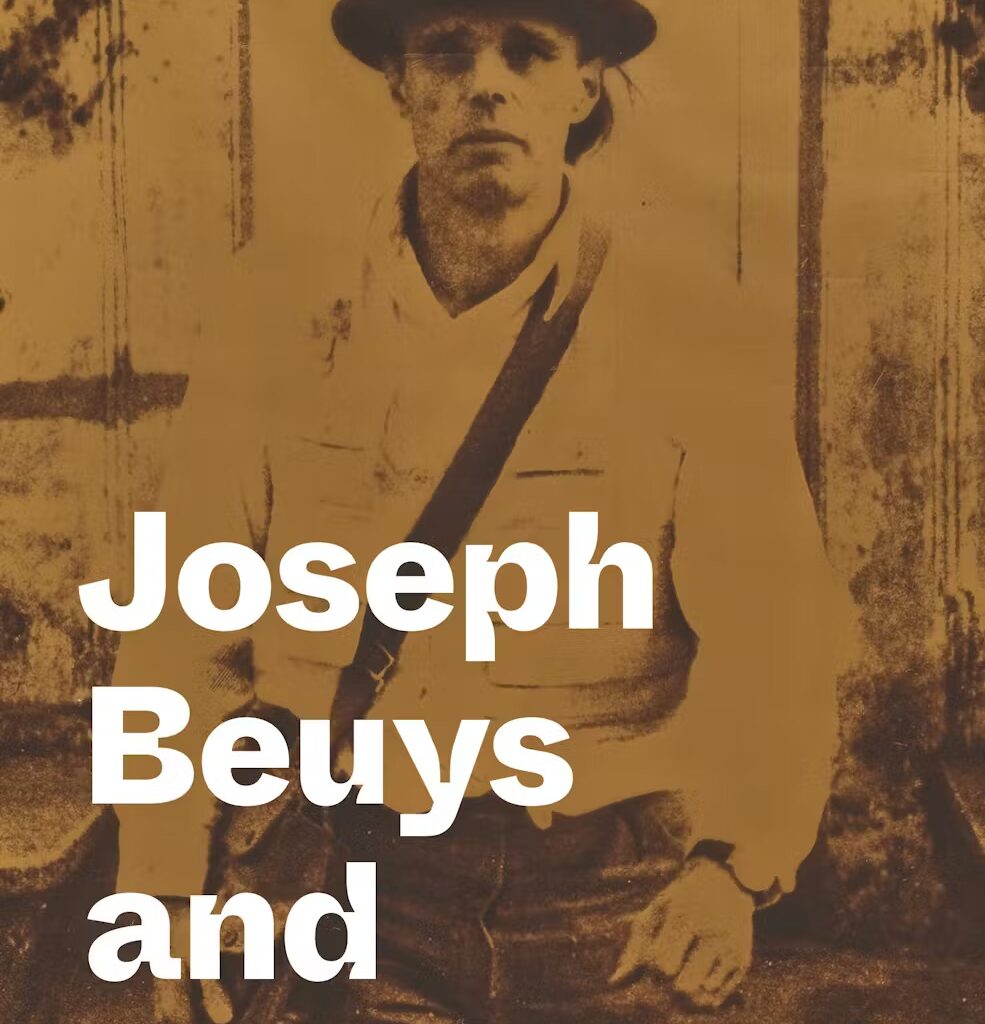
Joseph Beuys and History
Daniel Spaulding
Princeton University Press, 2026
In 1977, artist Joseph Beuys installed a massive apparatus at Documenta 6 in Kassel, Germany, consisting of a motorized pump circulating two tons of honey through transparent plastic tubing that snaked through the exhibition’s main venue in a closed loop. Titled Honigpumpe am Arbeitsplatz [honey pump at the workplace], the installation was meant to complement—and metaphorically exchange energy with—robust economic, social, and political discussions hosted in the galleries by Beuys’s Free International University (FIU), an itinerant academy the artist had co-founded several years earlier.
Honigpumpe’s intersecting associations—circulation, accumulation, and sociality in relation to the body, the economy, and the exchange of ideas—lie at the heart of Daniel Spaulding’s ambitious new monograph, Joseph Beuys and History, a densely theoretical rereading of the artist through the lens of Marxist social art history. (Be warned: if you are not versed in the vast Beuys literature nor particularly comfortable with critical theory, your entrée lies elsewhere.) Spaulding’s book is, above all, an attempt to take Beuys seriously. Many others, especially in the American academic context, have dismissed the artist as a charismatic mythmaker (or worse) and refused to analyze any aspect of his production beyond his persona. By sharp contrast, Spaulding amply demonstrates that much is to be learned by confronting Beuys’s works in all their unruly materiality and metaphoricity, in full view of the complex histories in which the artist was embedded.
Born in 1921 in Krefeld, Germany, Beuys served in the Luftwaffe during World War II. He later developed a partially fictionalized personal mythology around his wartime experiences, claiming to have been healed from a plane crash by nomadic Tatars who wrapped him in fat and felt. By the 1960s and ’70s, he had become a central figure in the European avant-garde, known for his use of nontraditional materials, as well as for a public persona developed through performances and expansive pedagogical and political commitments. At the height of his career, Beuys was nothing short of a household name in Germany, equally mocked and adored.
Over the course of the 1960s, Beuys elaborated two key propositions: first, what he called the “expanded concept of art,” exemplified by his catchphrase “everyone is an artist,” meaning that human creativity of all kinds (whether painting or potato peeling) should be equally valued; and second, the idea of “social sculpture,” which proffers a utopian vision in which society itself is constantly shaped and reshaped through the exercise of human creativity. Neither idea is fully original; both can be traced to nineteenth-century German Romanticism, Rudolf Steiner’s anthroposophical writings, and, rather unfortunately, to Nazi rhetoric under the Third Reich. Aware of their origins, Beuys turned these propositions—which continue to be widely influential today—into the basis of his artistic practice.
Through close examination of a number of Beuys’s large-scale sculptural installations of the 1960s and ’70s, Spaulding argues that Beuys advanced a conception of art as a totalizing social, political, and economic mediator, one that has its mirror in the only other totalizing concept experienced by the modern subject: capital. Per Karl Marx, capital flattens particularity into abstract value that can be measured in dollars, cents, and bitcoins, and does so with a naturalized violence.
Beuys himself, against the backdrop of Germany’s postwar economic and political developments and moments of crisis, offers a solution, summed up in an equation he oft repeated: “Kunst = Kapital,” or Art = Capital. Spaulding casts this as Beuys’s core paradox: art could function as expansively as capital, supplanting it as the organizing principle of society, but the way to this anticapitalist future is by modeling art after capital. Spaulding takes Beuys’s metaphor literally, testing it against his artworks—beginning with Honigpumpe, whose circulating honey he reads as a figure for the circulation of capital—to understand how such an operation would work, if it would work at all, and also to sketch more broadly how and to what end Beuys relies on metaphor and myth for meaning.