
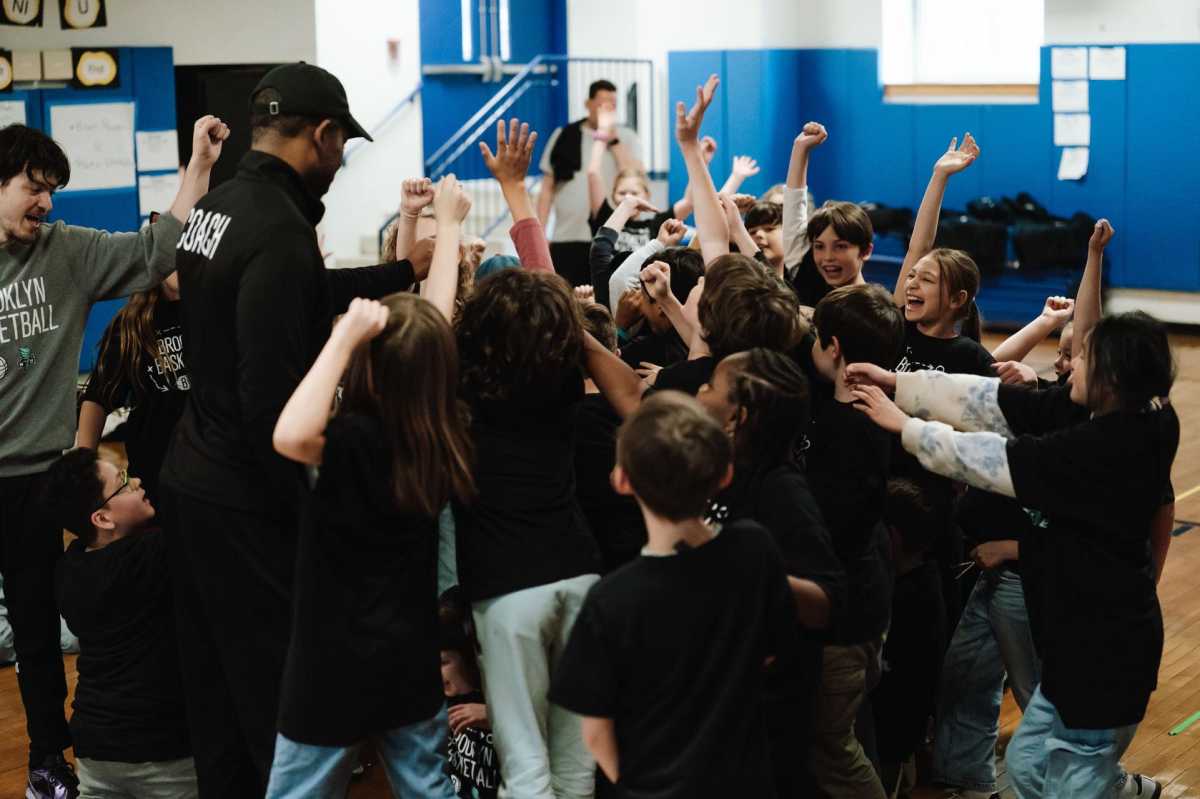
For decades, basketball has been the heartbeat of Brooklyn, from Bed-Stuy blacktops to packed high school gyms across the borough. But for many children, access to organized coaching and structured programming can still feel out of reach. That’s where Brooklyn Basketball is trying to close the gap.
What began as a small community initiative has evolved into one of Brooklyn’s largest youth basketball outreach programs, now reaching more than 200 schools and tens of thousands of students each year through partnerships with the New York City Department of Education.
At the center of that growth is head coach Michael Collins, whose coaching résumé spans nearly two decades across youth, collegiate and professional basketball.
“I’ve definitely coached the three major populations of basketball players,” Collins said. “The youth space, the college space, and I’ve worked with a ton of overseas and G League and NBA pros.”
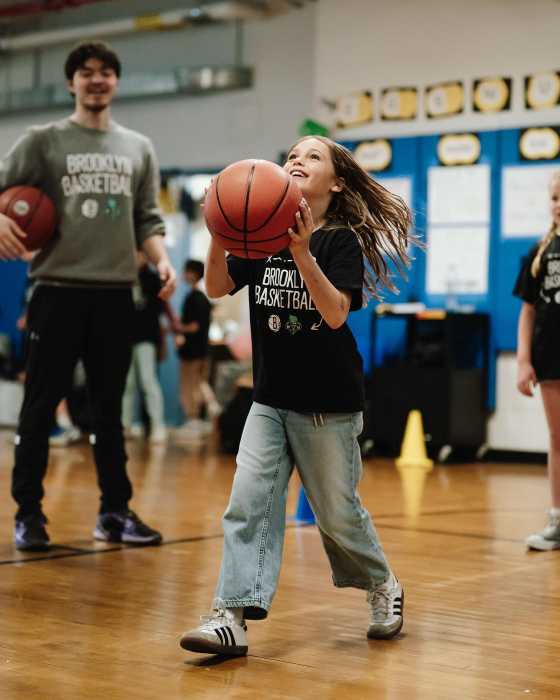 At PS8 The Emily Roebling Schools, over 100 students packed an auxiliary gym for basketball drills and shootarounds.Photo courtesy of Brooklyn Basketball
Since joining Brooklyn Basketball last September, Collins has overseen a rapidly expanding coaching staff that now includes more than 20 coaches and several full-time program leaders who run clinics throughout Brooklyn schools and at the organization’s training center across from Barclays Center.
But he said the mission stretches far beyond teaching jump shots and dribbling drills.
“The goal is always meeting the kids where they’re at,” he said. “That means being able to interact with a kid in seventh grade who’s never played the game and maybe not even that interested in the game. We want to make that experience — that hour, that two hours — very fun for them.”
Brooklyn Basketball’s school programming now operates five days a week, reaching nearly every corner of the borough. Coaches travel directly into schools, often adapting to whatever space is available — auditoriums, cafeterias or gyms without baskets.
“Sometimes there are two or three coaches with 50 kids, and not everybody has a basketball,” Collins said. “That requires a lot of energy, a lot of effort and flexibility.”
Brooklyn Paper observed one of those school visits at P.S. 8, The Emily Warren Roebling School, where Coaches Greg and Dante transformed a small gym into a high-energy learning environment over four sessions, each featuring about 40 fourth- and fifth-grade students.
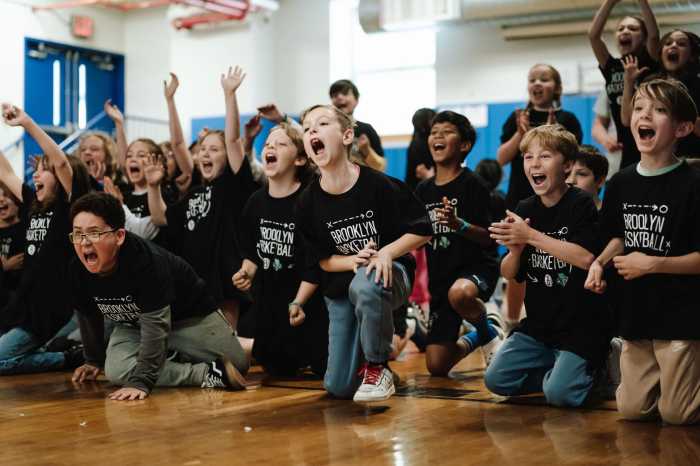 Students at PS8 get excited to play against coaches.Photo courtesy of Brooklyn Basketball
Many students eagerly jumped into drills and games, while others initially lingered along the walls, hesitant to participate. But for many of those quieter students, all it took was the thrill of making a basket to break out of their shell. By the end of each session, clusters of children surrounded the coaches, holding out pencils and scraps of paper in hopes of getting an autograph.
The organization uses what Collins describes as a “constraints-led approach,” where students learn basketball concepts through games and movement-based activities rather than traditional drills alone.
“To the untrained eye, it may not look like traditional basketball all the time,” Collins said. “But they’re going to have fun, and they’re going to learn through the game.”
For many students, the clinics become less about basketball itself and more about confidence, teamwork and resilience.
“They may not have thought basketball was a sport they could play, and then all of a sudden they can,” Collins said. “They saw some success, and they want to replicate that.”
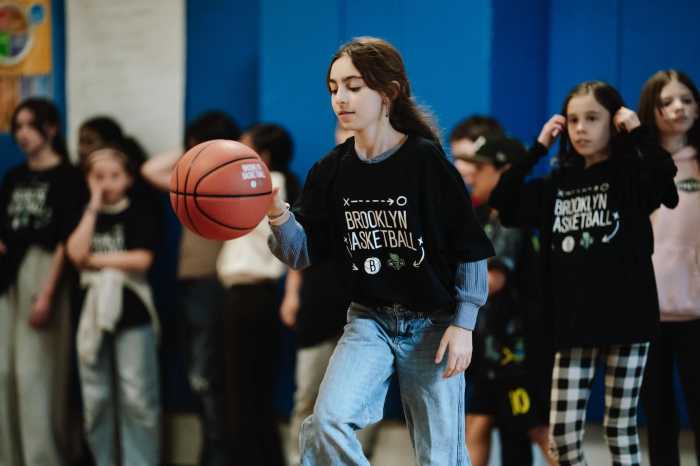
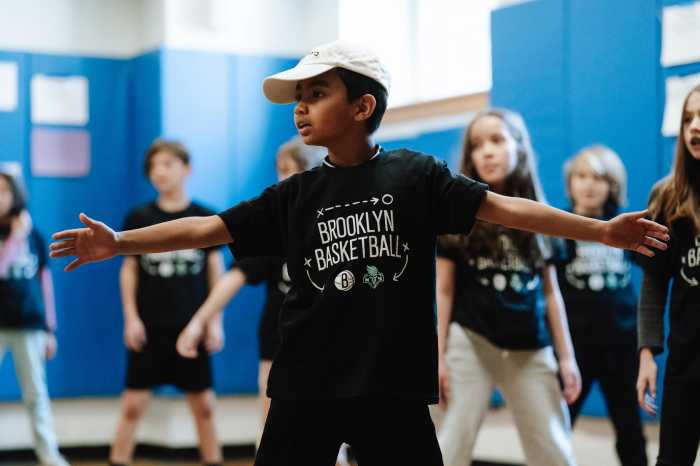 Students take part in a youth clinic run by Brooklyn Basketball at a Brooklyn school gym.Photo courtesy of Brooklyn Basketball
Collins’ philosophy is shared by Marissa Shorenstein, chief external affairs officer at Brooklyn Sports and Entertainment, the initiative’s parent company.
“We believe that basketball, even if a kid is not interested in becoming a basketball player — which most aren’t — the fundamentals of the game really help in all aspects of their lives,” Shorenstein said. “From leadership to teamwork to performing better at school.”
Shorenstein said the program also serves another purpose: strengthening the connection between Brooklyn residents and the borough’s professional basketball identity.
“We moved to Brooklyn as a team only thirteen or fourteen years ago,” she said, referencing the Nets’ relocation from New Jersey in 2012. “We really felt that this was a way to get the community to know us better through the game of basketball and to hopefully create lifelong fans from the Brooklyn community.”
That connection has only deepened with the opening of Brooklyn Basketball’s new training center across the street from Barclays Center roughly six months ago. The facility hosts camps, clinics, after-school programming, open-gym runs and all-girls basketball sessions throughout the week.
“The goal of creating this space was, how do we also bring kids to us?” Shorenstein said. “To a state-of-the-art facility where they’re getting coaching at a level they wouldn’t get otherwise.”
The facility has also allowed students who first encountered the program in school to continue developing their interest in the sport.
“We’ve seen some kids from our DOE program come here and want to take private lessons,” Collins told Brooklyn Paper. “We’ve seen some kids come here and then want to be in our after-school program or on the Shoot 360. That’s a testament to our coaches.”
The response from students, he added, has been immediate.
 Collins and Shorenstein emphasized their shared commitment to educating and supporting Brooklyn’s youth through basketball and community programming.Photo courtesy of Brooklyn Basketball
“The energy we receive back is amazing,” Collins said. “Yesterday I walked in [the center], and within five minutes I was asked for about 15 different autographs.”
Beyond schools and training sessions, Brooklyn Basketball has expanded into community centers, YMCAs and specialty clinics designed for students with disabilities, including children with autism and wheelchair users.
“We try to be really mindful of how we can reach all the audiences in Brooklyn so that they feel included,” Shorenstein said.
As the program continues to grow, both Collins and Shorenstein said their ambitions remain simple.
“We just want to continue to increase the amount of kids we reach and grow the game as much as we can,” Collins said. “I’m always like, ‘Everybody should play basketball the way the world plays soccer.’”