
Advocates have been seeking an expansion of taxpayer-subsidized pre-K and other child care options across New York.
Dan Clark/Times Union
ALBANY — New York lawmakers will provide more funding for schools to fulfill a new mandate to begin offering full-day pre-K by 2028 but will also delay the deadline by five years for districts to begin only purchasing electric buses as fleets are updated.

The proposed measures are included in the first of nine bills members of the state Legislature are set to consider over the next week before the final approval of this year’s fiscal spending plan.
Article continues below this ad
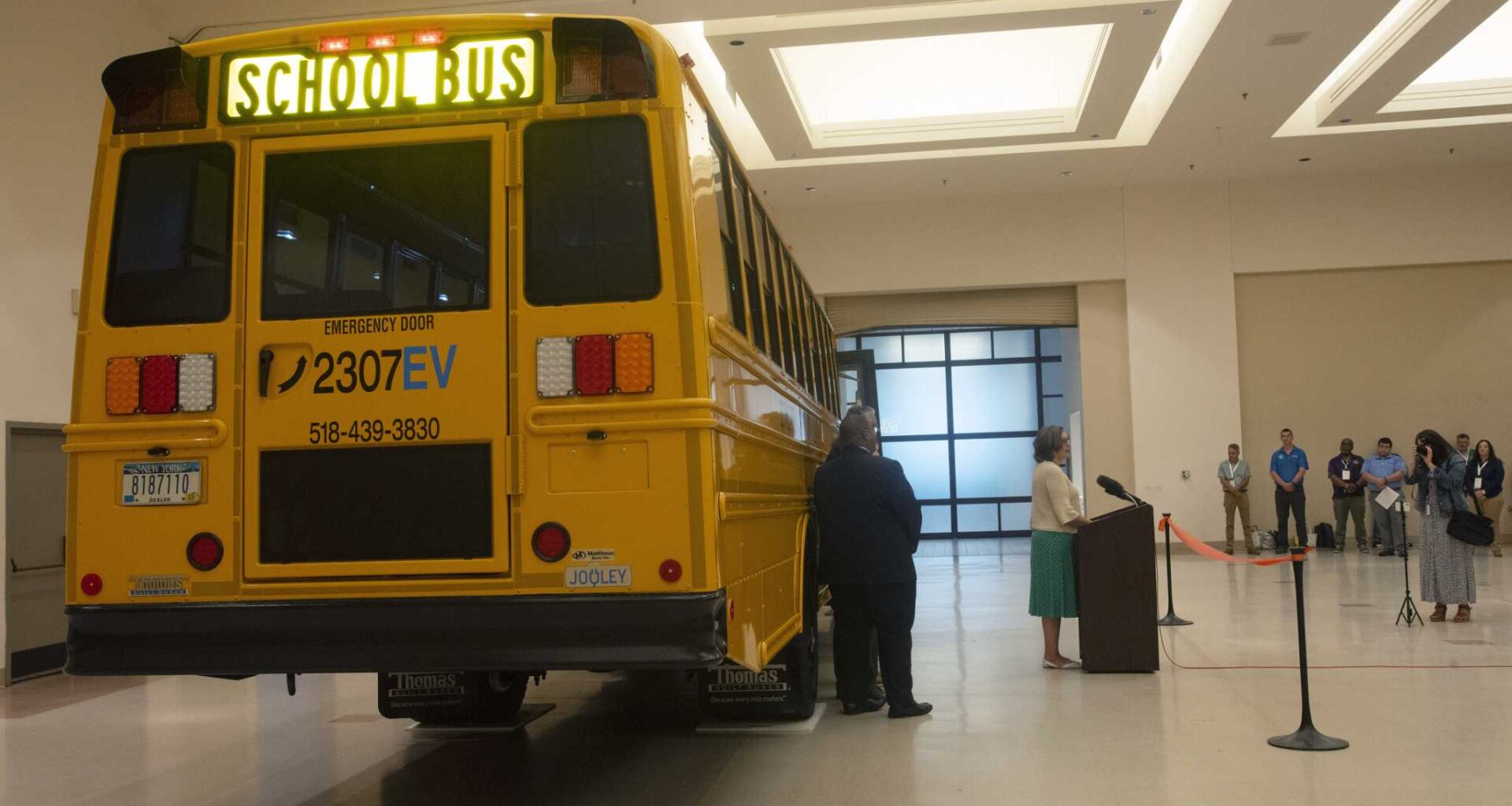
Judith Kehoe, the former chief business and financial officer at Bethlehem Central School District, speaks at an event showing one of the district’s new electric school bus in 2022. (Times Union)
Paul Buckowski/Albany Times Union
The proposals will also allow schools to receive more aid from the state based on the number of students they serve who either don’t have a permanent home or whose first language is not English.
“Adding a new weight for these populations, who face significant barriers to success in school, represents an important step forward,” said Maria Odom, executive director of Advocates for Children of New York, an advocacy group.
That’s on top of a guaranteed increase in state aid of at least 2% for districts, which put their own annual budgets up for a vote this week.
Article continues below this ad
Delaying electric school bus mandate
School districts in New York would now have an additional five years before they’ll be prohibited from purchasing new buses that run on fossil fuels. That was set to take effect next year.
Make the Times Union a Preferred Source on Google to see more of our journalism when you search.
Add Preferred Source
The mandate was put in place four years ago and intended to reduce emissions from buses that typically run on diesel fuel. But it’s proven to be an expensive endeavor for districts across the state. State Senate Deputy Majority Leader Michael Gianaris said the delay was in response to those roadblocks.
Article continues below this ad
“A number of school districts have expressed concern they were having difficulty implementing it,” Gianaris said. “It’s a significant cost for them that they cannot absorb right now so we’re trying to be responsible to the concerns of the people who would be implementing the policy.”
The high costs that legislation has saddled districts with is attributed to more than the price of the buses. Many districts are facing enormous costs to train or hire mechanics who are familiar with the electric buses operating systems. The electric grid also cannot easily provide enough power for the charging stations needed to power the buses, and upgrades to transmission lines — if feasible — are charged back to the districts.
The district would now have to begin purchasing new buses powered exclusively by electricity by the start of July 2032. They’ll have until 2040 to convert their entire fleet of buses to electric. Under the regulations that are being retooled, districts had been required to begin purchasing only electric buses by next year, and to convert their entire fleet to electric vehicles by 2035.
School districts will also be allowed to request state funding to install renewable energy systems for their educational facilities, including solar panels and geothermal units
Article continues below this ad
If districts choose to pursue those projects, the language included in the state budget will require them to minimize their impact on athletic fields, outdoor educational spaces and natural areas serving the school.
Those changes are not tied directly to the state’s electric school bus mandate but some districts had expressed concern about the cost of powering those vehicles and their implied reliance on the state’s energy grid to do so.
A electric school bus driver examines his safety stop signs in Rockville, Md. New York is considering extending its electric bus mandate.
Tom Brenner/Associated Press
State lawmakers are also seeking more guidance from Gov. Kathy Hochul’s administration to help schools with their transition toward an all-electric bus fleet, though such a requirement was not included in the state budget bill released Wednesday.
Article continues below this ad
“We still want to make sure there’s acknowledgement and cooperation and a plan from (the New York State Energy Research and Development Authority) on how to get this done, particularly in some of the more rural parts of the state,” said Assembly Speaker Carl E. Heastie.
Republicans have long been critical of the mandate instituted by Democrats four years ago for districts to transition exclusively to electric buses.
“Since the beginning, our conference has said this will be a disaster,” state Senate Minority Leader Robert G. Ortt said. “The underlying issue is that there’s a problem and I suspect at some point, even these kickout dates will have to be kicked out again down the road.”
Pre-K expansion
The other key portion of the legislation says that by the 2028-29 school year, school districts in New York would need to provide full-day pre-K access to all eligible 4-year-old children whose family applies for the services.
Article continues below this ad
The bill provides a substantial reworking of the state’s pre-kindergarten policy, a priority pushed by Hochul, who this month framed those changes as part of her “path to universal, affordable child care.”
While New York has funded universal pre-K for years, with the goal of opening it up to 4-year-olds, it has not required every district to offer a full-day seat to every family that applies.
Only about 75% of eligible 4-year-olds were enrolled in the state-funded pre-K program in the 2023-24 school year, according to a report from the state Education Department. That’s because some school districts offered no state-supported pre-K. Administrators, providers and the department identified persistent barriers, including inadequate space and insufficient reimbursement.
Another significant change proposed under the new bill is that nonprofit organizations, charter schools, libraries, museums and community-based organizations will be eligible to participate.
Article continues below this ad
Under the proposed changes, full-day programs must provide at least five hours of daily instruction, while half-day programs will provide between two-and-a-half hours to five hours.
The bill creates a unified “universal pre-kindergarten apportionment,” which combines funding for programs that serve both 3-year-olds and 4-year-olds. The funding formula is based on enrollment, aid-per-pupil calculations and approved expenditures. Full-day students can receive a full funding weight. Half-day students are partially weighted.
The bill strongly encourages districts to maintain and expand full-day programs for 3-year-olds by imposing “overage penalties” on districts that substantially replace full-day seats with half-day seats unless hardship waivers are granted.
Article continues below this ad
Lawmakers have expressed concern about the physical space required to house the additional 4-year-olds. Not every school district has the space.