
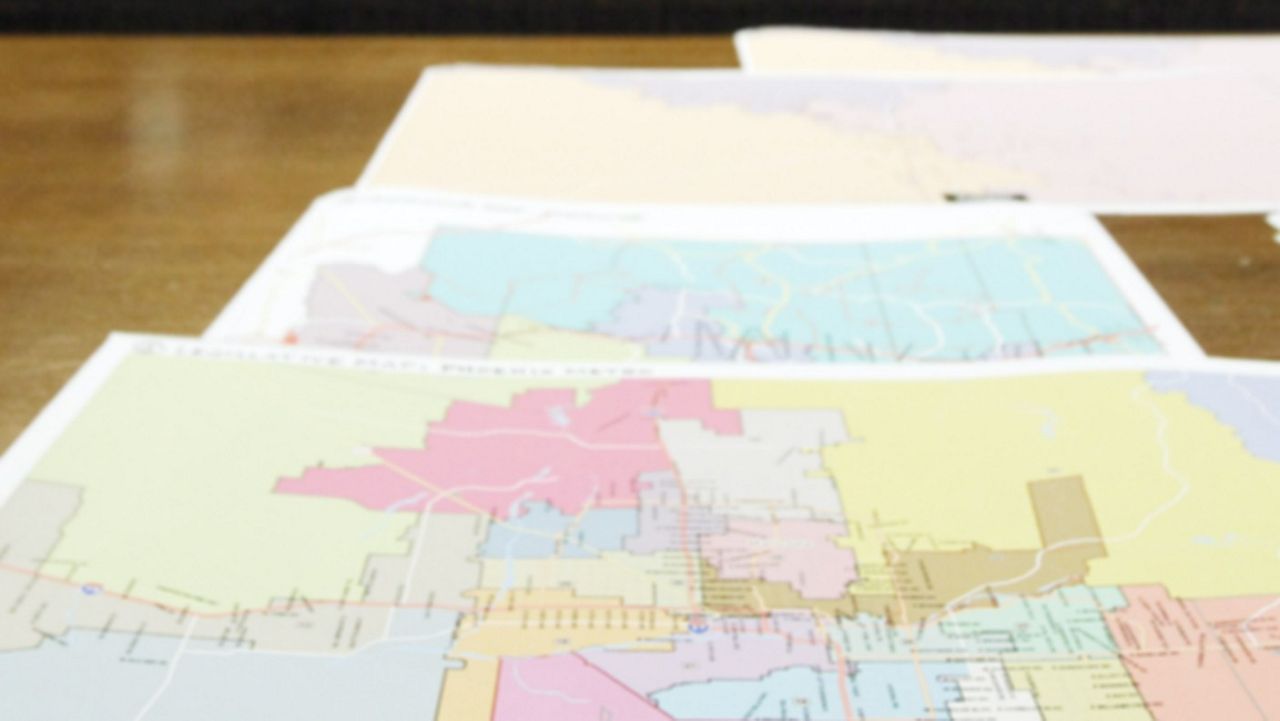
New York state Assembly Speaker Carl Heastie said he thinks the Legislature is eyeing two constitutional amendments that would change the state’s redistricting process in the wake of the Supreme Court’s decision that weakened a landmark Civil Rights-era law that has been credited for increasing minority representation in Congress and amid a larger national mid-decade redistricting arms race that has intensified over the last year.
Heastie said one would be related to the timing when redistricting is allowed and the other regarding the Independent Redistricting Commission (IRC), the panel which now oversees the process.
“One that I think would allow for [mid-decade] redistricting and the other one to change the composition of the IRC with the way it was done,” Heastie told reporters Wednesday in Albany.
The composition Heastie is referring to is the probability of an impasse on the IRC. Following the 2020 Census, the IRC went to work on its inaugural map-drawing but Democrats and Republicans on the commission failed to agree on a set of maps to submit to the Legislature, which threw the process to the state Legislature anyway, the very body the IRC was created to take the process away from to begin with.
“We don’t want to see a 5-5 deadlock,” Heastie said.
As lawmakers try to cross the finish line on a contentious and nearly two-month late state budget, redistricting has been a heightened issue with the time lawmakers have left this year at the state Capitol. Session is scheduled to end on June 4.
The Supreme Court earlier this month ruled 6-3 in striking down a majority Black congressional district in Louisiana that it said relied too heavily on race. Section 2 of the Voting Rights Act of 1965 bans voting practices that diminish or dilute the power of minority voters, which essentially has shown to have an impact on electing minority candidates.
That decision is wrapped up in an unusual national battle over redrawing congressional lines in the middle of the decade that started in Texas last summer at the request of President Donald Trump to help boost Republicans in the 2026 election cycle. California Democrats responded in kind. Missouri, North Carolina, Ohio, Virginia, Florida and Tennessee have joined the effort, with South Carolina and Alabama pending, bringing red states and blue states into the gerrymandering fight to try to outflank the other for so-called safe seats and eliminate more competitive races.
“We’re not going to be guided by gerrymandering. We like to go by keeping communities of interest together,” Heastie said.
Gov. Kathy Hochul and New York lawmakers have promised a response since the initial move in Texas — even hosting Texas Democrats in Albany. U.S. House Minority Leader Hakeem Jeffries, also of New York, tasked Democratic U.S. Rep. Joe Morelle, a veteran of the state Legislature, with steering New York Democrats’ efforts to change the process.
To do any kind of redistricting changes, New York faces constitutional limitations. The state in 2014 approved a state constitutional amendment that created the IRC. Changing the process would require once again a state constitutional amendment. In New York, constitutional amendments must be passed by two separately elected versions of the state Legislature and then approved by a majority of voters. At the fastest rate, Democrats would have to pass an amendment to give back power to the Legislature this year and again after the 2026 elections, meaning it wouldn’t be put to voters until November 2027 at the earliest, with any kind of potential new maps not taking effect until the 2028 election.
“We can’t be asked to play by a different set of rules than other states are and even more aggressively in Republican-dominated states,” Heastie said.
New York Republicans have railed against the effort despite its roots in the Texas redraw.
The Associated Press contributed to this report.