
The Trump administration has fired two leaders of the U.S. Preventive Services Task Force, an influential panel of experts who determine what medical screenings and preventive procedures insurance companies must cover for millions of Americans at no cost.
The two leaders — Dr. John B. Wong, a professor at the Tufts University School of Medicine, and Dr. Esa M. Davis, a professor at the University of Maryland School of Medicine — received letters notifying them of their firings. The New York Times obtained copies of the letters, which were dated May 11.
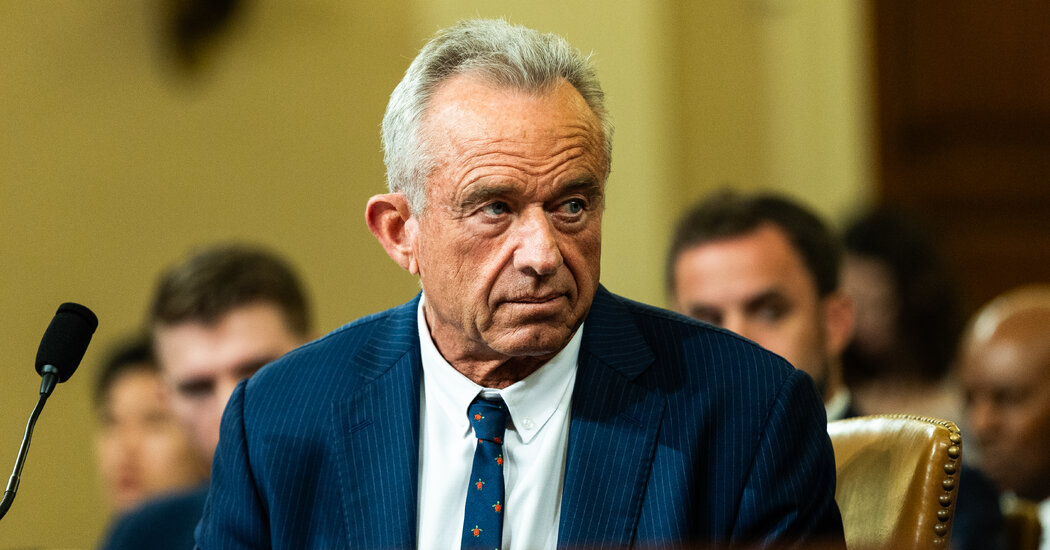
In the letters, Health Secretary Robert F. Kennedy Jr. wrote that he had “directed a review” of U.S.P.S.T.F. appointments “to ensure clarity, continuity and confidence” in his department’s oversight of the task force, and “to protect the integrity of the task force’s work.” He said Dr. Wong’s and Dr. Davis’s appointments were terminated “effective immediately” in order to “avoid uncertainty that could jeopardize the validity of future task force actions.”
The move has heightened concerns among public health experts that Mr. Kennedy is politicizing the task force, which assesses scientific evidence and makes recommendations on a wide range of medical services, including mammograms, colonoscopies, depression screenings and more.
Under the Affordable Care Act, most insurance plans must fully cover services that it assigns an “A” or “B” grade. That gives the panel’s 16 volunteer members significant influence over the care Americans can afford.
Over the past year, Mr. Kennedy has undermined the task force’s work, including by not replacing members whose terms ended in December. The task force issued fewer recommendations than is typical last year and missed a deadline for a legally mandated report to Congress after Mr. Kennedy postponed its meetings indefinitely.
Dr. Wong and Dr. Michael Silverstein, who was the chairman of the task force until he left this March at the end of his scheduled term, said the administration had also interfered in the normal process of releasing recommendations.
For example, they said the task force was blocked from releasing a new recommendation endorsing self-testing as an alternative to traditional Pap smears for cervical cancer screening after it was finalized last year. (An agency within the federal health department ended up issuing a similar recommendation.)
In response to a request for comment on the firings, Andrew Nixon, a spokesman for the Department of Health and Human Services, referred to the letters. He did not immediately respond to a follow-up question about the cervical cancer recommendation.
The letters from Mr. Kennedy said the terminations were not related to the leaders’ performance and that they were free to reapply for other positions on the task force. Dr. Wong said both he and Dr. Davis, who did not respond to a request for comment, had chosen to reapply.
But Dr. Wong said it had been made clear to them that, even if they were selected, it would not be for a leadership position. He added that he feared H.H.S. would appoint new members without the depth of expertise in primary care that the task force has typically called for.
H.H.S. has been soliciting applications for spots on the task force, with a deadline of this Saturday. Normally, Dr. Davis and Dr. Wong would have played key roles in evaluating candidates alongside H.H.S. officials. Now that they have been fired, the Trump administration can choose new members without their input.
Mr. Kennedy’s letters did not explain why he believed Dr. Davis’s and Dr. Wong’s leadership could “jeopardize the validity” of the task force’s actions. However, Dr. Wong told The Times that, in a meeting on May 12 with H.H.S. officials, he and Dr. Davis were told that they had been “prematurely” appointed under the Biden administration.
The May 12 meeting was with Benjamin Robles, the deputy general counsel for H.H.S., and Dr. Roger Klein, the director of the Agency for Healthcare Research and Quality, which is part of H.H.S. and oversees the task force. Dr. Wong said his understanding of the administration’s position was that Dr. Klein, a Trump appointee, should have named the chairs after the president’s inauguration.
Mr. Nixon, the H.H.S. spokesman, did not immediately respond when asked about that description of the meeting.
On May 14, Dr. Wong and Dr. Davis sent a follow-up email asking Mr. Robles and Dr. Klein to clarify the rationale for their firing. Dr. Klein declined to directly answer, but cited the Supreme Court’s 2025 ruling that the health secretary could remove U.S.P.S.T.F. members before their terms ended.
Public health experts have been worried for months that Mr. Kennedy would summarily remove members of the task force, as he did last year with the Advisory Committee on Immunization Practices, a C.D.C. panel that reviews vaccines.
That committee went on to upend the C.D.C.’s vaccination schedule, significantly reducing the number of shots recommended for all children, though a court temporarily halted those changes in March.
“I am concerned that what the administration did to the A.C.I.P. committee, they are doing to the U.S. Preventive Services Task Force, but in slow motion,” said Dr. Silverstein, the former chairman of the task force.
In December, while he was chairman, Dr. Silverstein emailed Dr. Klein, the A.H.R.Q. director, noting that the cervical cancer guidelines were ready. He asked Dr. Klein to help the committee conduct its work and begin deliberating on prostate cancer screening, early introduction of potential food allergens in children and “healthy lifestyle interventions for adults with and without cardiovascular risk factors.”
He asked Dr. Klein to give the task force approval to meet and vote on those topics, to work to smooth the process of making its recommendations and to temporarily extend the terms of members who were set to cycle off the committee given that no replacements had been named. He followed up in January, but received no response to either email, he said. (Dr. Silverstein provided copies of both emails to The Times.)
“The administration came after children’s immunizations, and now it’s coming after our mammograms and our other cancer screenings, and the medical community cannot let this happen,” Dr. Silverstein said.
Aaron Carroll, the president of AcademyHealth, a nonpartisan group that promotes evidence-based health policy and previously urged Mr. Kennedy not to interfere with U.S.P.S.T.F., said the task force’s credibility depended on “transparent and rigorous procedures” both for appointing members and for evaluating evidence.
By firing its leaders before their terms had ended, the Trump administration is “tampering with the critical infrastructure” that makes it possible for Americans to trust government health care systems, Dr. Carroll said.