
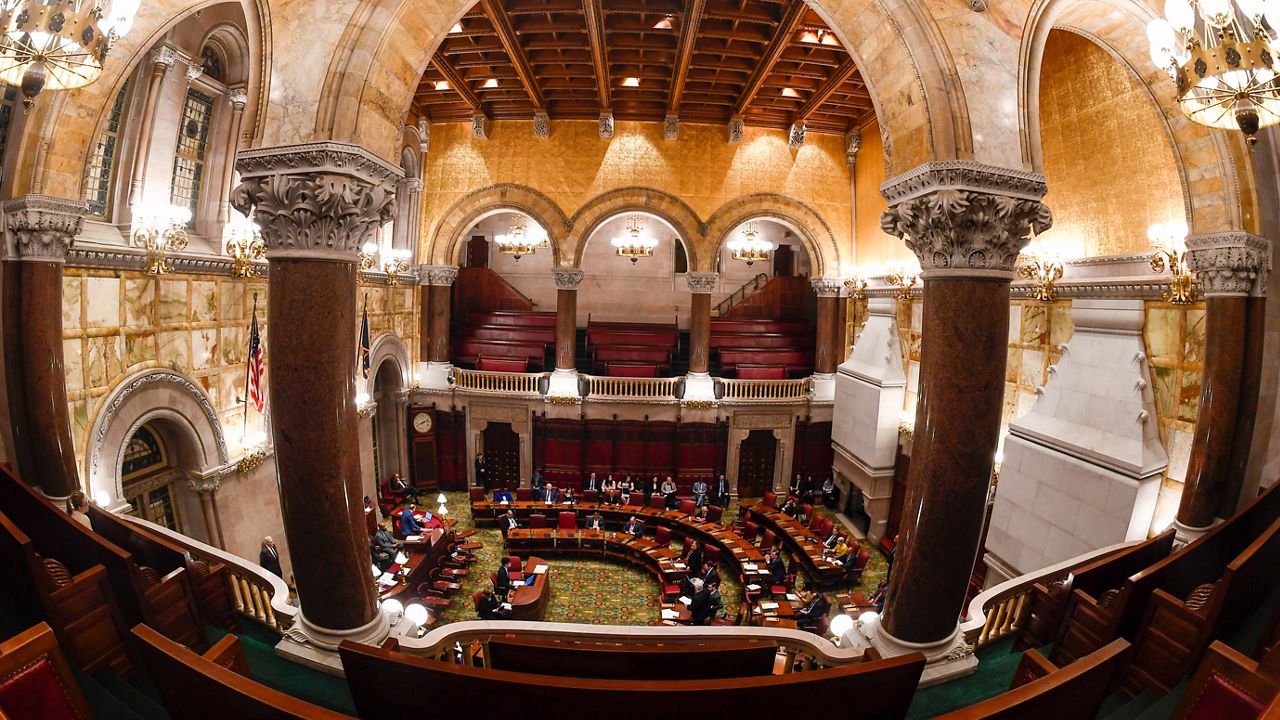
Seven weeks after the April 1 budget deadline, New York’s increasingly stale and tedious state budget negotiations are finally coming in for a landing, as voting on the remaining nine budget bills began Wednesday afternoon. Lawmakers approved the Education, Labor, Housing and Family Assistance, or ELFA, portion of the budget as the remaining bill await finalization and printing.
While it appears likely that Gov. Kathy Hochul will avoid passing her fifth state budget in a warm-weather month beginning with a “J” or an “A” — the true standard of late budgets in Albany — it will still be the latest in 16 years by a sizable margin. Last year, the budget was signed on May 9 and was, at the time, the latest since the 2010 spending plan was finalized in early August.
Despite that, Hochul claimed victory miles away from the goings-on at the state Capitol during a news conference in New York City.
“I’m proud of the budget that, in my opinion, is done, but they’re just still voting on it,” she said.
As of early Tuesday evening, it appeared likely that voting on state budget bills would not begin until after the Memorial Day weekend, but sources said a late push by Hochul’s team to get the process moving was successful in teeing up two bills for votes this week. The first, largely dealing with education spending, passed Wednesday, while a second dealing with public protection and a highly anticipated immigrant protection package is expected to come to the floor Thursday.
Lawmakers will take up the rest of the bills Tuesday and into next week after the Memorial Day weekend.
Despite Hochul’s declaration, Assembly Speaker Carl Heastie acknowledged Wednesday that key number breakdowns in the state budget have not yet been finalized, and Assemblyman Phil Palmesano, the ranking member on the Ways and Means Committee, criticized the majority for moving budget bills forward without a fully completed spending plan and related analysis.
“We should have a financial plan in front of us before we’re considering more than a quarter-trillion-dollar budget and doing it bill by bill, with education having such a financial impact on it,” he said.
In addition to a two-year extension of mayoral control in New York City, Wednesday’s debates focused on what will be a 2% minimum increase in Foundation Aid for school districts. That’s up from 1% in the executive budget.
Additionally, while Hochul said earlier this year there would be no changes to the Foundation Aid formula — the primary mechanism used to allocate state funding for schools — the Legislature succeeded in securing two changes: additional weighting for English language learners and students experiencing homelessness.
Bob Lowry, deputy director of the New York State Council of School Superintendents, said both changes will have a meaningful impact on districts adjusting to modern needs.
“With each of these categories of students, the circumstances of their lives may require additional help for them to succeed in school. Certainly with students who are homeless, there is apt to be a lot of chaos in their lives,” he said.
Lowry added that many districts have expressed concern that while the increase is an improvement over the initial budget proposal, 2% may not be enough to make up for inflationary increases and ballooning health care costs.
Also included in the budget bill was a five-year delay of the state’s zero-emission bus mandate, a late development in the budget process spurred by legislation introduced days after the budget deadline by Central New York Sen. Chris Ryan.
Under current law, districts would be expected to begin purchasing electric buses next year and aim for full fleet conversion by 2035. Once signed, that deadline will shift to 2040.
Lowry said the move was “appreciated” and reflective of the challenges districts have faced in working to fulfill the mandate.
“The price difference we expected would moderate and shrink — that hasn’t happened. Federal aid has been wiped out. The buses just will not work for some routes that districts have to run,” he said.
Heastie told reporters that despite ELFA making it to the floor, the exact parameters of how the state will provide promised assistance for the zero-emission bus transition are still taking shape.
“We haven’t nailed down that breakdown, but there will be something to help with infrastructure and purchasing the buses,” he said.
Heastie also provided additional information on other aspects of the budget, including how the spending plan will assist municipalities in bearing the brunt of an impending $500 million pension sweetener for public employees who are part of Tier 6, amid concerns from already fiscally strapped local governments.
“There’s also some aid that will go to municipalities that will help them cover the cost of pensions, I think it was $50 million. The state has a part, school districts have a part, and the city has a part,” he said.
Lawmakers also passed another budget extender Wednesday to keep government funds flowing through Tuesday.