
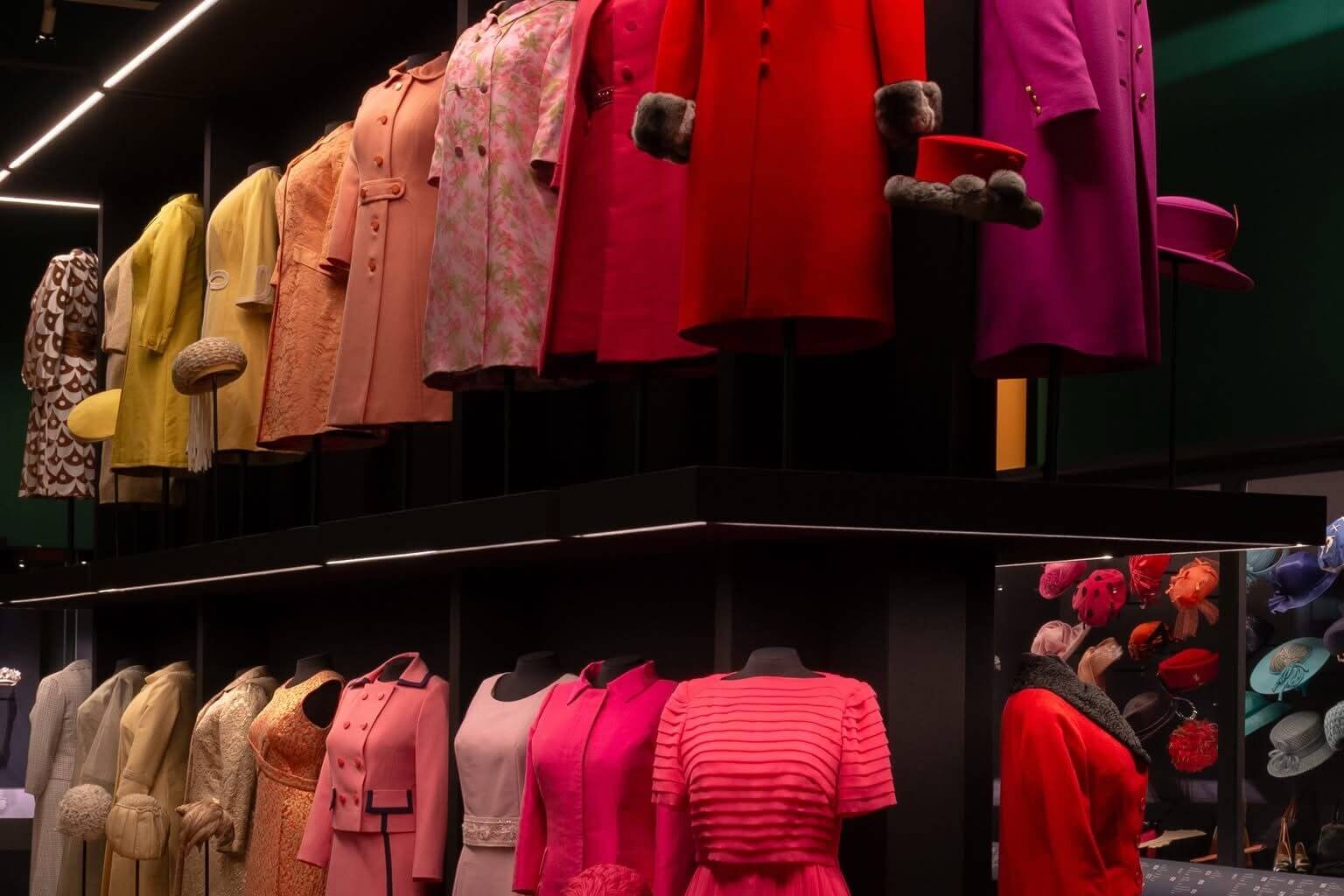
If you happen to be heading to London this year, you have until October 18th to catch this fascinating exhibition. As a retrospective of the late Queen’s fashions, it’s not just a chance to marvel at gorgeous gowns or gasp with envy at the stunning tiaras, but also a history lesson and class in diplomacy.
My mum, sister, and I went a couple of weekends ago. The gallery is at Buckingham Palace, and you need to have timed tickets booked. Warning: despite only letting people in at designated times, it does get crowded; it’s distributed over only four rooms, but it took us around an hour and twenty minutes to see everything. There is a free audio guide, which I highly recommend.
It was wonderful to hear our mother’s anecdotes as we went around. She gave us a behind-the-scenes peek, with first-hand knowledge of some of the featured designers, starting with Norman Hartnell, whose most famous designs were Princess Elizabeth’s wedding dress (1947) and Coronation dress (1953).
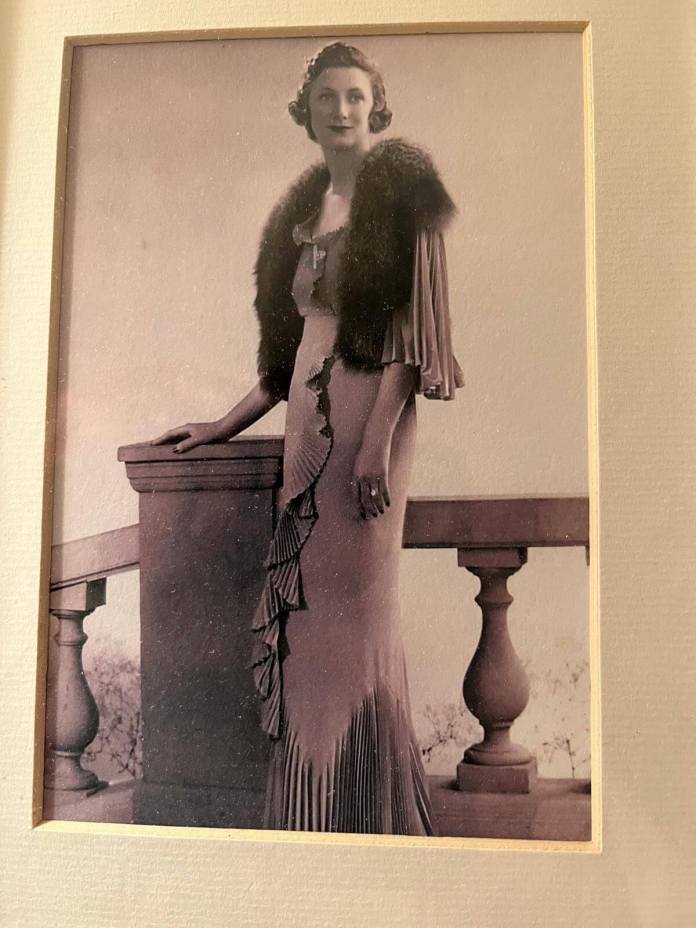
Her own mother, Joan, had been a Hartnell model, and in this photograph from the mid-1930s, Joan is wearing a Hartnell creation on her presentation at court. I’m not entirely clear as to why she was being presented – something to do with marrying my grandfather – but what you can’t see is the back of the dress. Just as well, because she had sat down on a bench in the palace gardens and got up with wet paint stripes on her bottom.
Hartnell’s passion was mostly for evening and formal dresses, although he designed much of the Queen’s daywear, and at the pinnacle of his career had over 400 staff and his own couture house.
It’s lovely to see some of the Queen’s childhood outfits. They are mostly quite simple, aside from the christening gown. The young princesses loved to play dress-up, and some of their costumes are on display.
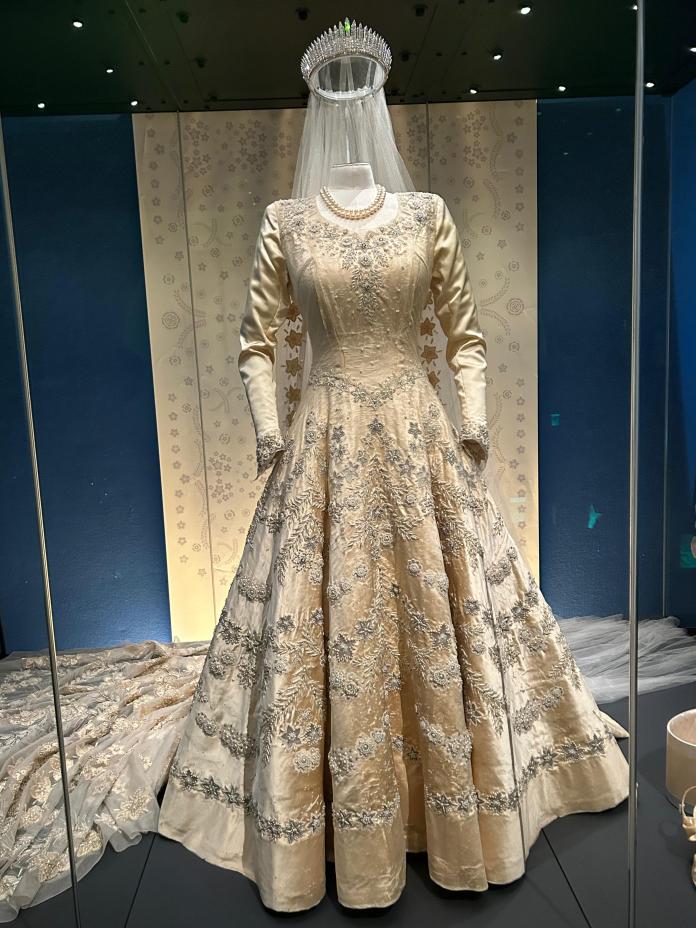
The wedding dress is a marvel of complex embroidery, and the 13-foot train is stunning, but because the wedding was just two years after the end of the war, material was still rationed. Hartnell struggled to source the seed pearls to complete his symbolic designs: wheat ears for prosperity, garlands of York roses, star flowers, jasmine, and orange blossom.
Speaking of rationing, when it came to the wedding cake, the royal couple decided that in this era of austerity, they would “only” commission twelve cakes. Queen Victoria had had over one hundred. Of the thousands of cakes offered from across the globe, they selected one as their official cake, but another eleven to be displayed in Buckingham Palace’s 60-foot blue drawing room. After the wedding, these cakes were cut up and sent to charitable organizations across the country and abroad. One of these eleven cakes was made by my family, J. Lyons & Co., and my parents’ wedding cake in 1959 was a copy of it.
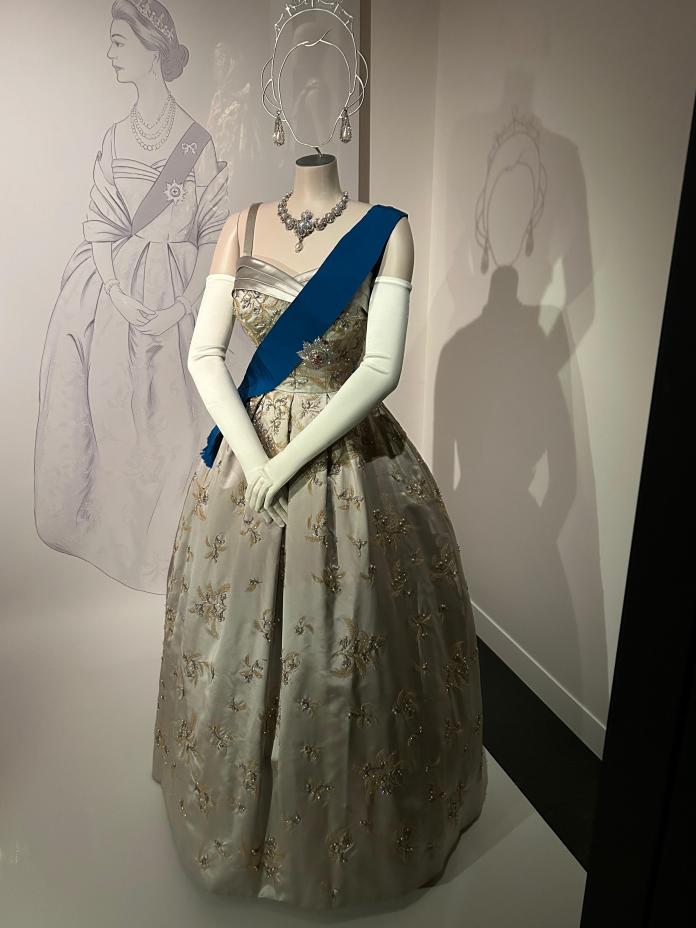
The Queen requested that her Coronation dress should conform to the lines of her wedding dress, but that the embroidery must be supplemented not only by the emblems of the countries of Great Britain but also of her Dominions. Thus, we see, among others, the thistle of Scotland, the maple leaf of Canada and the fern of New Zealand, beautifully embroidered on the skirt.
By the time Hardy Amies started designing clothes for the Queen, it was 1951. A former spy during World War II, he was famously as tough as nails (although witty and cynical in private) and would remain in her service until 2002. It was Amies who introduced bright colors to the Queen’s daytime outfits to make sure that she stood out in a crowd. He favored classic British tailoring over flashy and elaborate couture and famously wrote in his autobiography: “My idea of fashion is an evolutionary and not a revolutionary one”. This elegant simplicity greatly appealed to the Queen, who, behind the scenes, was happiest eating off a tray in front of the television or spending time with her horses and corgis.
Royalty has always understood that a dress is not just a dress when on an overseas visit. The exhibition has a section dedicated to “Dressing for Diplomacy”. Once again, Hardy Amies understood the assignment; one of his evening gown creations from 1959 incorporates Mayflowers, the symbol of Nova Scotia, when the Queen toured Canada. He also designed a stunning evening gown for her first visit to the White House in 1957, which is on display, as is a photograph of the Queen with Dwight and Mamie Eisenhower.
In the seventies, the Queen and country entered into the “what were they thinking?” era. There are some ill-advised outfits on display, one of which was a gift to the Queen. I hope she never wore it. It’s made of PVC in various neon colors, with patent leather boots.
Speaking of ill-advised, we finished with millinery. Here again, my mother knew one of the hat designers, Frederick Fox. He had designed hats for her aunt, and my sister and I were amazed by how ugly they were. He had even made a hat for our mother when she was very young. On my next trip to England, I plan to open some of her old hat boxes to find, I hope, some treasures.
In the display of terrible hats was one covered in flowers. My mother insisted it was a bathing cap, but I’m sure it wasn’t, even though it probably should have been. “I had that bathing cap,” she proclaimed, “and I was attacked by a swarm of bees.”
Mentioned almost as an afterthought is Angela Kelley. Her official title was “Personal Assistant, Adviser and Curator to Her Majesty The Queen (Jewelry, Insignias and Wardrobe).” She became the Queen’s dresser in 1994, designed many of her outfits, persuaded the Queen to switch from real fur to faux fur in 2019, had a run-in with Prince Harry about which tiara Meghan was not allowed to wear at their wedding, and became a close confidante of the Queen, living in a grace-and-favor cottage on the Windsor Estate. She was famously evicted on the Queen’s death, although King Charles bought her a small house in the Peak District in return for signing an NDA.
The Queen would have turned 100 this year, but even if you’re not a royalist, it’s absolutely worth visiting this exhibition to learn about and admire the history of British fashion over the past century.
Free British Weekly Newsletter
A Little Bit of Britain In Your Inbox Weekly. Sign-up for our free weekly British newsletter. Sent every Wednesday with the latest news from Britain!
Related