
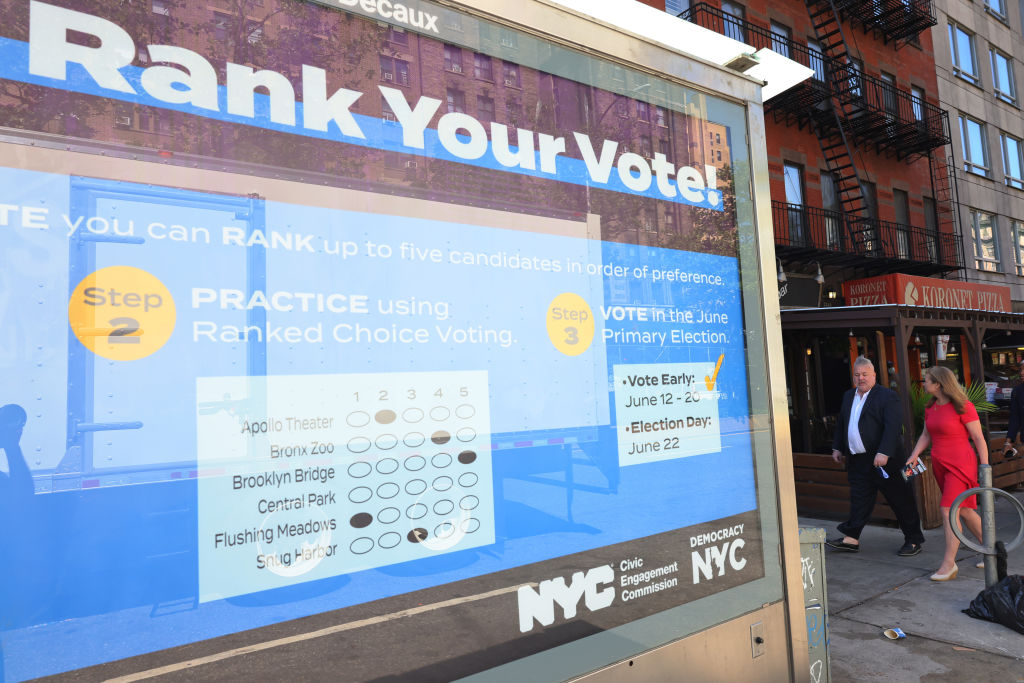
A sign on Manhattan’s Upper West Side explains ranked choice voting in 2021, the first time New York City used the election system.
Michael M. Santiago/Getty Images
When I first learned about ranked choice voting, I thought it was one of those ideas that was too good for the United States. Like excellent train networks, siestas and churros with chocolate — it was, I feared, one more great idea we seemed intent on passing by.

But then I learned ranked choice voting has been adopted around the country, from New York City and Newburgh to the entire states of Maine and Alaska, and dozens of other cities and towns. Heck, the Oscar Awards even use ranked choice voting to choose the Best Picture winner.
Article continues below this ad
I figured if they can all do it, there’s no reason we can’t do it in Albany.
What’s so great about it, you ask?
For voters, ranked choice means that instead of voting for a single candidate, you can rank candidates in the order you prefer them: first choice, second choice, third choice, etc. If your first choice can’t win, your vote automatically transfers to your next choice.
Make the Times Union a Preferred Source on Google to see more of our journalism when you search.
Add Preferred Source
This simple change could solve many problems.
Article continues below this ad
For one: Under our current election system, voters are often afraid to vote for the candidate we genuinely like most, and instead feel we must vote strategically. Under ranked choice voting, you can vote honestly, even if the candidate you like isn’t popular or belongs to a minor party. There’s no more “spoiler effect.” If your candidate can’t win, your opinion still matters; your vote just transfers to your next choice.
Another odd quirk of our current election system is how, in elections with three, four or more candidates, a candidate can win with a small fraction of the vote. That leaves a sour taste when most voters supported other candidates. Ranked choice voting solves this, too: A candidate wins only when they’ve received over 50 percent of the vote.
While we’re fixing our election systems, let’s follow the lead of cities like Minneapolis, Oakland and Boulder and adopt the single unified election model. That would mean no more primaries; instead, all candidates and all voters participate in one election, on Election Day, using ranked choice voting. This lets all registered voters vote in the election that matters –– that’s how democracy is supposed to work.
The implementation of both ranked choice voting and elections where all voters can participate has been found to produce results that better reflect the racial and gender demographics of the voters. And having a shorter election season would boost turnout, save us and our recycling bins months of campaign mailers, and save the city money. In this moment, maybe that should be the top selling point.
Article continues below this ad
Our group is gathering petition signatures to include this issue on the November ballot as a ballot initiative. We are well on our way, with 1,800 signatures so far of the 2,400 we need.
At a time when so many of us despair about politics, it’s remarkable to find a within-our-reach fix that would make city elections work better.
I’m still hoping someone will launch a pro-siesta movement. But in the meantime, adopting ranked choice voting is a no-brainer.
Article continues below this ad
Dorian Solot is the co-chair of Ranked Choice Voting Albany (rcvalbany.org). She lives in Albany.