
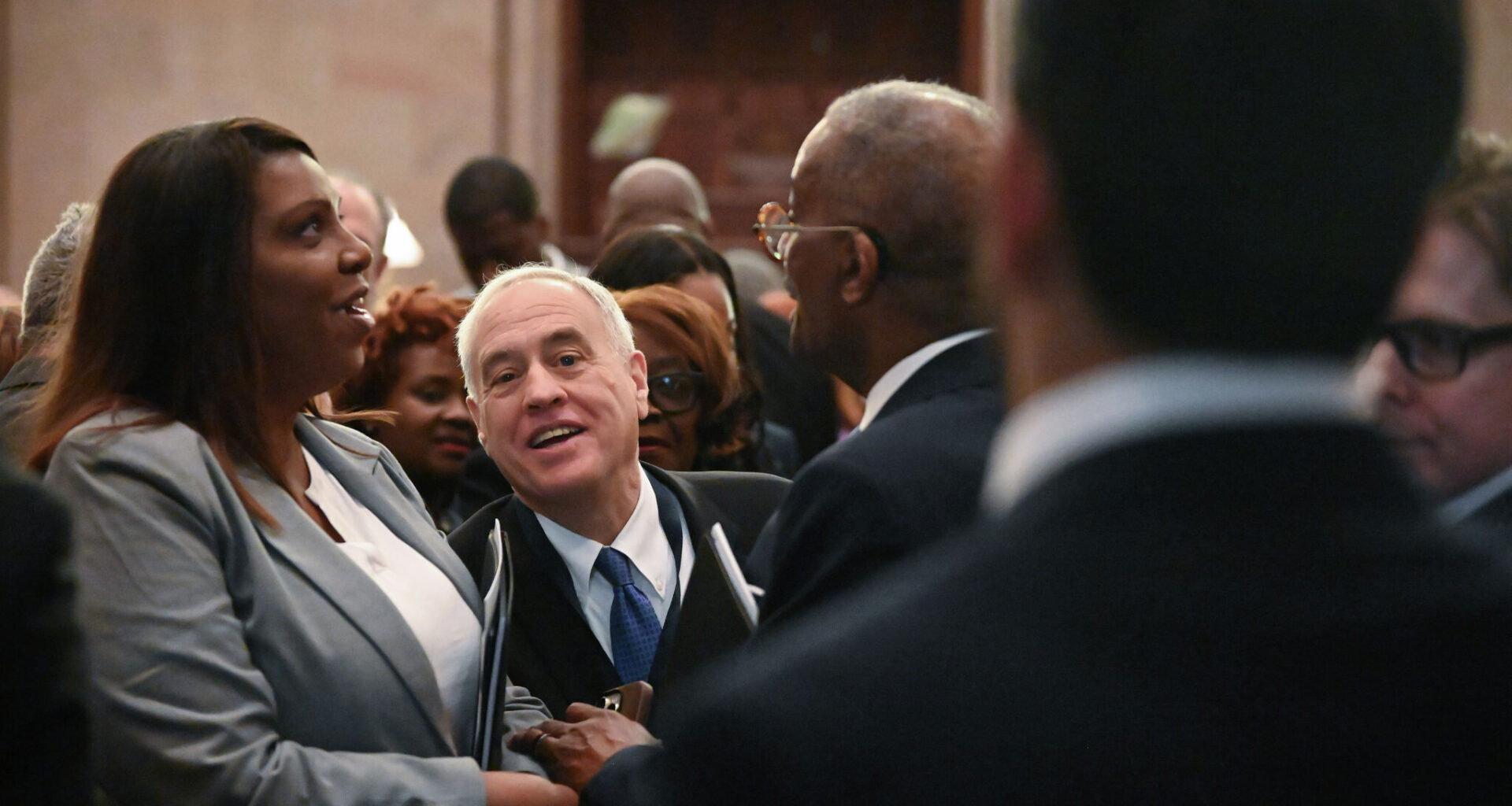
State Attorney General Letitia James and Comptroller Thomas P. DiNapoli at the Capitol in 2024. DiNapoli has the biggest war chest of any candidate in the comptroller race.
Will Waldron/Times Union
ALBANY — New York’s public matching campaign funds program, designed to amplify small donors and reduce the influence of special interests and the wealthy, is now helping bankroll campaigns for the office responsible for overseeing state finances and the public employee pension system.

With the June primary a month away, the program has already infused $4.63 million of taxpayer money into the state comptroller’s race. The incumbent has emerged as the biggest beneficiary, according to campaign finance data released this week.
Article continues below this ad
Thomas P. DiNapoli, who has been comptroller since 2007, is no stranger to political fundraising. He reported $1.3 million in cash on hand in January and has received over $2 million in public matching funds.
“It is a relief that instead of courting very wealthy donors, you can have more everyday New Yorkers being part of your political success story,” DiNapoli said. “So to me, that’s a positive.”
DiNapoli, a member of the Assembly from 1987 until he took his current statewide office, handily won reelection four times before this year without a primary challenger.
Make the Times Union a Preferred Source on Google to see more of our journalism when you search.
Add Preferred Source
But this year, he is facing Democrats Drew Warshaw and Raj Goyle. Both promise to audit more government programs and agencies and reinvest the pension fund to address a variety of issues to address New York’s high cost of living. Warshaw wants the fund to divest from fossil fuel stocks and foreign bonds.
Article continues below this ad
DiNapoli’s office announced on Wednesday that the state pension fund posted a strong 11.94% annual return and closed the fiscal year in March at a record-high of $295.4 billion.
All three candidates debated for the first time on Thursday, a requirement of the matching funds program. It was televised on Spectrum News NY1.
Goyle, a former member of the Kansas House of Representatives, trails close behind DiNapoli in public matching funds. He has received $1.7 million in taxpayer-funded campaign cash and logged $466,888 in qualified expenditures. Warshaw, a former affordable housing executive and aide to Gov. Eliot Spitzer, has received $840,690 in public campaign funds.
“We’re extremely excited by the momentum and energy we’ve seen,” Goyle said. “We’ve received thousands of matching funds to help us take down (the incumbent). … That shows how much people want change.”
Article continues below this ad
Goyle entered the race last September, and is touting how quickly he qualified to tap into matching campaign donations. Until DiNapoli pulled ahead last week, Goyle had received the most funds from the program.
The money allowed him to purchase advertisements and host campaign events across the state, he said.
Joseph Hernandez, a Republican entrepreneur, has not raised enough donations to qualify for the matching funds program.
All of the candidates for the state comptroller’s position have announced multi-million-dollar ad buys on television and social media.
Article continues below this ad
Warshaw said that the program has been an “incredible” boon to his campaign.
He pointed to the landmark 2010 U.S. Supreme Court decision — in Citizens United v. the Federal Election Commission — that limited the ability to set limits on campaign spending and has increased the influence of corporations and wealthy donors. Warshaw said that not allowing the FEC to restrict independent political expenditures by corporations “makes it impossible to get big money out of politics.”
Candidate for state comptroller Drew Warshaw said the state’s matching fund program has been a boon to his campaign.
Will Waldron/Times Union
However, the matching funds program gives his campaign “a chance at leveling the playing field, or at least making it more level,” he said.
Article continues below this ad
Created in 2020, the voluntary program is being offered for the first time this election cycle to statewide candidates. Attorney general and state comptroller hopefuls must raise at least $100,000 in contributions to qualify for the matching funds, including at least 1,000 donations from state residents, who must give at least $5 and not more than $250 per election cycle.
The program matches statewide donations at six-to-one and is capped at $3.5 million for the state comptroller’s race, one of four statewide elected offices in New York’s government.
‘Campaigns cost a lot of money’
John Kaehny, executive director of the good government nonprofit Reinvent Albany, said his organization is glad to see wide participation in the program.
Article continues below this ad
“The hope is that they help champion a culture of more and smaller contributions rather than depending on a few very big special interest donors,” Kaehny said. “For us, it’s a positive to see those matching funds go to even incumbents.”
That participation is important and makes the program stronger, Kaehny said. State Attorney General Letitia James and her Republican challenger Saritha Komatireddy are also participating in the program.
While the matching funds system was designed to help get big money out of politics, it hasn’t stopped DiNapoli and other candidates from collecting large campaign contributions. DiNapoli’s latest campaign disclosures from March show he received $25,000 from the law firm Bernstein Litowitz and Grossmann, one of multiple firms tapped to do litigation work with the state’s nearly $300 billion pension fund.
He also received an $18,000 donation from Ira D. Riklis, the CEO of COPS Monitoring, a New Jersey-based professional monitoring service. He has also garnered thousands of dollars from a variety of public unions.
Article continues below this ad
Warshaw has also taken large donations, including from Spitzer and his parents. Goyle reported multiple $9,000 donations from a variety of contributors in New York City and New Jersey.
Raj Goyle, a Democratic state comptroller candidate, received $1.77 million in matching funds.
Raj Goyle Campaign
DiNapoli said the matching funds program encourages grassroots fundraising by rewarding small donations, but it also requires more time and outreach to engage many smaller donors through events, technology and the internet.
“Campaigns cost a lot of money,” DiNapoli said. “And certainly for me this year with a primary, we have to raise money faster and earlier. … So even though some folks are maxing out or some unions or some wealthier donors, it’s nowhere near what the dynamic was under the previous system.”
Article continues below this ad
Despite being eligible for the campaign matching funds program, Gov. Kathy Hochul’s campaign has opted not to take public money, stating it should instead go to programs for New Yorkers. The Democrat-controlled Public Campaign Finance Board that oversees the program barred Republican gubernatorial candidate Bruce Blakeman and his running mate from receiving public matching funds. A judge recently overturned that determination, but the board has appealed.
“We are disappointed that Hochul did not participate and, through surrogates, (has) tried to deprive Blakeman of matching funds,” Kaehny said. “We want to see everyone participate in the program because it increases disclosure transparency and reduces dependency on bigger donors. The more the merrier, and the better.”