
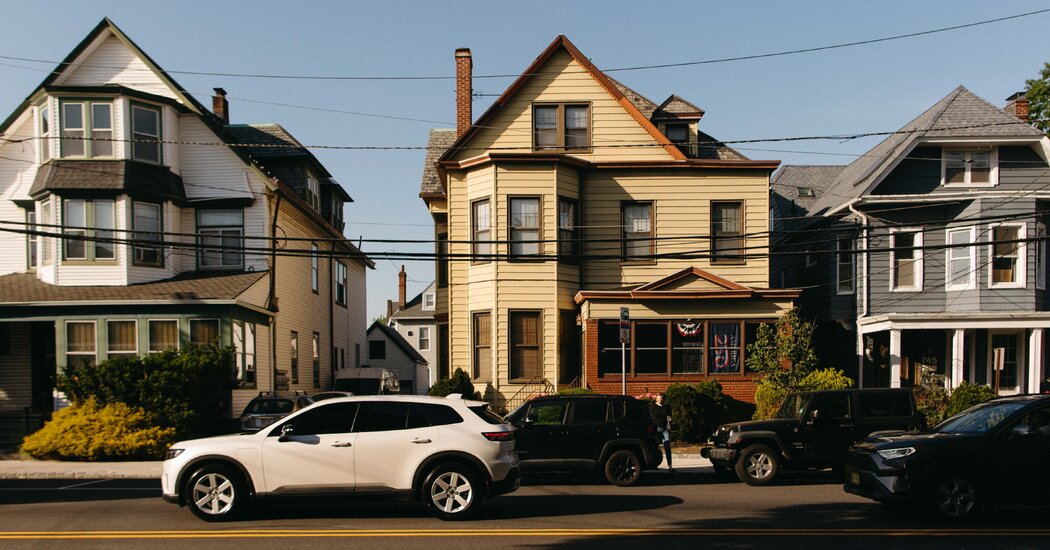
More than a million soccer fans are expected to visit the tristate area during the FIFA World Cup. Eight matches, including the final, will be held at MetLife Stadium in East Rutherford, N.J., which will be known as New York New Jersey Stadium during the soccer tournament.
But while New York City leaders have refused to ease restrictions on short-term rentals in anticipation of the event, New Jersey has doubled down on efforts to make the Garden State a hotbed for short-term stays.
On April 7, New Jersey’s Division of Local Government Services distributed a Local Finance Notice to municipal and county officials to “remind them of their authority to allow New Jersey residents to participate in the short-term rental market, helping them generate income while keeping tourism dollars within their communities.”
The notice states that the World Cup and America’s upcoming 250th anniversary celebration are both opportunities to “ensure that the economic benefits of tourism are felt directly by New Jersey families.”
Jamie Lane, the chief economist and senior vice president for analytics at AirDNA, a company that collects and analyzes short-term-rental data, said that the 2026 World Cup “is the biggest short-term rental event that’s ever happened.”
Airbnb is expected to generate $1.2 billion in spending across North America, and hosts could earn $212 million during the tournament, according to a Deloitte study commissioned by Airbnb, which has been a FIFA partner since 2025. In the tristate area, Airbnb hosts are expected to welcome approximately 25,000 guests and are projected to earn an average of $5,700 during the World Cup, the most of any host region, according to the study.
Regulation of short-term rentals in New Jersey is not governed by a single statewide law. Instead, individual cities and towns determine how Airbnb, Vrbo and other short-term rental hosts comply with local ordinances.
Some municipalities on New Jersey’s Gold Coast along the Hudson waterfront, including Hoboken and Jersey City, allow short-term rentals. In February, two New Jersey cities, Clifton and Passaic, reversed their stance on short-term rentals and passed ordinances allowing homeowners to rent their properties for 30 days or less.
A month later, in March, around the same time Airbnb rolled out a $750 incentive to attract new hosts in North American World Cup cities, the township of North Bergen, N.J., which is about eight miles from MetLife Stadium, implemented a new ordinance permitting short-term rentals where property owners live at the locations as their primary residence. Soon after, city officials in Guttenberg, the most densely populated municipality in the United States, also reversed their stance on short-term rentals and allowed homeowners in two- and three-unit properties to rent out their spaces as long as they reside on the property. (The hosts are not required to be on site during a rental.)
Wayne Zitt, the mayor of Guttenberg, partnered with Airbnb to promote units in his city. “It’s a good test for us to see what we get out of this,” he said. Short-term renters in Guttenberg can take a bus or ferry to Manhattan and Hoboken to catch a train or bus to MetLife Stadium, which is about seven and a half miles away.
Short-term housing demand is pushing into New Jersey primarily because of New York City’s Local Law 18, which took effect in 2023. The law effectively bans short-term rentals of fewer than 30 days unless the host is present. The city argued that the proliferation of short-term rentals through Airbnb and other platforms drove up rents and exacerbated New York City’s housing shortage.
In 2025, Airbnb, along with some property owners and civic groups, pushed a bill in the New York City Council that would allow short-term rentals in single- and two-family homes. Their argument was that short term rental restrictions did little, if anything, to reduce rents, and just made the city even more expensive to visit. That bill, which was strongly opposed by New York’s hotel industry union, was killed in December 2025.
Earlier this month, Airbnb renewed its campaign to loosen the New York City restrictions on short-term rentals by partnering with influential Black pastors, including the Rev. Al Sharpton, to argue that short-term rentals in the city would benefit Black homeowners.
“New York City’s loss is New Jersey’s gain,” Adam Alfandary, Airbnb’s U.S. East director, said by email. “As the biggest sporting event on the planet comes to North America, New Jerseyans are opening their homes, earning vital extra income, and raising revenue for state and local governments.”
Average listing rates for booked short-term rentals in Northern New Jersey, inclusive of Newark, Jersey City and Bergen County, are $242, up from $166 a year ago, according to AirDNA, a 45 percent increase. The average rate for available short-term rentals in New Jersey during June and July, when the World Cup matches will take place, is $435, more than double last year’s average available rate of $179 in the area. The number of listings in the area is up 16 percent from last year.
Airbnb data shows that there are approximately 10,000 available listings in Northern New Jersey during World Cup match dates. Nearly 60 percent of the available listings are priced at or below $500 per night.
The overall demand for travel and tourism in parts of Northern New Jersey, according to Mr. Lane, started to increased in 2023 with the passage of Local Law 18 and after the FIFA World Cup group stage draw in December 2025. Demand, Mr. Lane said, will continue as the tournament approaches.
“Overall occupancy during the group stage games, the night of and the night before, in New Jersey is running at about 45 percent,” Mr. Lane said. “We expect that to grow significantly in the next few weeks.”
Not everyone sees this as a good thing. Communities across New Jersey, including Kearny, Union City and Secaucus, have implemented laws that severely limit or ban short-term rentals to prevent unwanted disruptions in residential neighborhoods or to address concerns that they would limit housing or drive up costs for locals.
Mayor Zitt said that he has yet to receive any backlash from the Guttenberg community about the new ordinance.
“I think the restaurants and everybody were hoping that we were going to do this,” Mayor Zitt said. “If it turns into something, or it’s a burden, which I don’t foresee, then we would see how we can fix it.”