
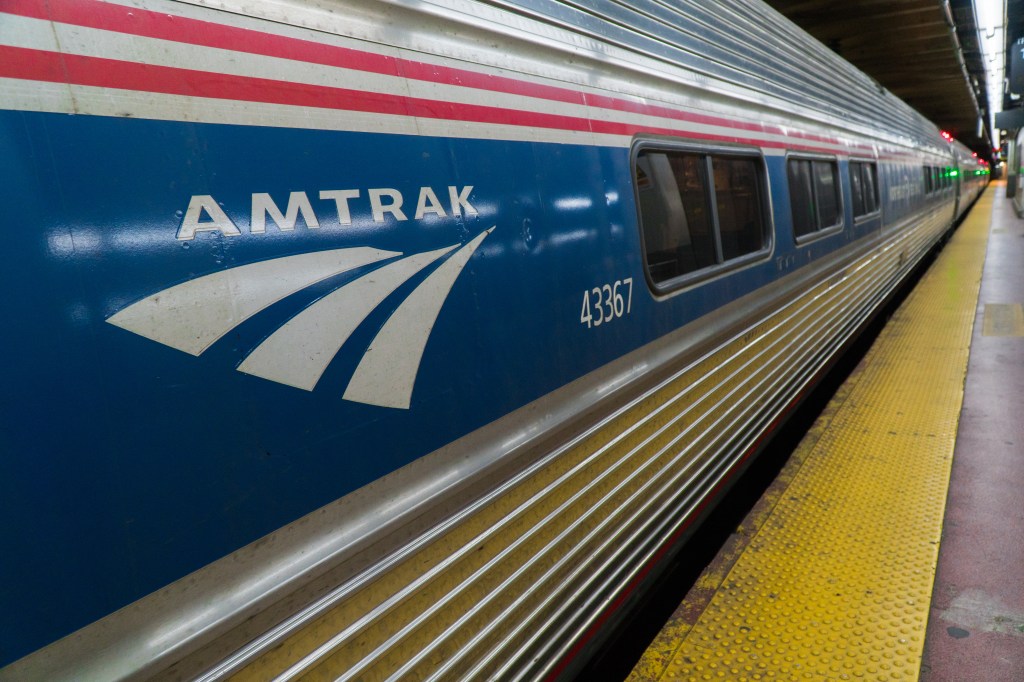
An amendment tucked into an infrastructure bill that working its way through Congress could wrest both control — and revenue — tied to Amtrak-related projects such as Penn Station away from New York City and New York State.
The amendment, which was added to the BUILD America 250 Act that passed the House’s Transportation and Infrastructure committee early Friday morning, would “authorize Amtrak to acquire, develop, and leverage property in the vicinity of intercity passenger rail stations, including in partnership or other arrangements with the private sector.”
That could include “real property and interests in real property located on or adjacent to intercity passenger rail stations,” used for station expansion and reconstruction, or used for commercial retail or office space.
Revenue from those properties would then go directly to Amtrak to fund the railroad, according to the text of the amendment, potentially squeezing out both the city and the state.
Some transit sources said Friday the amendment may be the feds’ way of raising funds for the $8 billion project by using development or tax revenue to offset the cost. Others expressed concern the power would incentivize Amtrak to once again pursue a southern expansion of the station — necessitating the demolition of so-called Block 780, a residential street on the station’s south side whose future has been widely debated.
Proponents of the measure say it makes sense.
“The model in the rest of the world that’s been so successful is to allow what’s called ‘value capture’ by the railroad that actually increases the value of that real estate by the service that they provide, and not have that tax revenue go somewhere else,” Rep. Seth Moulton (D-Mass.), one of the amendment’s boosters, said during markup of the bill Thursday night.
“This amendment makes possible the kind of station development that we’ve seen everywhere else in the world,” he said.
 Rep. Seth Moulton, D-Mass., questions witnesses during a hearing of a special House committee dedicated to countering China, on Capitol Hill, Tuesday, Feb. 28, 2023, in Washington. (AP Photo/Alex Brandon,File)
But Rep. Jerry Nadler (D- N.Y.), whose central Manhattan district includes Penn Station, cast the sole vote against the amendment.
“That amendment is very bad for Penn Station and for New York City,” Nadler said in the run-up to the vote.
“This amendment would not simply modernize station development, it would hand Amtrak and the Trump-Duffy DOT expanded authority over station-area real estate, financing, taxation, zoning, and private development — at the exact moment they are already running Penn Station in New York through a rushed and closed-door RFP process,” he said.
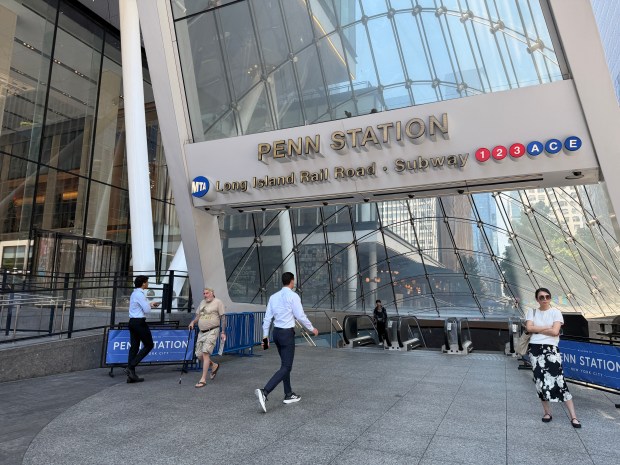 People are pictured outside Penn Station in Manhattan on Monday, May 19, 2026. (Rose Abuin / New York Daily News)
As previously reported by the Daily News, the process of picking a design, a developer, and a funding stream for a long-overdue overhaul of Penn Station has indeed been an opaque one ever since the feds took over last year. Transportation Secretary Sean Duffy announced earlier this week that a joint venture between development firms Halmar and Skanska will take the lead on New York’s most intractable transit project.
The announcement came three weeks after proposals were due to Amtrak — and nearly five weeks after President Trump hinted that the Halmar/Skanska plan was his favorite in an interview with the New York Post.
No updated renderings of the plan, which will not require moving Madison Square Garden, have been released since an early version was proposed under a different regime in 2023.
 United States Transportation Secretary Sean Duffy joins New York City Mayor Eric Adams for a train ride into Manhattan from the Dekalb Ave-Flatbush Ave subway station in Brooklyn on Friday, April 4, 2025. (Theodore Parisienne / New York Daily News)
Meanwhile, though Duffy told a Senate committee this week that the federal government would be investing $8 billion in the Penn Station glow-up, no details have been offered as to where the money would come from.
The BUILD America 250 Act still has a way to go before it can become law — it must pass the House and then the Senate before making it to the White House.