
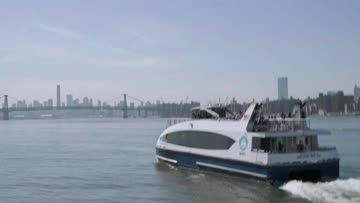
An NYC Ferry vessel heads across the East River, bound for landings in Queens, Brooklyn and Manhattan. Videographer: William Voermann
The city-run fleet of ferryboats is seeing a surge of riders — and social media fame — as it tries to navigate NYC’s challenging commuting landscape.
By Julia Press and Sarah Holder
May 22, 2026 at 9:00 AM EDT
The sun is still rising when Charles Rolling, an NYC Ferry captain, pulls out from Lower Manhattan’s Pier 11 and heads up the East River. “New York’s waterway is just like New York,” Rolling says as he tunes out the radio chatter directing rush hour traffic on the water. “It’s crowded, it’s assertive. You gotta know what you’re doing.”
This particular morning, the 58-year-old skipper is behind the helm of the Bay Hopper, one of 38 vessels in New York’s municipal ferry fleet. (All were named by second graders; Rolling’s favorite is Lunchbox.) Rolling often waves to his regulars from the wheelhouse, and recently passengers have started recognizing him, too — and not just for captaining their commute. That’s because Rolling is a recurring star of the NYC Ferry’s popular Instagram and TikTok accounts, which have more than 100,000 followers and nearly 2 million likes, respectively.
In one video, ferry staff don cowboy hats with boat decals ahead of Beyoncé’s Renaissance tour. In another, Rolling’s ferry races a bicyclist from the Bronx to the Rockaways. There are clip-art calls to action (“It’s time for BOATMAXXING”) and if-you-know-you-know internet references. The posts often anthropomorphize the watercraft — in a nod to the “2016 flashback” trend, one appears in a Snapchat-style photo with the caption “literally being built rn lol” — and celebrate the real ferry-heads, who “know it is ALWAYS ferry season in New York City.”
Weekday and Weekend Ridership Reach New Highs
Average daily ridership per month
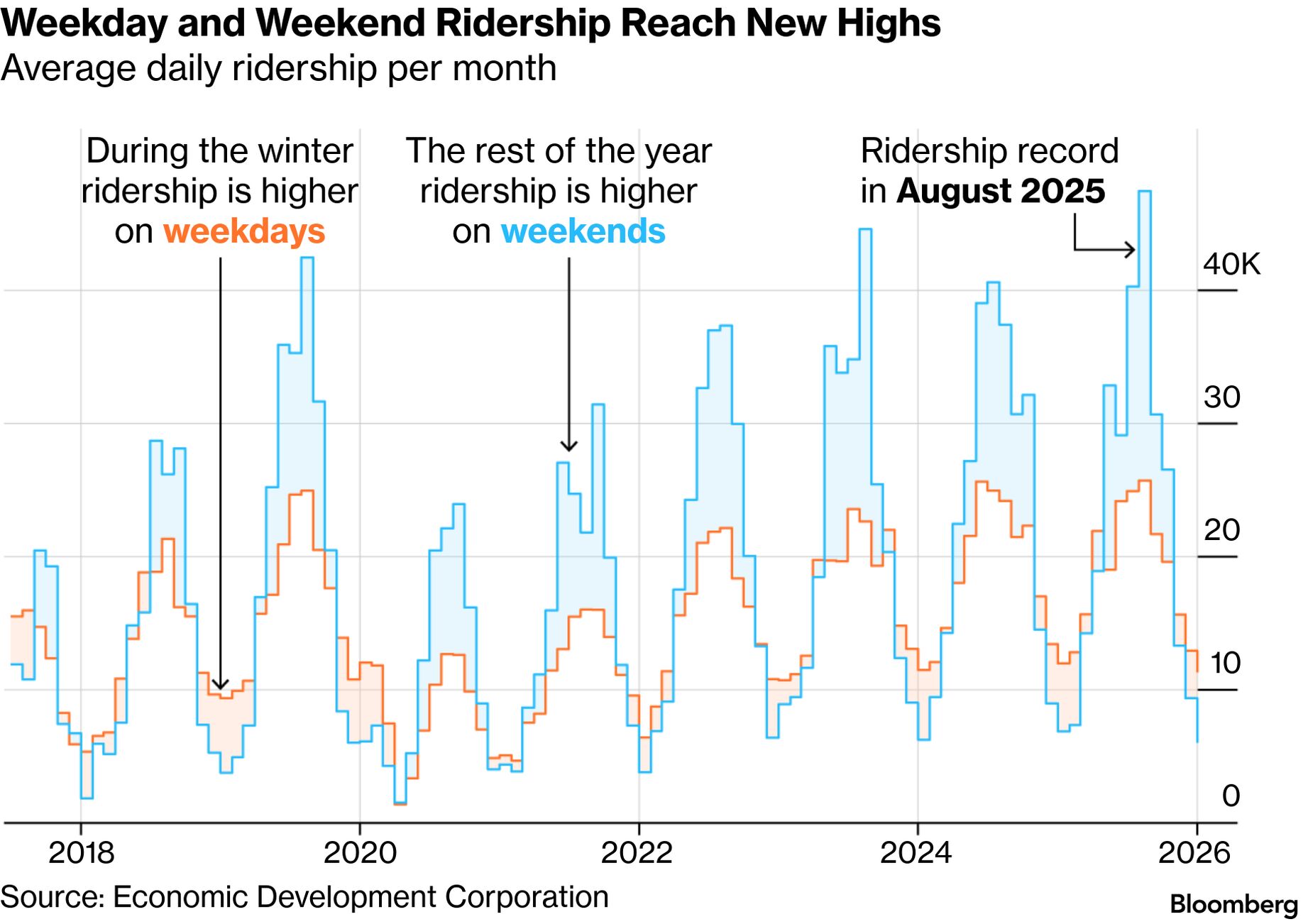
Source: Economic Development Corporation
But like many social media stars, NYC Ferry has also had its haters.
Critics of the system, which the city’s Economic Development Corporation has been running since its launch in 2017, have argued that it’s more pleasure cruise than public utility. NYC Ferry’s fare revenue doesn’t come close to covering its costs, its ridership has yet to reach the levels that were originally projected, and its routes tend to favor the city’s most affluent.
But nearly a decade since the first city-run ferryboat set sail, the system has been working to win over skeptics. The service now spans 25 landings across all five boroughs. Ridership is up, especially on the weekdays, and costs per passenger have been trending down from pandemic-era peaks. By its own accounting, the city is subsidizing each ride less than ever.
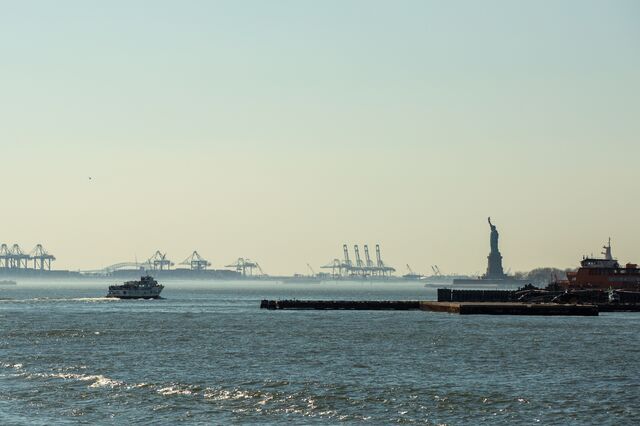
Ferries often negotiate challenging river traffic conditions. “New York’s waterway is just like New York,” a ferry captain says. “It’s crowded.” Photographer: William Voermann/Bloomberg
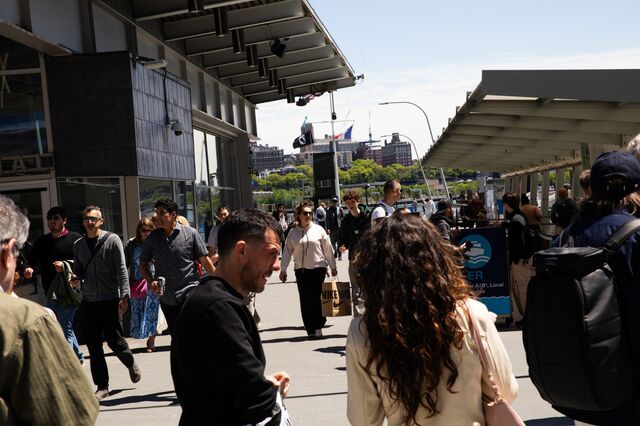
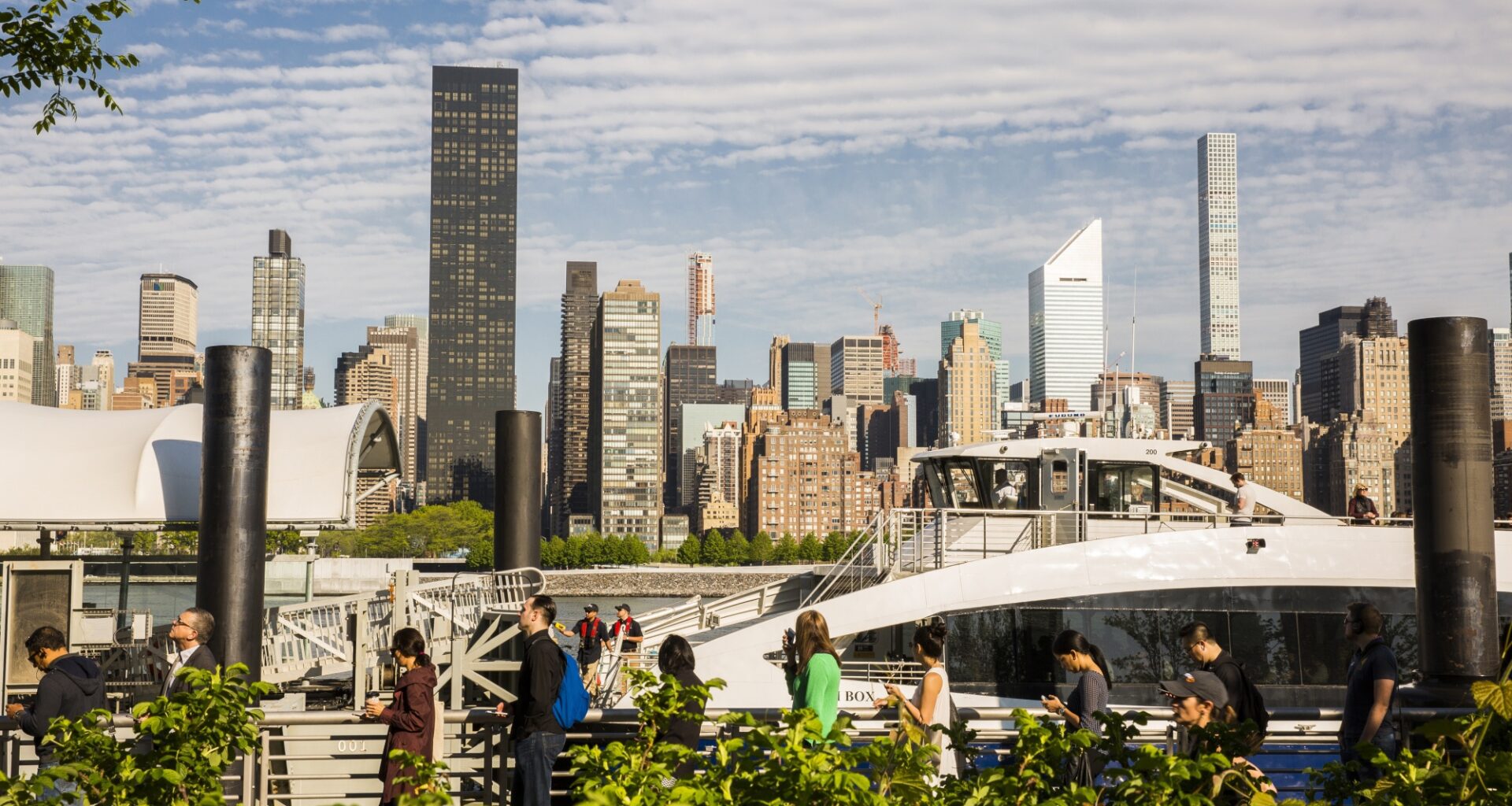
Commuters and tourists on a recent weekday morning at the Pier 11/Wall Street boat dock, in Manhattan. Photographer: Raphäel Gaultier/Bloomberg
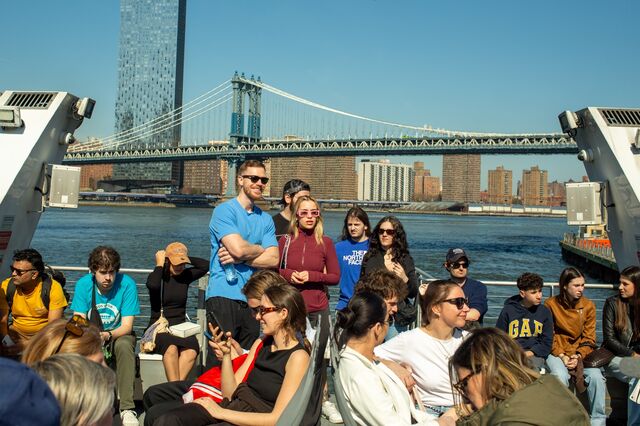
During the warmer months, ferry ridership swells on the weekends. Photographer: William Voermann/Bloomberg
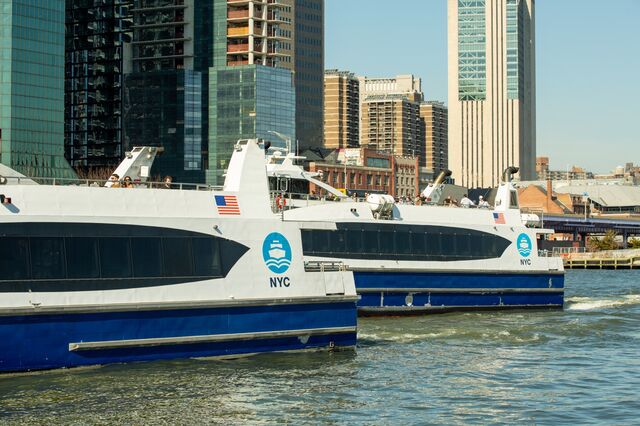
The NYC Ferry fleet now includes 38 boats, all owned by the city. Photographer: William Voermann/Bloomberg
And as other public ferry systems around the US struggle to recover post-Covid ridership and fight for federal funding, NYC Ferry is using its social media clout to convey this transit mode’s more intangible value: It’s fun.
“One of the things that really differentiates us as a transit system in New York is how personable it feels,” said Franky Ponce, the ferry’s social media manager. “Quite frankly, I think a lot of it, too, is the views are just so good.”
New Yorkers have been getting around on watercraft for centuries, but as an official public transit service, NYC Ferry is barely a tween. Mayor Bill de Blasio pitched the idea for a modern municipal ferry in 2015; he saw it as a way to ease congestion, bring down traffic fatalities and provide an alternative to the beleaguered subway system.
“We very much needed to get people out of their cars, and yet the number-one alternative was less and less reliable and losing the faith of the public,” said de Blasio in a recent interview. “We needed a game changer.”
Watch: Has the NYC Ferry Righted the Ship?
A ferry could also better connect Manhattan to what de Blasio described as the new gravitational center of 2015 New York: the east side of the East River, from Astoria, Queens, down to brownstone Brooklyn.
“ I had long believed we were not using our waterways the way we could,” he said. “And I thought, why not here? Especially because it used to be true in New York City a hundred years ago.”
Ferries were once the backbone of New York City’s transportation infrastructure. For much of the 19th century, there were no bridges or tunnels crossing the East and Hudson rivers. Steam-powered boats “played the initial role, and for a long time, they played the only role,” in getting people from the island of Manhattan to New Jersey, Brooklyn or Queens, according to Brian Cudahy, author of Over and Back: The History of Ferryboats in NY Harbor.
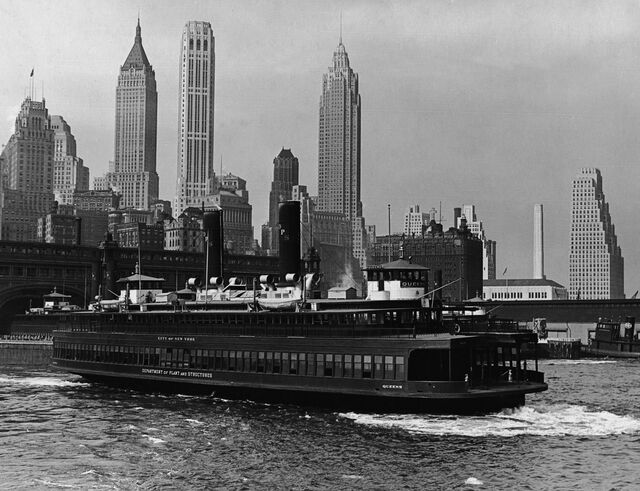
Private and city-run ferries, like this one near Battery Park in 1932, have long been a part of the city’s transit mix. Photographer: FPG/Getty Images

A woman waits for a ferry to Manhattan circa 1905. New bridges and subway lines competed with ferryboats in the early 20th century. Photographer: FPG/Getty Images
In his 1856 poem “Crossing Brooklyn Ferry,” Brooklyn-based Walt Whitman rhapsodized “the hundreds and hundreds that cross, returning home” via boat. In Whitman’s time, 70 different steam ferries plied Gotham’s waters.
By the early 1900s, though, ferries faced competition from the Brooklyn, Williamsburg, Manhattan and Queensboro bridges, as well as the newly built subway system. As private ferry operators saw profits evaporate, the city stepped in, taking over what would become the Staten Island Ferry in 1905 and then other routes. It was one of New York City’s first forays into truly public transit.
But the golden age of these municipal ferries was short-lived. After the 1929 stock market crash, funding faltered. By 1955, only the Staten Island line remained under city control.
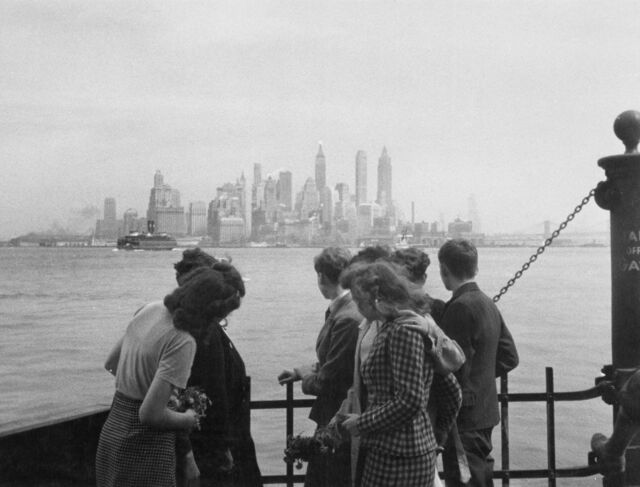
Ferry passengers take in the sights of Manhattan in the early 1940s. Photographer: FPG/Hulton Archive
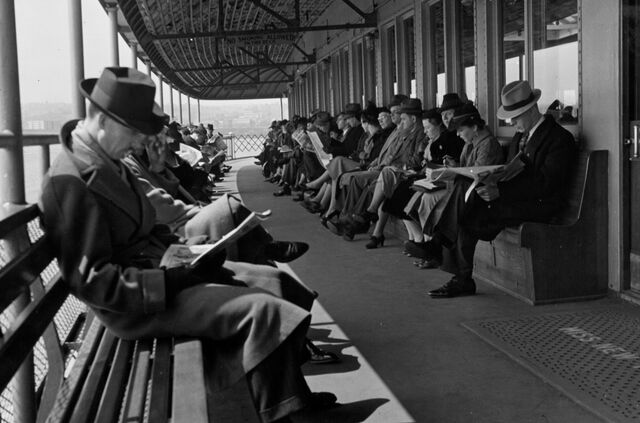
If you were riding a New York ferry in 1955, like these passengers, you better be wearing your fedora. Photographer: Arthur Swoger/Getty Images
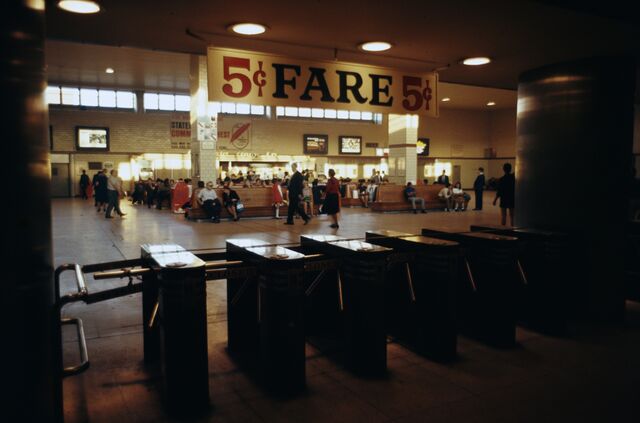
The Staten Island Ferry’s famous nickel fare lasted from 1897 to 1972, when it was raised to 10 cents. Since 1997, the ferry has been free. Photographer: Arthur Swoger/Getty Images
The stage for a public ferry comeback was set in the 2000s, as new Lower Manhattan parks brought foot traffic to the waterfront and residential growth soared in river-abutting neighborhoods like Williamsburg, Greenpoint, Dumbo and Long Island City. Reviving a ferry system, the thinking went, would help the city capitalize on that, and in 2011, Mayor Michael Bloomberg launched a pilot. (Bloomberg is also the founder and majority owner of Bloomberg LP, parent company of Bloomberg News.)
De Blasio wanted to go bigger. “ I thought this was a step towards an entirely different conception of mass transit,” he said.
Compared to other New York transit offerings, the resurrected municipal ferry had a unique structure. Instead of a transportation agency, de Blasio put the city’s Economic Development Corporation in charge of the new ferry system. The organization was already managing the city’s piers and waterfront property development, and had overseen Bloomberg’s ferry pilot. “They could blend it with their larger strategy for economic growth along that corridor,” said de Blasio.
Running the ferry through EDC had another advantage: Rather than relying on state and federal transportation funding, or elbowing its way onto the city budget each year, the nonprofit had its own pool of cash. It could use some of the extra revenue it generated from the rental properties it managed on the city’s behalf to cover ferry operations. “There was more freedom of maneuver with EDC,” the former mayor said.
This model also set NYC apart from typical US public ferry systems, which rely heavily on farebox revenue or bridge tolls, along with state and federal support. The San Francisco Bay Ferry, for example, gets more than 70% of its operating revenue from tolls, another 20% from fares and the rest from state and local sources. “I would dream of having the funding structure that NYC Ferry does,” said Lauren Gularte, who manages government and regulatory affairs for the San Francisco Bay Ferry and chairs the national Public Ferry Coalition.
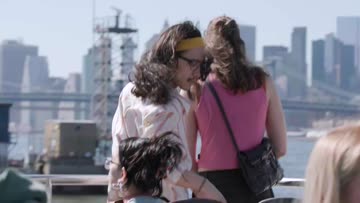
For $4.50, ferry riders get first-class views of the Manhattan skyline. Videographer: Suma Hussien
While EDC determined fare policy and routes, it contracted with a private transportation and sightseeing company called Hornblower Group to operate the system and build a fleet of 19 boats from scratch. Under the terms of their contract, Hornblower would own the craft, while the city retained the right to buy them back eventually.
Timothy O’Brien, Hornblower’s senior vice president for ferries and concessions, said the scale of New York’s ambitions for a “brand new, startup ferry service” was pretty unique.
“The comparisons of naval wartime efforts to deliver vessels were made many times,” said James Wong, NYC Ferry’s executive director, who’s been at EDC since 2014. Most of the aluminum-hulled boats, built for an average of $4 million each, were completed in 11 months, and in 2017, right on schedule, NYC Ferry hit the water.
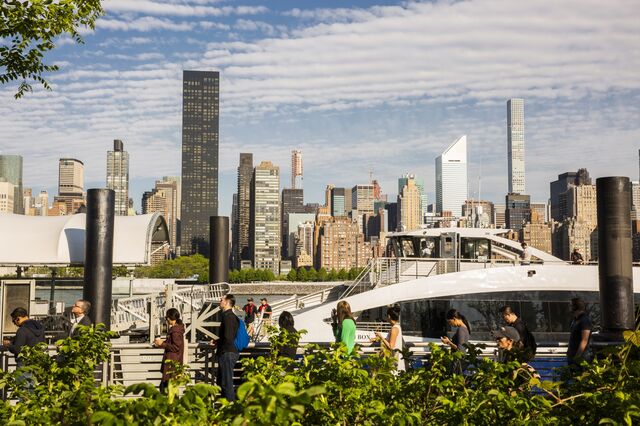
NYC Ferry commuters line up for a ride in 2018, one year after the city-run service launched. Photographer: David Williams/Redux
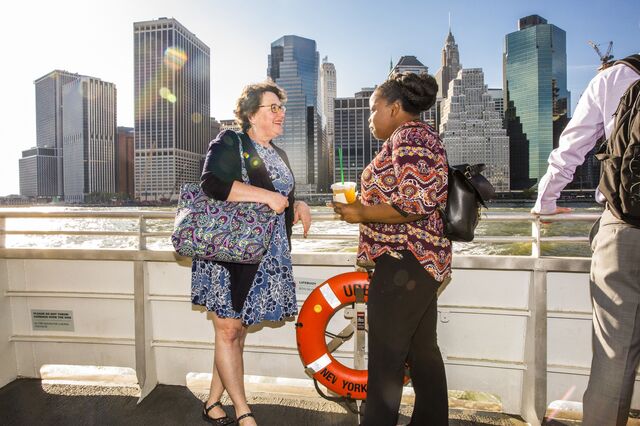
Early ridership was high, but so were the costs of subsidizing the ferry service. Photographer: David Williams/Redux
At first, the city set fares at $2.75 for a single ride — same as a subway swipe — in an effort to build ridership. In its first seven months, the system transported over 3 million riders, about 33% higher than projected, on routes connecting Bay Ridge to Brooklyn Bridge Park, and Wall Street to Astoria and the Rockaways.
By 2019, an average of 16,000 people were riding the ferry on weekdays. Hornblower was hard at work doubling the city’s fleet to 38 boats, and the city had a plan to purchase the vessels for more than $230 million. But fares were covering less than 20% of the system’s operating costs, according to figures from the National Transit Database. And critics took notice.
That year, the Citizens Budget Commission, a nonpartisan financial watchdog, published a report titled “Swimming in Subsidies.” They found that the city was paying the equivalent of $10.73 to cover the price of each ferry ride — far higher than the $6.60 subsidy rate the de Blasio administration originally projected. The rate was also ten times higher than the city’s subway and bus network.
There was an “imbalance between a system that had very high operating costs and very low fares,” said Sean Campion, who authored the Citizens Budget Commission report. Public ferries in San Francisco were charging more than two and a half times NYC Ferry’s fare for their cheapest rides in 2019, according to a CBC analysis; Boston and Washington State’s baseline fares were nearly a dollar more.
NYC Ferry Subsidies Drop as Ridership and Revenue Grow
Subsidy per trip for select passenger ferries and NYC-area public transit systems
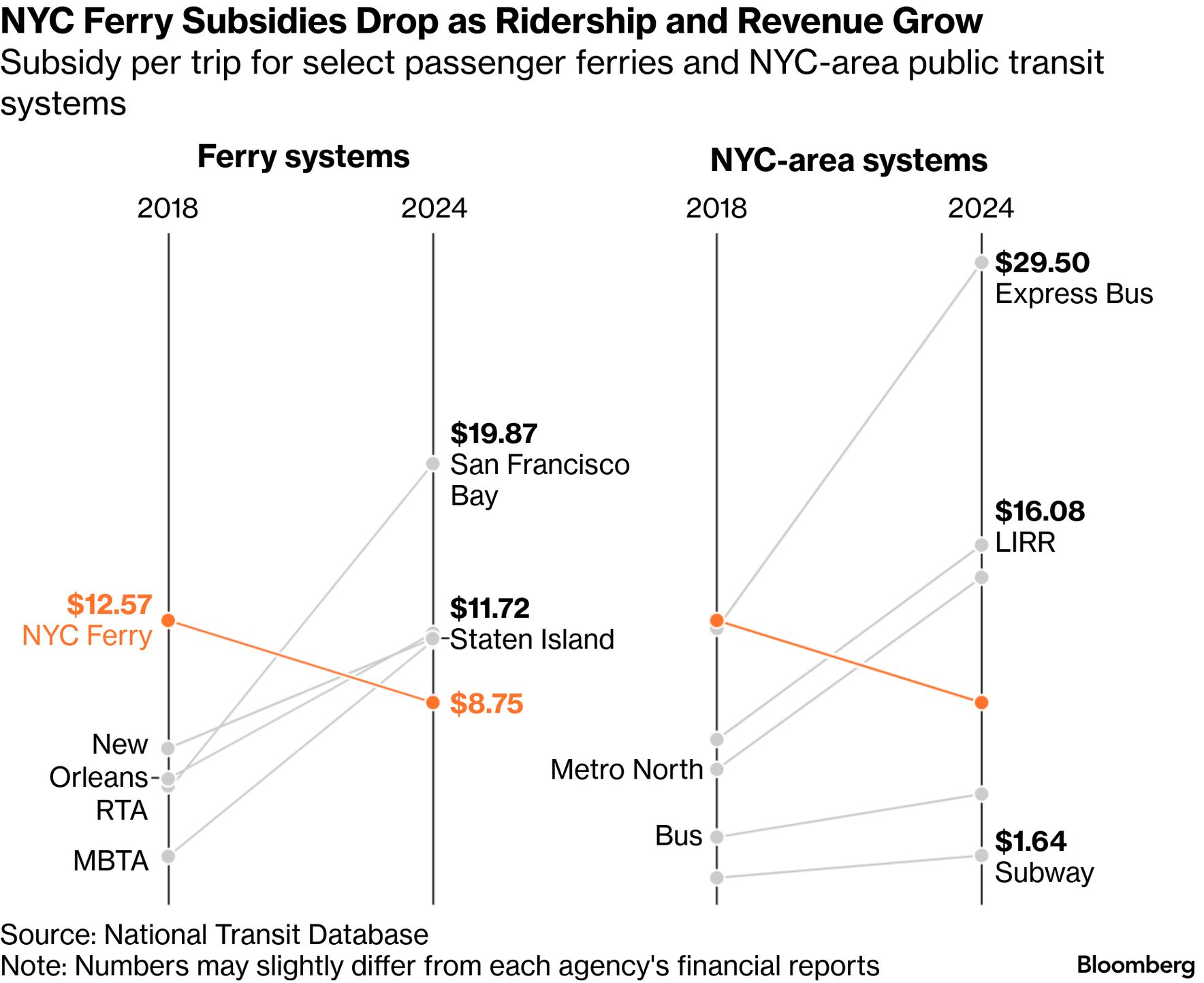
Note: Numbers may slightly differ from each agency’s financial reports Source: National Transit Database
The Covid-19 pandemic added to NYC Ferry’s financial woes; as commuters and tourists stayed home, ridership collapsed and the per-rider subsidy spiked.
Critics also pointed out that compared to other transit options, NYC Ferry routes privileged wealthier neighborhoods and riders. A 2019 survey found passengers had a median income of $75,000–$99,999, compared to the city median of under $38,000. Speaking to press at a 2019 city council hearing, then-Brooklyn councilmember Antonio Reynoso put it bluntly: “Are we giving $10 per ride to someone that doesn’t need the help?”
Wong said holding the ferry’s per-rider costs up to the subway’s is like comparing apples to oranges: “They have a scale that we’re never going to try to meet.” In NYC Ferry’s first full year of operation, it transported fewer people than New York’s subway did in a day. The subways and buses also cost about $10 billion to operate in 2019, compared to the almost $82 million EDC reported spending on the ferry that year.
Still, Wong said, getting that subsidy-per-rider number down was “critically important.” It had become shorthand for measuring the transit mode’s value.
Some transit advocates say it shouldn’t be. SF Bay Ferry’s Gularte says ferries look better if you measure efficiency by cost per passenger mile. And Ben Furnas, executive director of the nonprofit advocacy group Transportation Alternatives, points out that cars aren’t held to the same standard. “People don’t talk about our road system as a per-rider subsidy,” he said. “It’s sort of just assumed that a road network that allows private automobiles to drive on it is a public good.” Similarly, ferry service can bring social and economic benefits, he stressed, spurring “investment and new businesses and new homes and new relationships” along each route.
Indeed, the boat service has been both thanked and blamed for boosting waterfront housing prices. Research has shown that while property values near ferry landings rose after the launch of NYC Ferry, these stops also tend to be slated for areas that are already experiencing economic growth.
Eric Goldwyn, the director of the transportation and land use program at the NYU Marron Institute of Urban Management, notes that when it comes to expanding transit access, ferries have other potential advantages. Compared to a new subway or train line, infrastructure needs are modest and require less community buy-in. New York’s Second Avenue subway extension, for example, is costing an estimated $2.5 billion a mile, and a plan to build a new line connecting Brooklyn and Queens is hitting some public resistance. In comparison, Goldwyn said, “these waterways look wide open.”
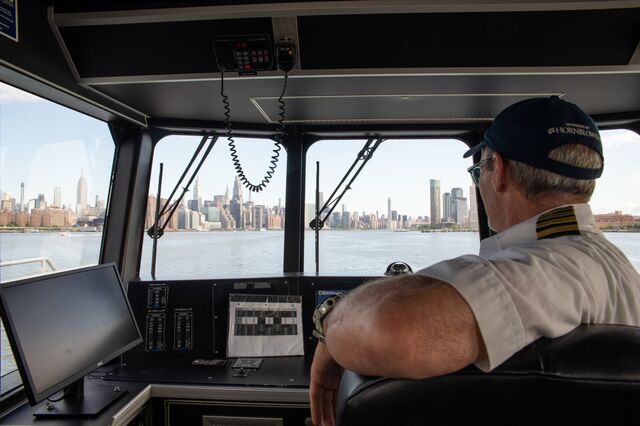
Charles Rolling, a NYC Ferry captain, begins his shift. Some passengers recognize him from his appearances in the ferry’s social media feed. Photographer: Raphäel Gaultier/Bloomberg
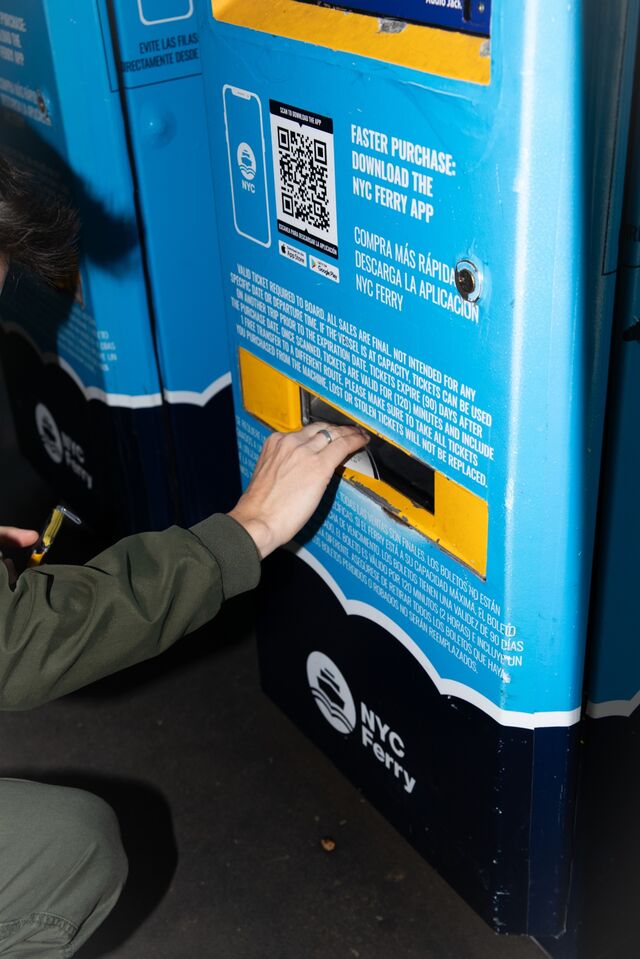
Ferry fares have gone up from $2.75 at launch to the current $4.50. Photographer: Raphäel Gaultier/Bloomberg
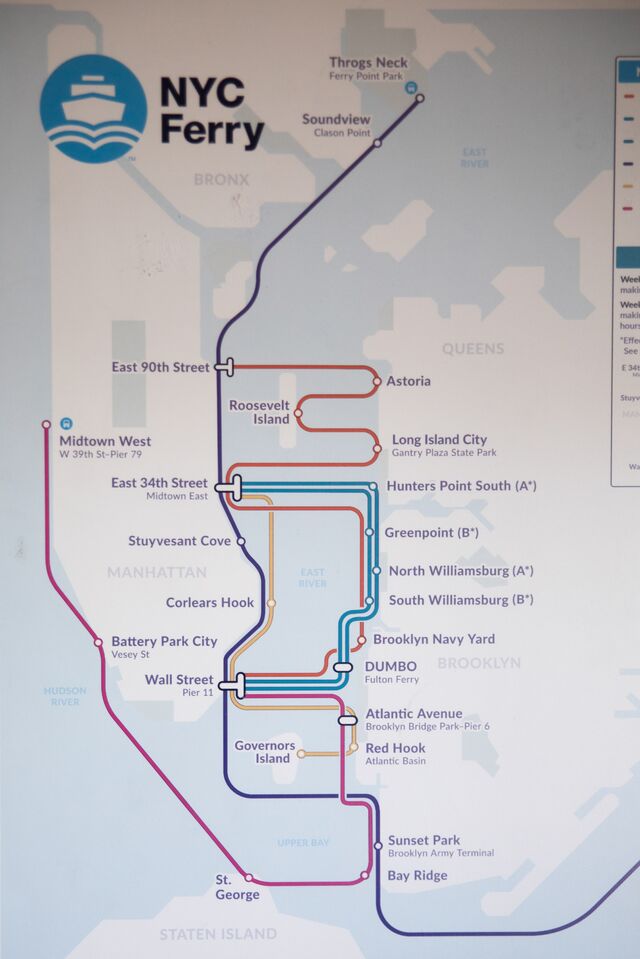
The NYC Ferry system has been adding routes and landings, too. Photographer: Raphäel Gaultier/Bloomberg
In 2022, the NYC comptroller’s office entered the chat with an audit finding that EDC had underreported its ferry-related expenditures by more than $224 million since 2015, and had made several decisions that were “not financially prudent,” like overpaying Hornblower for ferry vessels by tens of millions of dollars and overcompensating them for fares. The audit recommended that EDC claw back $12 million from Hornblower, something EDC didn’t pursue. “Walt Whitman waxed poetic about New York City’s ferries, but EDC’s responsibility is to provide adequate oversight and report accurately,” Brad Lander, then the city’s comptroller, said in a statement.
EDC defended its spending decisions, saying all payments to Hornblower were “in accordance with the contract,” and said that it believed the audit misrepresented data. In comments at the time, a Hornblower spokesperson stressed that the comptroller had not accused the operator of violating its contract.
The audit was nevertheless a wake-up call. “There was an acknowledgement that, yes, regardless of what this audit says, when we look at our own numbers, things were getting expensive,” Wong said.
The city’s soul-searching came at a somewhat opportune moment: EDC’s contract with Hornblower was set to expire in 2023, and the organization was ready to rework the terms of the deal.
“We were growing fast,” Wong said, “and there was a pivot that we made really through the last administration to say, before we grow more, we have to fix the inside of the systems from the ground up.”
Ultimately, after a competitive bidding process, EDC again chose Hornblower as its operator but with a new contract under different terms. The contract with Hornblower, which is now owned by a private equity company after filing for bankruptcy a few years ago, is locked in at least until 2028, with the option to extend it up to six more years. The city now owns the ferry fleet, which should save the city money in the long run, said the Citizens Budget Commission’s Campion.
Another key to the turnaround plan was to lean into the ferry’s secret weapon: being a remarkably pleasant way of getting around. As one TikTok video put it, “NYC Ferry is essentially a public yacht that goes from island to island.”
EDC decided to reassess fares accordingly. It increased the cost of a one-way ticket first to $4, and in the fall of 2024, to $4.50. Specialty trips, like summer service to Rockaway Beach, offer $12 premium fares with reserved seats and priority boarding. The system still offers a 10-trip value pack for $29, which comes out to ten cents less than a subway swipe after the MTA’s latest fare hike. Students, seniors, and people with disabilities qualify for additional discounts.
The idea is to keep costs low for commuters while capitalizing on the fact that non-commuters, tourists and joyriders make up nearly two-thirds of passengers, according to EDC’s latest survey from the fall of 2024. “Our lived experience is that yes, commuters rely on this every single weekday. But I’m not going to pretend that we don’t also have a lot of people who are here for a recreational visit,” Wong said. “We’re willing to let people who are riding for more of a recreational trip pay more.”
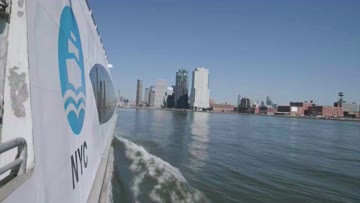
On sunny days, floating to work beats an underground subway ride. Videographer: William Voermann
In April, a blast of summer-like temperatures hit the East Coast, and with the sun came the ferry fans.
“We’re soooooo back @NYC Ferry,” wrote one TikToker. Another compared her ride to “a mini vacation.” Her video received more than 10,000 likes. Offering a weekday happy hour at its onboard bar and epic views of the skyline, NYC Ferry does its best to live up to that reputation.
Many of the popular videos on its own TikTok account tap into this wow factor, featuring dolphin-spotting on a passage to the Rockaways and a twilit view of the Brooklyn Bridge (captioned “girl whatever”).
When Ponce was hired as Hornblower’s social media manager in late 2022, the ferry’s online presence was, as he described it, “very service-focused.” He decided to infuse the accounts with more personality, tap into the zeitgeist, and feature more crew members. Per EDC, Dash Social Analytics data shows the ferry’s accounts got 14.7 million impressions on social media in 2025 alone.
Hornblower has also started partnering with brands, hosting an event with Smurfette to promote the 2025 Smurfs movie and inviting Fudgie the Whale, of Carvel ice cream cake fame, aboard to offer free soft serve. EDC splits the revenue from these marketing activations with Hornblower; last year, the organization picked up around $320,000.
Whether Smurfette is getting people to buy a ticket is hard to track. But Wong sees the ferry’s social media persona as an important part of its ridership strategy. That, and doing what any public transit system has to: running frequent, reliable service where people want to go. “ Can we control ridership? Not directly, but we can control how convenient it is,” he said. NYC Ferry boats are almost always on time, which sure beats the subway (though on some East River stops, headways can be up to 25 minutes during peak service hours). EDC recently redesigned routes to make getting to Midtown more efficient for commuters, and getting to the Rockaways better for beachgoers.
By many metrics, all these post-pandemic efforts to “right the ship,” as Wong put it, are working. NYC Ferry is now the third-largest municipal ferry system by passenger volume in the US, trailing only the free Staten Island Ferry and the Washington State system (which also carries cars). And while those systems haven’t yet recovered their pre-pandemic ridership, the 7.4 million passengers NYC Ferry carried last year represents a gain of over 30% since 2019. (The system still hasn’t reached the 11 million annual riders projected pre-pandemic.)
Though operating costs have gone up due in part to rising fuel prices, the system has still been able to push down the per-rider subsidy to $8.33, according to EDC’s latest figures. As of 2024, the last year with comprehensive national data available, NYC Ferry had the lowest subsidy of any major municipal passenger ferry in the US. The EDC’s goal is to reduce it by another dollar by 2028.
Reflecting on NYC Ferry’s impact so far, former mayor de Blasio said this first decade has just been “act one.”
The waterfront is hotter than ever: Red Hook is poised for an EDC-led redevelopment, and neighborhoods like Greenpoint and Williamsburg just keep growing. New landings are planned for East Harlem and Sunset Park, and in late April, a group of city lawmakers proposed adding service from West Harlem to accommodate World Cup fans heading to MetLife Stadium in New Jersey. EDC said it appreciates the proposal and “will evaluate it thoroughly.”
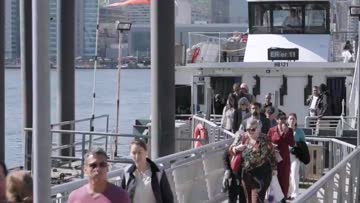
Passengers disembark on the Hunter’s Point South ferry landing in Queens. Operators expect the World Cup to bring extra crowds this summer. Videographer: William Voermann
In the meantime, Mayor Zohran Mamdani announced an increase in ferry service on May 19 to support the summer influx of tourists. “The world is coming to New York City — and New York City is ready,” he said in a statement. Mamdani is known for being more of a bus guy, but a City Hall spokesperson said that the mayor sees NYC Ferry playing “an important role in the transit ecosystem of the city” and is exploring how areas underserved by public transit could be better connected by waterways.
As NYC Ferry maps its expansion, advocates say it should take social factors into account. Canarsie, Brooklyn, has been asking for ferry service for years, says Tyler Taba, director of policy and government affairs for the Waterfront Alliance. Why not add a stop there, or run a line from LaGuardia Airport to the Bronx, where many airport employees live? “That could be a really easy way to bring people to and from work,” he said.
In addition to increasing access, Taba said, ferries can offer transit redundancy in emergencies — as the city saw on 9/11, when an armada of tugs, ferries and sightseeing boats evacuated people trapped on the southern tip of Manhattan after the terrorist attacks.
But right now, transit advocates say the ferry’s usefulness remains limited by its lack of connection with the city’s broader public transit network. Landings tend to be distant from bus and subway stations; tickets are bought on a separate platform from the MTA’s other modes, and there are no free transfers. “You want to have that multimodal connection,” said NYU’s Goldwyn. “We have not figured that part out.”
It’s a geographical disconnect that reflects a broader conceptual gulf, according to Taba. “For a city of 520 miles of coastline, we don’t see ourselves as that waterfront city,” he said.
Ponce says he’s trying to change that, bringing “the waterways into the New York storyline,” post by post.
“I promise,” he said, “it’s as good onboard as it is on social.”
— With assistance from Marie Patino, Sophie Butcher
More On Bloomberg