
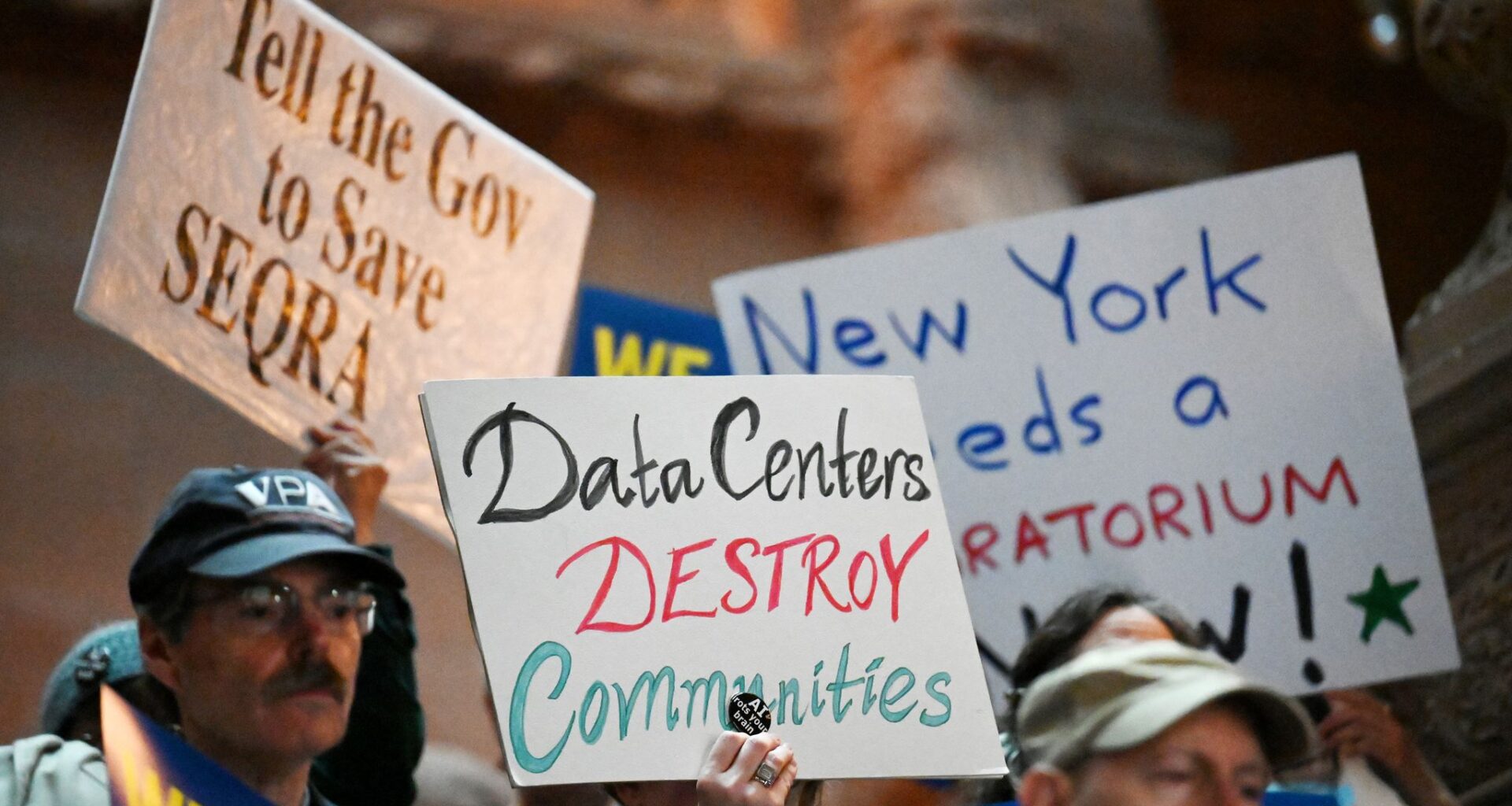
Environmental advocates and progressive lawmakers are pushing for a statewide ban on new data center development.
Will Waldron/Times Union
Assemblywoman Anna Kelles and other proponents of the moratorium say it’s necessary to avoid further raising utility rates and to prevent environmental degradation.
Will Waldron/Times Union
Lawmakers pushing a data center moratorium are likely to be rebuffed by Gov. Kathy Hochul who told the Times Union she’s opposed to such a plan.
Will Waldron/Times Union
Data center opposition is concentrated in rural areas where many of the proposed projects look to come online.
Will Waldron/Times Union
Genesee County residents have swarmed public hearings to oppose a data center in Alabama, N.Y.
Ezra Bitterman/Times Union/(Ezra Bitterman/Times Union)
Stream, a Texas based data center company, is proposing a large facility in Alabama, N.Y., at a rural industrial park.
(Ezra Bitterman/Times Union)
ALBANY — Taxpayer funds were earmarked to launch a clean energy hub at a rural Genesee County industrial park. But instead of making a zero-emission alternative to diesel, the site is likely to become a data center that will use green energy, not create it.

The state gave $56 million to upgrade infrastructure for the project as part of its push to foster new manufacturing and zero-emission technologies. When the developer dropped out, Genesee County officials allowed a data center proposal to go forward in its place, prompting outrage.
Article continues below this ad
“I will have to pay more taxes, pay more for water, pay more for electric; what are we getting for all this?” said Debbie Leising, as she protested data center development outside a recent public hearing in Alabama, a small town in northwestern Genesee County.
It’s one of many proposals across the state facing immense backlash as local leaders try to attract new investment while residents worry about increases to their energy rates and potential degradation of the environment.
Collectively, data centers proposed across the state could require levels of electricity approaching the power demand of New York City, according to a Times Union review of data from the New York Independent System Operator, which manages the state’s electric grid.
Make the Times Union a Preferred Source on Google to see more of our journalism when you search.
Add Preferred Source
Data centers are usually set up in large warehouses filled with high-energy consuming equipment that enables companies to access and transmit information. They’re an essential component of modern technology, including the internet, but were first built more than 80 years ago to house the U.S. Army computers needed to accurately launch missiles.
Article continues below this ad
New York has long been a leader in the use of data centers as financial services giants like JPMorgan Chase use the facilities to speed up transactions and to enable services such as mobile check deposits.
What’s being proposed in the pastoral fields of Genesee County — and across the country — is a colossal version of those earlier data centers equipped with specialized computer chips needed to operate ChatGPT and other AI products.
Those processes require immense amounts of electricity.
Article continues below this ad
Stream Data Centers, a Texas-based company proposing the Genesee County project, is seeking to use 500 megawatts of electricity, about one-third of the Capital Region’s power use.
Some residents near the proposed site are frustrated because the company received hefty tax breaks.
But proponents say it’s worth it because the potential economic benefits could be generational.
If given final approval, Stream will send annual payments to local municipalities amounting to nearly as much as all economic development projects in the county combined over the last two decades, according to Mark Masse, president and CEO of the Genesee County Economic Development Center.
Article continues below this ad
Near ‘everyone’s favorite bar’
But it’s unclear how many of these mega-projects will come online in New York because many exist only in applications, and very few have taken steps to get built.
“It’s all rumor,” Michael Loguercio, a Brookhaven town councilman, said of data center developments in the Suffolk County area.
The “rumor” emerged when the builder of a local warehouse — which has struggled to attract tenants — informed the state Independent System Operator it wanted to use the site for a data center. The developer hasn’t spoken with local officials about the plans and didn’t respond to requests for comment.
Article continues below this ad
The largest data center proposal seeking to enter New York’s grid also hasn’t offered plans to Dutchess County officials or local elected leaders in the town of East Fishkill, where it’s supposed to come online. County Executive Sue Serino, a Republican, didn’t rule out potential development but said projects “need to demonstrate a clear benefit to our community.”
Local pushback spreads quickly in New York in the wake of even speculative proposals.
In Ilion, a Mohawk Valley town, owners of the closed-down Remington Arms Factory said in filings with both the Independent System Operator and state Department of Environmental Conservation that they intend to put a data center at the shuttered site.
Article continues below this ad
But the Herkimer County IDA, which received a $500,000 state grant to redevelop the factory, told the Rome Sentinel that the developers are pivoting “to a vision that will add more value to the community.”
Betsy Briggs, co-chair of the Herkimer County Democratic Committee, is skeptical, saying local leaders are just trying to calm backlash but remain open to data centers.
Briggs opposes the project because it’s “right in the middle of the village,” and across the street from “everyone’s favorite bar.”
In the $7 trillion arms race for AI dominance, there’s “charlatans mixing in with the serious players,” said Gustavo Schwed, a finance professor at the New York University Stern School of Business.
Article continues below this ad
But even with serious projects, pitfalls abound.
Less than one-third of data centers slated to come online this year across the country have started construction, in part because there’s been a “huge backlash across communities,” said Olivia Wang, a researcher at Sightline Climate, which studies data center development nationwide.
Local opposition alone is expected to kill more projects in the first half of 2026 than all of 2025, according to Heatmap, an energy news and research outlet.
Genesee County residents have swarmed public hearings on the Stream proposal to fight the project citing impacts on utility bills, water supplies and public health, which officials say are overstated.
Article continues below this ad
“They’re not only ruining agriculture, they’re putting things in there (that are) actually going to harm us, and in the long run, sooner or later, people are going to start feeling that effect,” said Vance Wyder, a 76-year-old resident of Alabama. Wyder stayed for nearly three hours at a recent hearing but didn’t get to speak, as more than 100 people showed up.
Retaliation against the Stream facility is largely built on a “whole lot of misinformation,” said Masse, the Genesee County economic development leader.
He noted that, despite public concern about water use, the project will have roughly the same impact as a small office building.
Stream claims it will have no impact on electricity prices because it will reimburse a portion of $56 million in state grant funds used to upgrade local power infrastructure.
Article continues below this ad
Stream’s claim of no impact may be dubious because New York doesn’t have the same excess cheap electricity as other states.
New York’s electric grid is more strained than any time in “recent history” heading into the summer, according to the Independent System Operator. When the oldest, most expensive power plants have to run frequently to keep the lights on, it can increase energy prices, said Long Lam, a researcher at Brattle, an energy consulting firm.
Gov. Kathy Hochul’s plan to aggressively ramp up energy supply is to build new nuclear power facilities, which are reliable but will likely take more than a decade to build.
Data centers pose more indirect threats to energy costs, too. They’re buying equipment that utility companies need to upgrade the electric grid, partially causing some components to be upwards of 80% more expensive than five years ago, Reuters reported.
Article continues below this ad
‘Just straight up stupid’
Some residents near the Stream proposal in Genesee County are not only frustrated over potential energy cost impacts, but also because the company is receiving hefty tax benefit agreements without the promise of strong permanent job growth.
“In the economic world that we live in, that is stupid, just straight up stupid,” Cheryl Cordes, a 43-year resident of Alabama, said of the incentive package the company is receiving.
Stream will receive about $1.4 billion in subsidies from state and local tax exemptions. The company said it will spend roughly $20 billion on the facility and create about 120 permanent full-time jobs with an average salary of $88,000.
Article continues below this ad
Between taxes on electricity that Stream will buy, payments to local school districts, and payroll to workers the deal is expected to deliver more benefits than costs for Genesee County residents, according to an economic analysis from the county.
The same can’t be said for residents outside the county, as the benefits of the project do not outweigh the costs for state taxpayers, the same analysis reported.
The project will create thousands of temporary construction jobs, which union leaders say will bring economic benefits to New York and help build a strong workforce.
“Temporary jobs (are) how I feed my family and my members feed (their) family… that’s how I earn my pension and retire with dignity,” said Greg Inglut, the business manager of the International Brotherhood of Electrical Workers Local 41.
Article continues below this ad
Inglut’s comments are part of a national trend of unions supporting the workforce development AI can bring.
“The explosive growth in the data center industry is a wave we are perfectly placed to ride,” IBEW President Kenneth W. Cooper said in a post on the union’s website.
Masse said the revenue to local governments, “can help pay for capital projects, (and) could help lower taxes.”
“We have data centers filling school budget gaps. … Do you need a new wastewater treatment plant? OK, we can, we can pay for that,” said Dan Diorio, vice president of state policy for the Data Center Coalition, a trade group representing developers. Data centers added over $20 billion in labor income to the New York economy in 2023, according to the coalition.
Article continues below this ad
‘No means a slam dunk’
Leaders across the state are evaluating what’s happening in Genesee County and weighing how to respond if a data center comes asking for electricity and incentives.
“Data centers do not create many jobs but do create other headaches that affect us all, like increased utility costs, and are being funded by billionaires and multi-national organizations who don’t need a tax break,” Erie County Executive Mark Poloncarz posted on social media last month.
“In St. Lawrence County, you don’t put ‘only’ in front of 100 or 200 jobs,” said St. Lawrence County Industrial Development Agency CEO Patrick Kelly.
Article continues below this ad
St. Lawrence County has the second most data center proposals of any county in New York. Despite the range of interest, much of it remains speculative. None have formally submitted proposals to the local IDA yet, but Kelly said it’s likely some will soon.
Data centers are “by no means a slam dunk,” Kelly conceded. But, he added, it’s important to view them in the modern context of automation, where most large projects offer fewer jobs than in decades past.
More income from large industries could help alleviate the “tale of woe” afflicting rural communities in the county, where local governments, school districts and hospitals are struggling to stay afloat.
‘We’re not inhospitable’
Legislation crafted in Albany with a “surgical” approach can improve how counties review projects, Kelly said. He cautioned, though, against overly prescriptive mandates where it “feels like when you have a fly on your counter and somebody takes out a flamethrower.”
Article continues below this ad
State leaders are considering both the flamethrower and surgical approaches.
The bold option is proposed legislation that would put a statewide moratorium on new data centers for at least three years.
It’s an approach that’s already been taken by several communities across New York and the country.
William Rivera Jr. ran for Oneonta town supervisor on a promise to ensure none would ever be built in the town. He was elected and delivered on that promise, as the Town Board passed a one-year ban.
Article continues below this ad
“We have to be the ones defining our energy future; we have to be the ones saying no to data centers,” said state Sen. Kristen Gonzalez, a New York City Democrat.
Assembly Speaker Carl E. Heastie didn’t rule out the moratorium legislation, but said his conference is still discussing the best way to “deal with the impacts that data centers can have on the grid.”
Hochul told the Times Union she opposes an outright ban on new development, noting the significant funding that AI development can bring to local governments. In Loudoun County, Va., data centers generate over $1 billion in annual revenue, enabling steep reductions in property tax rates.
“We’re not inhospitable, but we want to make sure that you’re not creating a burden for our ratepayers,” Hochul said.
Article continues below this ad
In January, she directed the Public Service Commission, which regulates New York’s utilities, to create new policies requiring large energy users to either bring on enough clean power for their own operations or pay higher electricity rates. The commission is in the midst of responding to that request and is expected to produce a report by early next year.
One bill proposed in the Legislature would ban the large energy intensive projects from receiving power from the New York Power Authority, which is intended to go to businesses that provide economic development benefits to the state.
Eleven of the 910 megawatts doled out as part of the authority’s ReCharge NY program go to data centers, according to a spokesman who declined to comment further.
A Bloomberg facility in Rockland County is allocated more than 10 times as much power as a nearby hospital while employing one-sixth as many workers.
Article continues below this ad
State Sen. Rachel May, a Syracuse-area Democrat, said “it’s pretty obvious” data centers shouldn’t receive economic development electricity because they don’t create enough jobs and are a strain on the energy system.
Assemblywoman Yudelka Tapia, a Bronx Democrat, as proposed a more measured option. New large developments would need to pay for utility bill relief or upgrades like rooftop solar panels for nearby residents under her proposal. Data center development is “going to happen regardless,” Tapia said. Her bill allows communities to “choose what they need most” when the growth comes.
For some, no amount of benefits account for the costs.
Article continues below this ad
Wyder, the longtime Alabama resident and a citizen of the Tonawanda Seneca Nation, has seen changes in local wildlife from other construction projects at the rural industrial park, including the loss of migratory geese.
“Eventually, our small towns are going to be broken up, and we’re going to have nothing but problems,” Wyder said.