
DEKONSTRUCTING THE KARDASHIANS: A New Media Manifesto, by MJ Corey
MJ Corey, best known as TikTok’s resident Kardashian scholar, had never paid much attention to America’s first television family until 2018, when her roommate put on a rerun of their eponymous show and Corey, on a whim, plopped down beside her.
She’d previously considered reality TV “junk food for the brain,” but somewhere in Season 6, when Kim and her brother, Rob, become locked in a heated exchange during a family trip to Bora Bora, Corey found herself transfixed. She was fascinated by the performance of it all, but also by how genuine it felt — and when she relayed this experience to her sister, a media studies major, the latter suggested she read the work of Jean Baudrillard.
A French Marxist philosopher who coined the theory of “hyperreality” was perhaps not an obvious entry point, but for MJ Corey (which is a pen name), it clicked. Corey is by day a psychodynamic psychotherapist in private practice, but her side hustle as the meta-influencer behind the popular social media account Kardashian Kolloquium, and now a book, “Dekonstructing the Kardashians,” has built a following by hyper-intellectualizing “a multibillion-dollar matriarchy who began their public lives as punchlines.”
Faux/pop academia has found a niche on TikTok, and a subject like the Kardashians — long dismissed as too shallow for serious study, but “cheat code” for social virality, Corey writes — turned out to be ideal material. On any given day, you can find the author breaking down the semiotics of Kim’s exposed roots; explaining how her role in “All’s Fair” mirrors “brain rot culture”; or unpacking how the Skims jawline wrap, essentially a face-lift bandage (released on the heels of Kris Jenner’s own procedure), represents “the democratization of access to beauty enhancements.”
As Corey knows, the Kardashians don’t just reflect the zeitgeist, they create it, influencing the ways we spend our money, think about our bodies and understand online identity. Yet, Corey writes, there remains a kind of cultural condescension when it comes to studying their appeal. “We should probably try a little harder to understand exactly how and why they’ve managed to pull this off — and question what it says about us.”
The book is Corey’s attempt to do that, interweaving memes and lore with the philosophies of theorists like Walter Benjamin, Marshall McLuhan and Thorstein Veblen. These names, and a litany of others, are a through line of the book, as Corey aims to show how the Kardashians, and especially Kim, function as a “blueprint” for “postmodern iconicity”; their rise “a composite of historical touch points, media tropes and shifting identities” that can be reproduced and recycled and remixed on command.
In other words (I think): They are not just celebrities, but a kind of replicable media system that shows us how modern culture works, and on which modern internet life rests.
There is, at times, a kind of punishing density to this approach — a layering of theory on top of theory that can feel like graduate school homework. But if you can push through, there is also real insight. One particularly compelling framework plays on the idea of the family — again, especially Kim,as cultural shape-shifters. “Kim Kardashian has cracked the code: Embody every icon,” Corey writes. “Live up the luxury life, invoking collective contempt,” like Marie Antoinette did; “play muse to grand designers while spinning memorable mythologies about family dynasty” à la Jackie O. Kim, she concludes, confronts us with Hegelian dialectics, the idea “that seemingly oppositional phenomena can in fact be synthetized.”
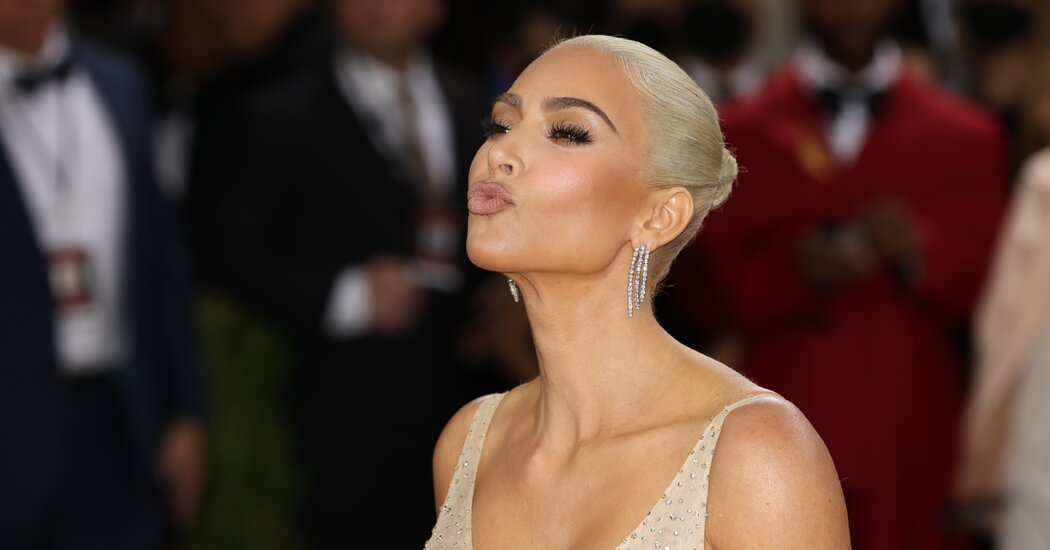
The book is structured around many of these merged identities. There is a meditation on iconography and imitation, centered on Marilyn Monroe and the rabid internet discourse that was provoked by Kim’s decision to wear Monroe’s dress to the 2022 Met Gala. (Was the act disrespectful? Did Kim wish she were Marilyn? How dangerous was the message she sent by the crash diet she undertook to fit into it? Or was it an appropriately iconic moment for an icon of a different generation?)
There is Cleopatra, and Princess Leia. There is Princess Jasmine, to whom Kim has returned repeatedly in costume, and whose symbolism Corey interprets as a fantasy of exoticized femininity that Kim tries on, repeats and refines over time.
Corey’s chapter on the Spice Girls is particularly astute, positioning the 1990s group as a clear predecessor to the Kardashians: a female collective derided as “fake” and “talentless,” manufactured to sell products under the guise of empowerment. Both played on the public’s desire to identify — were you a Posh or a Baby? A Kim or a Khloe? — and managed to earn collective power as well as individual celebrity.
It is tricky to translate years of short-form video content into readable book form. And while Corey’s ambition is undeniable — there’s a chapter that draws connections between Disney, the gulf war and the way Kim presents her ethnicity — and her meta-analysis often genuinely persuasive, it can be easy to get lost in a dizzying amount of scholarship, blended with a sometimes fragmented structure.
Too often, the book can feel like intellectual over-performance, without the conversational tone or playfulness of the original Kolloquium. One wonders if Corey felt the need to prove something on the page, and in that sense maybe she has succeeded — to insist, to all those detractors, that the Kardashians really are worth taking seriously.
DEKONSTRUCTING THE KARDASHIANS: A New Media Manifesto | By MJ Corey | Pantheon | 448 pp. | $30