
Advancing small modular reactor safety research
Alongside CHEMNUS, Prof. Béland also received $240,000 through the NSERC-Canadian Nuclear Safety Commission Small Modular Reactors (SMRs) initiative. This funding will support the development of next-generation computer models and laboratory techniques to better predict how materials used in future SMRs will perform under extreme conditions, with a focus on safety and performance.
His approach combines machine learning, quantum mechanics, and advanced computer simulations with laboratory experiments at Queen’s Reactor Materials Testing Laboratory to recreate radiation damage under reactor-like conditions.
“Many reactors in Ontario are now several decades old and that means some components are being exposed to reactor environments for longer than the time scales where we have direct empirical data,” says Prof. Béland. “A similar issue applies to new small modular reactors which cannot rely on past operating experience. Our combined approach gives us a way to connect fundamental physics to practical questions about safety, performance, and lifetime.”
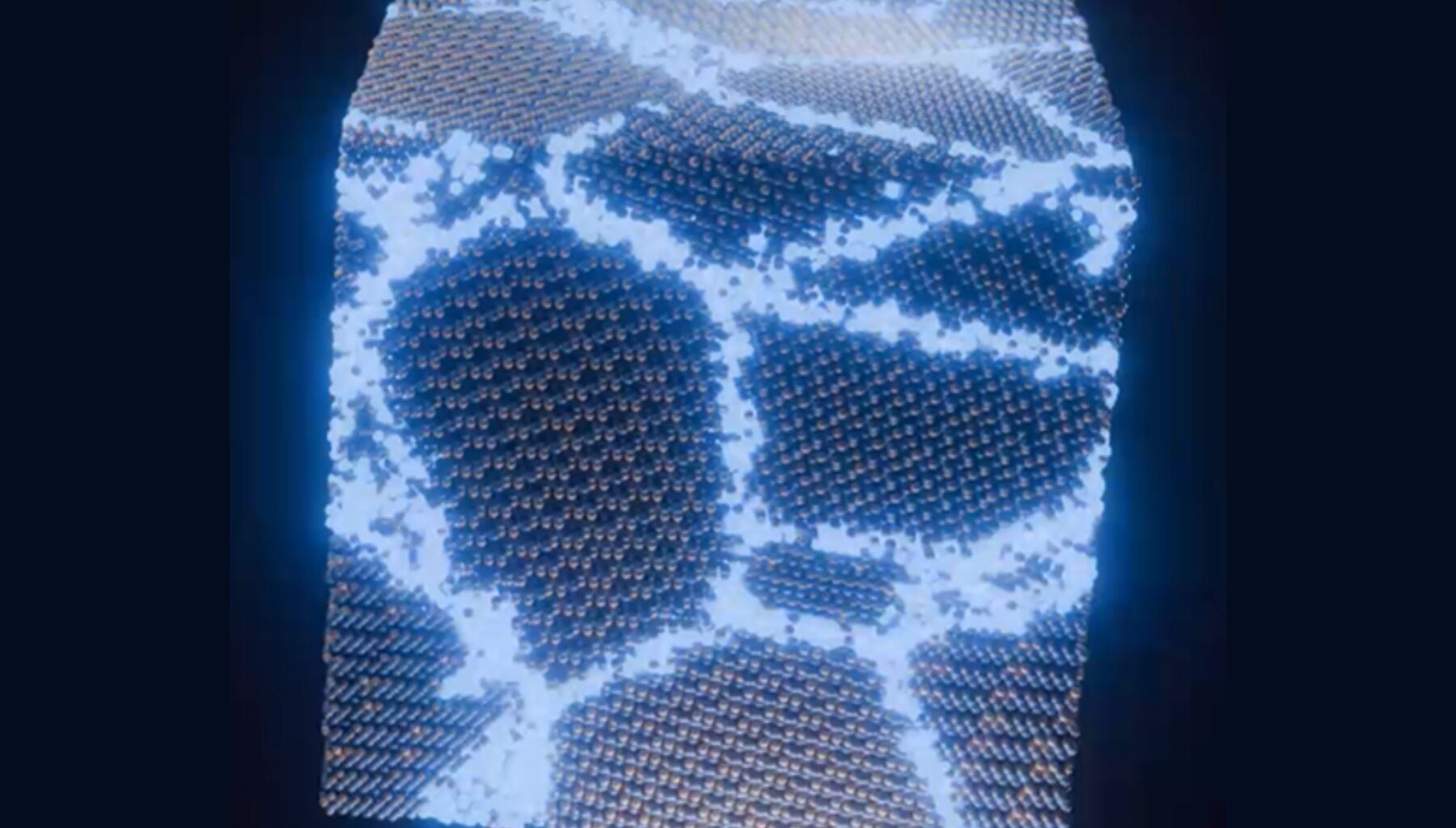
The experiments will mimic conditions inside a reactor using particle beams to recreate radiation damage. Combined with advanced computer simulations that assess radiation at the atomic level, this research will help predict long-term changes in materials, including weakening due to tiny bubbles of gas and changes in chemistry that make metals more vulnerable to corrosion.
Supporting Canada’s clean energy future
For Prof. Béland, the long-term goal of both projects is to help create a stronger and more self-sustaining Canadian nuclear research ecosystem. This includes ensuring students, researchers, industry, and government having the expertise and tools needed to keep advancements at the forefront.
“Science and technology alone will not solve the climate crisis,” he says. “The final decisions are political, economic, and social. What researchers can do is broaden the set of viable options. We can make technologies safer, cleaner, more efficient, and more reliable. That is a meaningful contribution.”
To learn more about Prof. Béland’s research, visit the Béland Lab website.
A total of 21 initiatives were funded this year through CREATE, Collaborative Research and Training Experience, from NSERC. The fund works to develop talent pipelines through large-scale and highly networked initiatives focused on training students and young researchers with the skills and experience needed to thrive in Canada’s evolving workforce.
Queen’s is also co-lead on the Transform Scientific Computing Training to Advance Molecular Modeling in the Age of Artificial Intelligence CREATE initiative announced in this round. The program is led by Dr. Paul Ayers at McMaster University with Queen’s leads Farnaz Heidar-Zadeh (Chemistry), Catherine Stinson (Philosophy), Tucker Carrington (Chemistry), and Ryan Grant (Electrical and Computer Engineering). Additional CREATE-funded programs at Queen’s provide specialized training in medical informatics, cybersecurity, watershed sustainability, clean (bio)tech, photonics, and mobile robots.