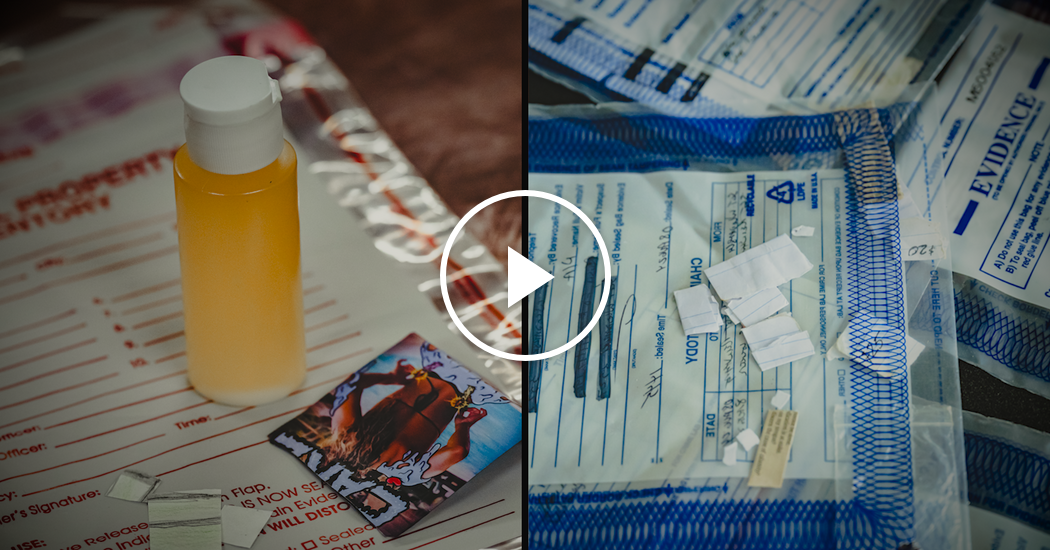
“A new kind of drug crisis is taking over the world. It’s faster, more unpredictable, and far more lethal than what’s come before. And what’s driving it are new types of synthetic drugs, substances that can be made almost anywhere, altered endlessly, trafficked easily, and then consumed in just about any form imaginable. So how in the entire world did we get here? That’s what I’m talking about today with my colleague, Azam Ahmed. An investigative reporter who’s just spent more than a year embedding into every corner of this new criminal world. In his latest piece, Azam spent months reporting on the Cook County jail in Chicago, where a mystery substance was killing inmates in a way that no one ever expected. His reporting lays bare one of the biggest policy failures of our time. How, after 50 years of the drug war, we aren’t just losing the battle, we’re actually contending with a more addictive and deadlier drug epidemic than anything we’ve seen in modern history.” [music playing] “How are you?” “This feels like a lot. There’s a lot of people. Yeah.” “I know.” “It’s a real thing.” “Yeah, I was going to say, it’s really nice to have you here, and not in, like, an opium den or like a narco hut, you know, like the places you like to do work.” “I know. I actually got a haircut.” “You look really good.” “Thanks.” “OK.” “I think you’re good to go.” “Great.” “Anytime you want.” “OK. Azam, welcome to ‘The Daily.’ It’s wonderful to have you here in New York.” “Well, thank you for having me.” “You are here, not only because you have won multiple awards for your investigations. This is true. You can’t deny it. Not only because you are, I think it’s fair to say, a foreign correspondent’s foreign correspondent. Your photo on the wall of foreign correspondents at The New York Times is you climbing through, I think, a jungle with migrants in Mexico. It’s accurate?” “Yeah, yeah. That’s accurate.” “That’s accurate. But because you are in the middle of truly mind-blowing reporting on the new world of synthetic drugs, and I think this is something that none of us, even me, who, you know, I have a special interest reporting experiences in this world really understood until you started to break these stories. So I want to just start with how you got to this. What drew you in to these stories?” “Obviously, we worked together in Mexico. And in Mexico, you’re constantly looking at the repercussions of the war on drugs. You’re looking at countless lives lost. You’re looking at inordinate amounts of drugs, fentanyl, moving north into the United States. You kind of see the mechanism of failure up close. And if you’re not careful, you’re just constantly just in that space. Reporters like you and others have figured out a way to be more global about it. But for me, I kind of was stuck with this feeling like, we all know the war on drugs has failed. We also know, like, it not only failed, it kind of made things worse. How do you write about that? How do you conceptualize it in a way that brings not only the story forward, but talks about what’s happening? And you realize, fentanyl, meth, two of the first sort of synthetic drugs were out there, basically, they were harbingers of this sort of dystopian future that is upon us. For most of human history, drugs have been grown in the land. When the war on drugs was first declared by President Nixon, there was cocaine, marijuana, heroin.” “Yeah, the big ones.” “Now there’s, like, 1,450 new psychoactive substances.” “Is that a real stat?” “That’s a real stat from U.N.O.D.C.” “Yikes.” “It’s gone up, it’s tripled in the last decade. I mean, the number of new drugs that are coming out, it’s like chef’s testing new recipes, because it’s all synthetic now. It’s made in labs. And you can basically turn a molecule and change it in all these different ways and have a completely new drug, which basically leads to the major point that they are largely more potent, more deadly, easier to manufacture, easier to smuggle, harder to track, harder to treat, and more profitable than almost any time in human history.” “What you’re describing is the kind of beginning of something, but that beginning is really important. This idea that you get a drug, like fentanyl, 50 times more powerful, I think, than heroin. It’s really compact. It’s really easy to transport. It’s really easy to make. You can make it, I saw, in a kitchen in Sinaloa. Randomly, you can open a lab anywhere. There is a kind of revolution that happens with that first step.” “Exactly. And I think, for good reason, we in the United States look at fentanyl as almost the end-all, be-all because of how many — I mean, these massive numbers of death. Like, we’re not accustomed to that. It’s so pervasive. And yet, I think the scariest thing about the reporting is like, that is not the end-all, be-all. That is a harbinger of, as I said, the dystopian future to come. There are now new drugs much more powerful than fentanyl that are popping up, not just in the United States, but all over the world.” “OK, talk about that. I want to hear about that.” “So a drug called nitazenes can be 20 to 40 times more potent than fentanyl.” “What are nitazenes?” “Nitazenes are essentially like fentanyl, a pain reliever. They’re an opioid that was created in the 1950s by a Swiss pharmaceutical, but turned out to be so potent that it didn’t really have a natural market. And so it never went to market. And then somebody basically, as this sort of fentanyl crisis was unfolding, mined some archive and found the formula for making nitazenes, and they started producing it. Once they started producing it, they now have like a dozen different variants of nitazenes that have been discovered all over the place. You’re finding them in the United States. You’re finding them throughout Europe. And one of the reasons you’re finding them in Europe is because fentanyl has been so controlled and so tightly managed — and this is important because this is the heart and center of why the drug war kind of made everything worse. So you’re like, shit, we got to do something about fentanyl. This is killing way too many people. Let’s control the precursor chemicals. Let’s stop, let’s pressure Chinese pharma from making this stuff. Let’s crack down on the Mexican cartels. Great.” “This is the approach of the drug war. It’s to focus on enforcement, to focus on supply.” “Supply. To focus on the supply side. And then they’re like, oh, cool. OK, we’ll just come up with something else. So now they’ve made nitazenes available on the market. And that is gradually expanding and more people are dying from it. But now there’s things that are even going to replace nitazenes that are popping up in certain places. That is the thing about synthetic drugs.” “Basically, what you’ve described is the idea that regulation just breeds innovation.” “Innovation. It’s one of the most entrepreneurial markets in the world. I mean, they find new ways, because as long as you have demand, someone’s going to figure out how to supply it. Because if it’s restricted, it’s going to be lucrative. I mean, we’re looking at a totally different universe.” “So now I want to talk about your latest investigation that just came out that talks about the Cook County jail, because I think it really illustrates just how much these drugs are changing. Walk me through that story.” [music playing] “So in January 2023, jail authorities are called to the scene of a dead body. And they show up, and there’s this inmate who basically has died from some kind of overdose, but they can’t find anything. There’s no contraband. They just find all these little paper roaches scattered around like burned confetti. And they’re kind of mystified by what this is, but it’s clear the guy’s overdosed. And it sort of launches them on this incredible odyssey where they start having these deaths and these crazy overdoses, people going into almost these exorcistic fits, having seizures, and they’re watching them on camera. And then it clicks. They’re like, oh, my god, they’re smoking paper. They’re literally smoking paper. And they realize what’s happened is someone has figured out how to turn synthetic drugs into liquid, soaked sheets of paper into it, and then smuggle paper into the jail. Now, paper is the most ubiquitous thing in the world. It’s been around since ancient Egypt. How do you stop paper?” “Well, so just to back up. What is on this paper? Like, do they know? You’re describing the exorcistic fit, and I’m wondering what causes that.” “At the time, they don’t know what’s on it. They would find someone high or maybe find someone dead. They would get a toxicology report of the person who died to figure out what they might have smoked. They would also find paper within the jail facility itself, and they’d send that off to get tested. And a few months later, they’d know it would be anything from cannabinoids to sometimes fentanyl, all different kinds of synthetic substances. I mean, at some point they were finding recipes for Raid and rat poison. So there was all this stuff was happening at the same time. And then in August of 2024, they found this sheet that I started to refer to as the Rosetta Stone because it had 10 different synthetic drugs on it.” “Whoa.” “Which didn’t make any sense. It’s like, why would anybody — because it was cannabinoids. It was opioids. It was all different sorts of things that have different corporal implications. They affect you. The high is different.” “And so just to understand the Rosetta Stone, which is, by the way, a crazy image, is it 10 different substances all in different quadrants or?” “No, they’re overlapping.” “Wow.” “Basically, the best we could figure is somebody had a bunch of chemicals they were spraying on paper, and they just wanted to get rid of them all. So they dumped them all on one sheet, and that went in. I mean, from your reporting on fentanyl, there’s not really a calculation of how deadly this could be, how potent this is going to be. I mean, they were testing it on chickens in Mexico.” “Yeah, I know. I was going to say, to the extent that there’s a calculation, the calculation is, how bad can we make this? Meaning how potent, how strong. Because obviously, potency is really valuable to not just dealers, but to producers.” “Completely. That’s exactly right. It’s, the more potent, the less I have to smuggle.” “Correct.” “The less risk I take. The more potent, it’s usually cheaper, too.” “You get — whatever. It’s like the bang for the buck phenomenon.” “So, OK, how do they go about actually understanding, like, how to stop it?” “The lead criminal investigator inside the jail is this guy named Justin Wilks. He’s like you’re sort of central casting of a Midwestern nice guy. He’s avuncular. He has glasses. He never curses. Instead of using words like ‘ass,’ he says ‘keister.’ I mean, in a jail environment, that’s pretty exceptional.” “Did you have to censor yourself around him?” “I mean, I felt — initially, yeah, I felt self-conscious. I curse a lot. So I was like, is he going to judge me for this? Is he going to keep talking to me if like — he corrects me by saying ‘keister?’ So they start with things like sensing the texture of soaked paper. In the mail, books would be coming in, photographs from families, letters from loved ones. All of these things suddenly became like, how do we have a process wherein where we search for this and know what we’re looking for? So guys would start wearing gloves and going through pages of every individual piece of mail by hand.” “This is crazy to think about someone just like holding a piece of paper and feeling it and smelling it to be like, are there just extremely deadly drugs on this thing.” “Exactly. Could this kill people in jail.” “Horrifying.” “Completely. I mean, what’s even more horrifying is imagine the guy or the girl who’s taking that into the jail, who is going to give a sheet of paper a second look? A cop pulls you over and sees a bag of coke. He’s like, all right, you’re going to jail. Cop pulls you over and there’s sheaf of papers, it could be for anything. Nobody’s going to give that a second look. So they are basically like, how do we get rid of paper? The sheriff of Cook County calls around to other jurisdictions facing similar problems, because now this is becoming a nationwide phenomenon. I mean, I found instances of 14 different states that have had some kind of prosecution for drug-soaked paper in carceral facilities.” “So it’s not just Cook County?” “Yeah, it’s all over the place. So some of these places have decided, we’re going to ban paper outright. And he’s like, I didn’t want to do that.” “Why?” “The thing about paper is, it’s a lifeline for people in jail. It’s not just administrative numbers and menus or whatever else they use paper for. It is a letter from a child to his father. It is a note from a mother to her son. It is the thing that tethers you to the world outside of this dark space of privation that is the Cook County jail. So they start kind of figuring out how to deal with that. But lighting this. How do you light paper in prison? Lighters have been banned for ages there.” “Yeah, so?” “You can’t sneak that in. So there’s this photo we have of an air duct with these almost burn marks around the ventilation. They braid rolls of toilet paper into these tight braids. They then get something like a potato chip bag, which has a foil lining on the inside, put it in a microwave, turn it on so that a spark flashes. It ignites this roll of toilet paper, and it’s braided so tightly that it burns slowly. They then take these so-called wicks, and they feed them down ventilation shafts so that they slowly smolder. So you can basically pop off the ventilation shaft, pull out the wick, light your paper, drop it back down. They can burn for days.” “This is insane. OK, I want to ask about what the experience of actually doing it is. I mean, I think part of the other thing that a lot of people who don’t use these drugs don’t understand is what is attractive about the feeling. So just walk through the implications of people rushing to use a substance that is life-threatening.” “Completely.” “What is happening there? What’s the psychology of that?” “It’s one of the most baffling things for a non-using public to understand about the mentality of drug use. And it is that death is not dissuasive. Someone dies and our reaction is like, oh, my god, why would anybody ever touch that? But if you are a user, you’re like, that must be really strong. And I remember having conversations with people in the jail. One guy that I spent a lot of time with was Rashad Rowry. He had previously smoked paper, but had now sworn it off and hadn’t been using it, but he was a really thoughtful, charismatic guide into why people use it and how they use it. And just describing both the desperation, but also the implications and physical effects of using the drugs.” “I think we have that tape. Mustafa, will you play it so we can hear it?” “I got addicted to how it made me feel. I got addicted to not caring. It’s like I can get on the phone, and hear some bad news, and go smoke. It’s hard being in jail. I’ve been here 11 years. And yeah, it’s hard. And when you get high, it’s just like, whatever. Sometimes when you get high, you don’t even care about going home. You don’t care. Like, seeing people die is not even really why I’ll stop. It is what it is.” [end playback] “He’s saying it.” “Yeah.” “That’s — yeah.” “Yeah, I mean, I couldn’t have asked for a better person to describe that phenomenon. And to finish the thought he was starting with is like, he basically said, he’s like, well, just because that guy dies doesn’t mean I’m going to die. And I want something potent. I want something that’s going to knock me out. There’s also a huge component of these crises of tolerance. Your body quickly adapts to whatever toxins it’s putting into it, such that you need more. So if you’re a regular user, and you know there’s a heavy pack and somebody died, and your objective is to escape in as profound a way as you can, like a portal out of the misery of jail and all the trappings of life that entails, you move towards it, not away from it.” “And you might be saying, well, that person who died, they just weren’t used to it. They were soft. They weren’t like me.” “Exactly. So in the jail, they start with 24-hour surveillance, because they want to catch more of these overdoses faster. There has been criticism that they weren’t reacting fast enough, that they weren’t following their own protocols about when they were supposed to be checking on inmates. So they made sure they were following all the protocols, monitoring this in a much more comprehensive way. And then in reviewing the tapes, they find there’s this one prisoner who had basically been caught with paper stuffed in his anus, right? Which they refer to as the ‘jail wallet.’” “The ‘jail wallet.’” “The ‘jail wallet.’ Euphemistically known as the ‘jail wallet.’ So they catch him, and he’s been prosecuted for having this, but they start wondering, well, how did he get it? So they look at every single one of his prison visits for an extended period prior to him being busted in the jail with this paper. And they realize that over the course of months, his girlfriend who had come to visit him would always slip him paper. They’re like, oh, wow.” “Oh, my god. So she was slipping in paper, like, what?” “Because it’d be like me and you sitting here talking. They would have visitation hours. Someone would distract the guard and she would find a way to get him paper.” “Wow.” “Again, it’s not like a dog is going to pick up that smell. At the time, they might not have even known what they were looking for.” “Yeah, yeah.” “So another detective, this guy, Adam Murphy, he shows up at the girlfriend’s house, and he basically just gets her to talk. And she describes this whole network of all these different prisoners with girlfriends who are all coming and visiting and doing the same thing. And it all ties back to this one dealer operating out of the South Side of Chicago. And so they get on this huge case. They’re like, wait a minute, we actually know who’s behind this. So they start tracking this guy. They realize he has this huge stash house in the south of Chicago. They’re like, this is big. We’ve actually found a guy who is doing stuff across state lines. He is what we believe to be the single biggest supplier to the Cook County jail of drug-soaked paper. This guy is like a paper baron.” “That’s crazy. All from the girlfriend.” “All from the girlfriend. So we follow this case for almost a year, until finally, I’m there when they arrest the main figure.” “Wow.” “We’re all barreling down this suburban street. They pull up in front of this house with one of these signal blocker trucks. Somebody bashes down the door. They send a drone in to search the house.” “No.” “And then everybody floods in because the guy’s not there.” “Whoa.” “And it’s crazy because it’s like this new drug bust. They come out carrying these amber bottles filled with chemicals and like sheafs of paper. This guy has a postal setup in his house with prepaid envelopes to send drug-soaked paper to different places, presumably. And I think it’s just this dude operating out of there.” “That’s so wild. OK, so they find this guy —” “They find this guy, they bust him, he gets arraigned. And I go back to Cook County. And I’m like, wow. A year later, here it is. You’ve busted the biggest paper pusher in Illinois, presumably. What’s going to happen? And in my mind, I guess I already kind of knew. I was like, this isn’t going to change anything. It’s every time we take down a kingpin, it ranges from bad to worse, the response to it. I mean, our time in Mexico, every time they killed one of these capos, they announced it with this saber rattle of, look, we did it again. And every time, there would be a fight for control, there would be more violence. Worst case scenario, it would be the hydra effect where they cut off the head, multiple heads sprung up, and then you just had disorganized chaos. The theory being, if we break them into smaller groups, local law enforcement can take care of it. But that didn’t happen. In the same way they bust this guy, and I’m talking to Justin, the investigator, and he’s like, did we solve a mystery today? Yes. Did we solve the mystery? Do I think this is going to change the phenomenon or they’re pioneering? He’s like, no.” “So after all that, he basically recognizes, yeah, this is a win for us, but this is nowhere near the end. Doing this is not going to solve the problem.” “This is another spoke in the turning wheel.” “So, I mean, did that pan out?” “It did. It did. A couple months later, I checked in on the data, and they were like, we’re having the same number of overdoses. They now have something that’s five times more potent on paper there. But also around that time, they found new ways and novel ways in which they’re getting the drugs in. People had figured out how to use Amazon to send drug-soaked paper into the jail.” “Through Amazon?” “Through Amazon. Basically, someone would register as a third-party seller, would have a drug-soaked book, list it on that, and then the person would buy from that direct seller, thereby laundering a drug-soaked book through Amazon and Amazon packaging, which made it incredibly difficult because prior to that, jailhouse authorities were like, we don’t have to worry about that. It’s coming from Amazon.” “That’s crazy. What an image.” “It was just that kind of — I wouldn’t say perfect, but that representative microcosm of the catch ’em here, they move there. This game, this quixotic game of whack-a-mole that they continue to play as they find new different — we’re going to crack down on that, OK, they’re going to do something else. We’re going to crack down on this drug, OK, we’re going to get another drug. And this is in the most controlled setting you can imagine.” “Yeah. The innovation is happening.” “Everything is a right now, as of now. Maybe you do manage to crack down on fentanyl as a powder. Maybe you innovate in some law enforcement way that is perceived as a tremendous, astounding victory, only to herald the arrival of paper as the primary modality of drug abuse. And then you’re — yeah, again, that would be in fitting with the pattern that it kind of just keeps getting worse. So on the streets, you can still score fentanyl. You can get a cannabinoid vape instead of having to smoke it on paper.” “It’s very easy.” “So you don’t have it transferring yet, but it could. It wouldn’t be out of the realm of possibility. And that, I think, is what scares them the most. Because if they’re having a hard time controlling that in a jail setting, which of carceral institutions is one of the most closely controlled ones, even more than prisons in some cases, what happens when that hits the street?” “OK, so now that you have your arms kind of wrapped around just how bad this new synthetic drug epidemic really is, just how much invention and reinvention is kind of built into it, I want to ask, and I want to turn to the question of, what do we do now? Because I think a lot of people who hear this, and who have not spent more than a year covering it, are going to be wondering, like, how do we stop this? What is the path?” “It’s funny, as journalists, we try to stick with like presenting what’s happening. But you can’t help but think about, what’s the road that led us here? Is there a road to lead us out? Or are we kind of trapped in this cyclical framework where we just keep doing more of the same thing? And that is the inescapable feeling, especially with this administration, which has opted to kind of kick more ass, so to speak, against drug cartels, and smuggling, and all of that, is that that hasn’t worked. You might see the Mexican police motivated to bust a narco, but we’ve busted a lot of these guys before, and all it does is just, a new kingpin emerges. So perfect example of this. One of the stories that I’m working on is in Myanmar, and Thailand. Authorities are seizing more than double the amount of meth that the U.S. authorities are seizing at the southwest border with Mexico. I mean, they’re producing quantities in Southeast Asia that would put the United States and Mexican cartels to shame. It’s like 200 tons in one year. That’s what they seize.” “Crazy.” “So you’re like, how is this even possible? So I started looking into this, wondering, how are they finding so much of it? How are they even making so much meth? And if you talk to the experts, they’re like, you know what the weirdest part about this is? We’re not finding precursors anymore. We start looking into this, and it turns out somebody has figured out how to use industrial legal chemicals to produce these precursors that are then used to make meth. Some of the chemicals are incredibly common because they’re used in incredibly common household purposes, like plastics, perfumes, things that are used literally every day in every country across the world.” “Wow.” “So it’s not only that they’re legal, but they’re also omnipresent.” “So criminals, I assume, are making the precursors that you use to make meth.” “Yes. And with ingredients that basically cannot be stopped.” “And just to say, the idea that these criminals have figured out how to make these precursors is amazing, because everybody knows, if you are able to move up in the chain of production, if you can own the means of production, you can make it yourself, that gives you so much more control. It’s just so much more difficult to stop it. I mean, just the mere fact that you found criminals who were doing this on an industrial scale, I mean, that is terrifying. We should just pause and say, that is scary.” “Yeah.” “That’s like a level of advanced drug production that, I mean, I had never heard of.” “We have kind of woven our own nightmare scape. Like, what do you do when they have finally pioneered to the point where they are farther up the chain, but more importantly, where you can’t ban the substances they’re using anymore?” “Crazy.” “It’s so staggering because the drug world didn’t change that much. For most of human history, it’s been one thing. And now, since it’s gone synthetic, there are just so many different ways to use chemistry to expand, and profundicize, deepen the world of illicit drugs.” “What about the other option? The alternate route here from the one that the drug war has taken, addressing demand.” “Yeah, legalization, or decriminalization.” “Or any way of, yes, of getting at the consumption side. The fact that in Mexico, the idea that you’re going to stop drugs from being produced without dealing with the fact that the largest consumer market in the entire world sits right on top of this country, on its border, is sort of laughable. What about those methods? How do you see that? Is that a potential way forward here?” “The thing that struck me is, this whole framework around legalization, decriminalization, we have been talking about it for so long. There’s a few countries that have done it, like Portugal, but by and large, experiments in this have been few and far between. And it’s mostly just been a talking point among progressives. The problem is, it’s too dangerous to have a decriminalization procedure that creates a wider array of availability for things that chemists, and scientists, and doctors themselves don’t know the human implications. Nitazenes has never been tested in a medical setting for any long period of time. We’re still arguing about a paradigm that might have worked when there were just three or four drugs we were worried about. Now we’re worried about 1,400 and counting.” “So what you’re talking about is a situation where, like, maybe decriminalization could have been a solution in beforetimes, but we’re not in beforetimes. The horse is out of the barn, basically.” “Exactly. That’s exactly what I’m saying. So I think to answer your bigger question, which is what do we do? If you talk to a lot of scientists, they’ll be like, yeah, I don’t think legalization is the way or decriminalization is the way to go either. You should have elements of this, like harm reduction, for instance. That is an important component of this that Europe is really focused on. And harm reduction is basically what it sounds like. We understand people are going to use drugs. We understand that we’re never going to be able to fully reduce all of the demand. So how do we keep deaths and serious injury from happening?” “That’s interesting.” “We swap needles, right, so no one is sharing needles. H.I.V. rates plummet. We issue Narcan everywhere so that if your friend overdoses, you give them a shot of Narcan, you revive them, they don’t die. We pass laws that are like, if you call the cops, or rather the authorities because your friend is overdosing, you’re worried they’re going to die, we’re not going to prosecute you or send you to jail, because that then means fewer people will die.” “It’s treating it as a public health crisis and not a criminal problem.” “Exactly, which is something the United States has always struggled with.” “It sounds like what you’ve learned is that we don’t have the language to describe what we’re seeing. And so a first step is to just, all of us, wrap our minds around what this is and really change our entire framework of thinking about it.” “I think that’s right. I think it’s also just looking at it with, like, dispassionate, brutal honesty, which has always been hard for us. We are still thinking that blowing up boats or targeting kingpins is going to stop this, and it’s clearly not. You can have little bits of pressure, and maybe that can even be a good thing to force the Mexicans to actually do something about this gigantic industry within their borders, but that’s not going to solve it. We are still getting this kind of retrograde rhetoric coming out of the White House, and other corners of the U.S. government, about cracking down more. We’ve never needed more creative thinking about this problem because it’s never been more dangerous or creative. We’re kind of moving in opposite directions on one of the most costly issues of our time.” “Well, on that depressing note —” “Yeah, not happy stuff.” “I mean, I do think that one of the things that you’re doing with this reporting is forcing us, honestly, to look at this thing with very clear eyes and to understand that we are that society that’s in the throes of an addiction crisis, and that it is happening in ways that I don’t think any of us expected it to. And I don’t know if any of us really totally understand. So I’m going to be, obviously, waiting to see what you come up with next. And I’m excited to read — ‘excited’ is the wrong word. I will be glad once I have understood the extent of this through you and through your reporting. So thank you. Thank you so much for being on the show.” “Oh, thanks for having me.” [music playing]