
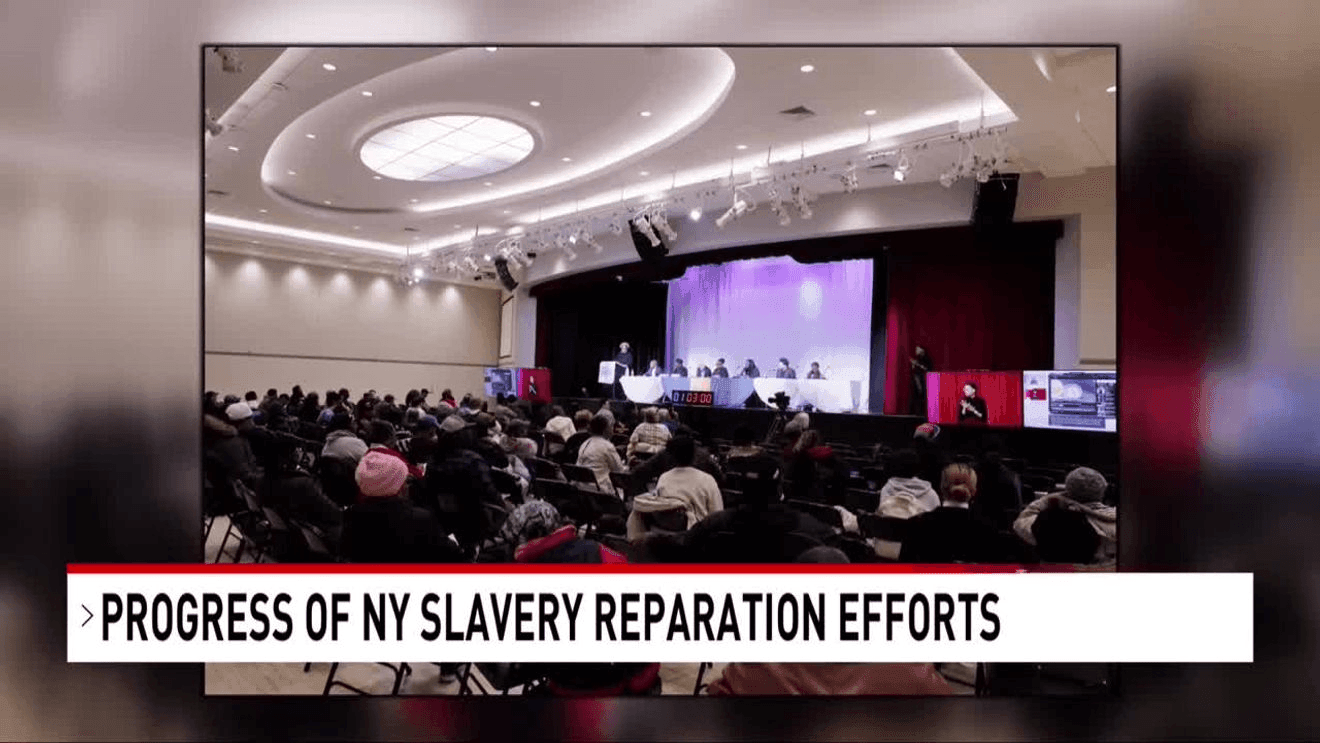
Albany, NY (WRGB) — A year after their report was pushed back until 2027, New York’s Reparations Commission now has until 2029 to issue its findings and recommendations. This was first reported by The Gothamist, included in the “State public protection and general government budget for the 2026-2027 state fiscal year” budget bill.
The legislation reads: “The commission shall submit a written report of its findings and recommendations to the temporary president of the senate, the speaker of the assembly, the minority leaders of the senate and the assembly and the governor not later than [thirty] fifty-four months after the date of the first meeting of the commission held pursuant to subdivision c of section four of this act.”
The Commission was signed into law at the end of 2023, and after appointments were made, first convened on July 30th, 2024. $5 million was allocated in a previous State budget for the Commission’s work.
In a statement, Dr. Seanelle Hawkins, Chair of the New York State Community Commission on Reparations Remedies, saying:
“The New York State Community Commission on Reparations Remedies continues to host public hearings and business meetings across the state. We encourage all New Yorkers to share their voice and engage the commission, in-person or virtually, at the upcoming hearing in Harlem on May 30. Since its charter, the Commission has hosted more than 30 public meetings, education workshops, and business sessions in more than 20 cities across New York. To date, the Commission has collected over 200 hours of testimony from all manner of New Yorkers, which will be incorporated into the Commission’s final report. Additional updates are available on social media @NYSCCRR.”
CBS6 reached out to the bill sponsors, but have not heard back as of this report.
In Albany, the Center for Law and Justice has been gathering their own feedback and comments to provide for the Commission to consider. Executive Director Ta-Sean Murdock says he’d disappointed at another delay.
“I think we’re continuing to see steps backwards, and not only just in the elimination of history, but really in all the work that we have done to get to this point,” Mudock says. “We see the changing in voting laws recently by the Supreme Court. This is another instance where we’re starting to see, you know, while some might argue, well, this isn’t a big deal, it’s just 2029, I would say to you that this is just the start to a potential where are we going to say next that the Commission is eliminated and there’s no need for it, so we really have to be on par for some of the steps that may not look like a big deal that can actually become a big deal.”
Murdock also spoke to the feedback they’ve received regarding “reparations”, including its definition, and who it should apply to.
“One of the things that we found is community healing was one of the top discussions,” he said. “The stigma around reparations, most people will say, well, ‘people of color just want money’, and what we’re finding through our work is that is actually not the case. People want to live in better communities, where there’s support and healing for those communities, and that will really get into the root causes of trauma for things like violence and poverty, and all of those things that communities of color deal with, and so we found that, and again we’re hoping that the information that we provide around the community healing work could be helpful, and will be helpful.”
Last year, CBS6 spoke with Dr. Seanelle Hawkins, you can watch that full conversation here: