
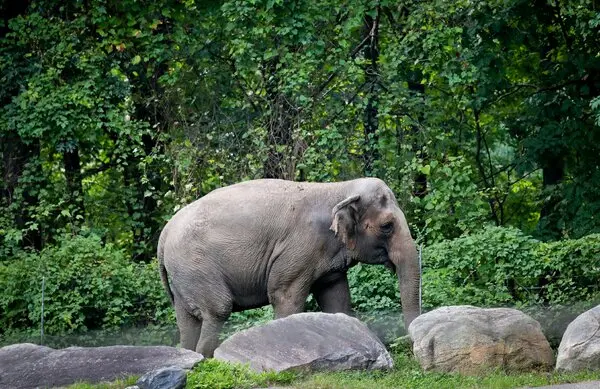
Happy, the 55-year-old Asian elephant whose decades-long confinement at the Bronx Zoo sparked a landmark legal battle over animal personhood, was euthanized on Tuesday following a rapid decline in her health.
The Wildlife Conservation Society confirmed that the pachyderm was put to sleep after severe age-related conditions, including crippling arthritis and inoperable uterine tumors, critically compromised her quality of life. Happy’s death brings a tragic conclusion to a life defined by extraordinary scientific discovery and profound legal controversy. As the central figure in a fiercely contested habeas corpus lawsuit, her existence forced the global judicial system to confront the ethical boundaries of keeping highly intelligent, socially complex creatures in permanent urban captivity.
The Mirror Test and Cognitive Breakthroughs
Born in the wild in Asia and captured as a calf, Happy arrived at the Bronx Zoo in 1977. For decades, she entertained millions of visitors, but her true legacy was cemented in 2005 during a groundbreaking cognitive study. Researchers successfully demonstrated that Happy possessed self-awareness, a trait previously thought to be exclusive to humans, great apes, and dolphins.
During the experiment, researchers painted a visible mark above Happy’s eye. When placed in front of a massive mirror, she repeatedly touched the mark with her trunk, proving she recognized the reflection as herself rather than another elephant. This revelation sent shockwaves through the scientific community, irreversibly altering the human understanding of elephant neurobiology and emotional capacity.
Veterinary neurologists argue that this level of cognitive sophistication makes the psychological toll of captivity exponentially more severe. Elephants in the wild traverse dozens of miles daily within deep, matriarchal family structures. Confinement in a one-acre urban enclosure, they argue, constitutes a form of psychological torture for a creature capable of profound grief, memory, and self-reflection.
The Legal Battle for Personhood
Happy’s demonstrated intelligence became the bedrock of a revolutionary legal campaign spearheaded by the Nonhuman Rights Project. The organization filed a writ of habeas corpus on her behalf, arguing that her cognitive abilities entitled her to the fundamental legal right to bodily liberty, and demanding her transfer to an expansive sanctuary.
The case escalated to New York’s highest court. In a deeply polarizing 5-2 decision, the judiciary ultimately rejected the activists’ claims, ruling that while elephants are highly intelligent beings deserving of compassionate care, they do not possess the legal status of “persons” equipped with constitutional rights. However, the scathing dissenting opinions issued by two judges remain a watershed moment in jurisprudence, powerfully condemning the morality of her continued confinement.
Happy lived for nearly 50 years in captivity after being captured in the wild.The 2005 mirror test proved she possessed advanced self-awareness.The New York Court of Appeals ruled 5-2 against granting her legal personhood.Patty, a 57-year-old female, is now the final remaining elephant at the Bronx Zoo.The Kenyan Conservation Perspective
The tragedy of Happy’s life in a New York enclosure resonates powerfully across East Africa, the frontline of global elephant conservation. In Kenya, organizations like the Kenya Wildlife Service and the Sheldrick Wildlife Trust operate under the fundamental belief that elephants belong entirely to the wild. The Amboseli ecosystem stands as a testament to the complex, multi-generational societies these animals build when free from human cages.
For a reader in Nairobi, the concept of a solitary elephant dying of tumors in a concrete American metropolis represents the absolute failure of the archaic Western zoo model. African conservationists have long lobbied international bodies to ban the export of wild elephants to foreign zoos, arguing that no artificial enclosure can replicate the ecological and social necessities of the African savanna or Asian jungles.
The Future of Urban Zoos
Happy’s passing forces a brutal reckoning for the global zoological industry. The Bronx Zoo’s parent institution, the Wildlife Conservation Society, announced two decades ago that it would cease acquiring new elephants, acknowledging the mounting ethical pressure. Now, the zoo faces intense scrutiny regarding the fate of Patty, the 57-year-old sole survivor left in isolation.
Industry advocates argue that urban zoos serve a vital educational purpose, inspiring conservation funding from populations utterly disconnected from nature. They point to the exceptional veterinary care and millions of dollars invested in habitat enrichment.
However, a growing consensus of biologists and ethicists insists that the era of the mega-fauna exhibit is over. The science is incontrovertible: animals with the capacity to recognize their own reflections possess an undeniable right to exist beyond the boundaries of human entertainment. Happy’s life was spent in a cage, but her legacy will undoubtedly dismantle the bars for generations of animals to come.