
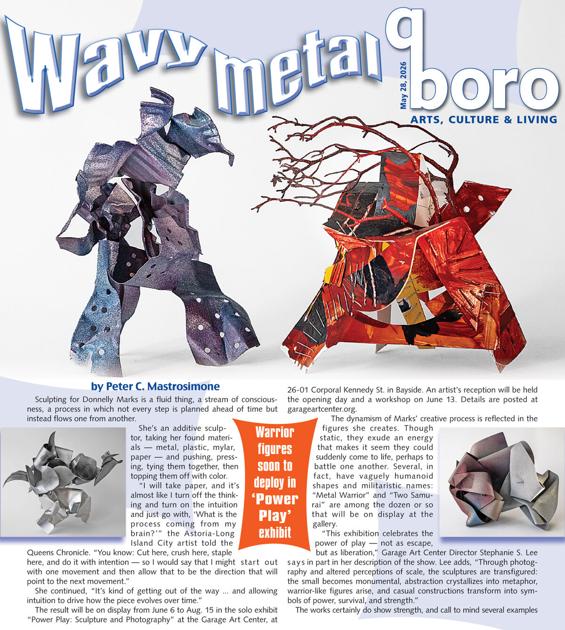
Sculpting for Donnelly Marks is a fluid thing, a stream of consciousness, a process in which not every step is planned ahead of time but instead flows one from another.
She’s an additive sculptor, taking her found materials — metal, plastic, mylar, paper — and pushing, pressing, tying them together, then topping them off with color.
“I will take paper, and it’s almost like I turn off the thinking and turn on the intuition and just go with, ‘What is the process coming from my brain?’” the Astoria-Long Island City artist told the Queens Chronicle. “You know: Cut here, crush here, staple here, and do it with intention — so I would say that I might start out with one movement and then allow that to be the direction that will point to the next movement.”
She continued, “It’s kind of getting out of the way … and allowing intuition to drive how the piece evolves over time.”
The result will be on display from June 6 to Aug. 15 in the solo exhibit “Power Play: Sculpture and Photography” at the Garage Art Center, at 26-01 Corporal Kennedy St. in Bayside. An artist’s reception will be held the opening day and a workshop on June 13. Details are at garageartcenter.org.
The dynamism of Marks’ creative process is reflected in the figures she creates. Though static, they exude an energy that makes it seem they could suddenly come to life, perhaps to battle one another. Several, in fact, have vaguely humanoid shapes and militaristic names: “Metal Warrior” and “Two Samurai” are among the dozen or so that will be on display at the gallery.
“This exhibition celebrates the power of play — not as escape, but as liberation,” Garage Art Center Director Stephanie S. Lee says in part in her description of the show. Lee adds, “Through photography and altered perceptions of scale, the sculptures are transfigured: the small becomes monumental, abstraction crystallizes into metaphor, warrior-like figures arise, and casual constructions transform into symbols of power, survival, and strength.”
The works certainly do show strength, and call to mind several examples of it, from popular fiction to fine modern art.
Marks herself sees echoes of the kaiju, the Japanese movie monsters epitomized by Godzilla, in some of them.
When she takes the power of the creative process and turns it into figures, she finds that “they’re referencing those powerful Japanese monsters.” And, she adds, “They have energy, they are for good.”
The viewer might also see in them echoes of the Transformers, especially in their later, less boxy shapes: Think the title character in the 2018 movie “Bumblebee.”
One piece, a figure that makes up half of the work “Two Samurai,” calls to mind the Ents in the film version of “The Lord of the Rings” as they withstand the onrush of a river flood. Twigs that arise from the top of the figure appear to be blowing branches, bent by a wuthering wind.
How did they get incorporated into the work? “I pruned a little cherry tree I have and I looked at the pieces and I’m like wow, those are pretty cool looking,” Marks said.
“Two Samurai” and many of her other warrior figures are small, less than 6 inches tall, but that’s where the photography comes in, much as it did with models in films such as the original “Godzilla.”
“I enjoy the ambiguity photography can create, playing balance, perception and scale where a piece 4 inches tall appears monumental,” Marks said. “The ‘Two Samurai’ would be a good example.”
Aside from science fiction and high fantasy, Marks’ warrior figures also echo a notable work of modern sculpture from more than a century ago, one taught in many an art history class: Umberto Boccioni’s “Unique Forms of Continuity in Space.”
The 1913 Futurist sculpture, later cast in bronze, depicts a striding figure “who forges ahead as if carved by speed,” as the Museum of Modern Art says in its online entry on the piece. MoMA goes on to link the work to an even more vital masterpiece: “While born of Futurist aspirations, it also remains evocative of an ancient statue: the wind-swept, striding Victory of Samothrace in the Musée du Louvre in Paris.”
The outer power of art, from Samothrace through “Two Samurai,” is, for Marks, also within: “For me, making things is a very powerful healer and coping mechanism and I feel like there’s a power in that.”