
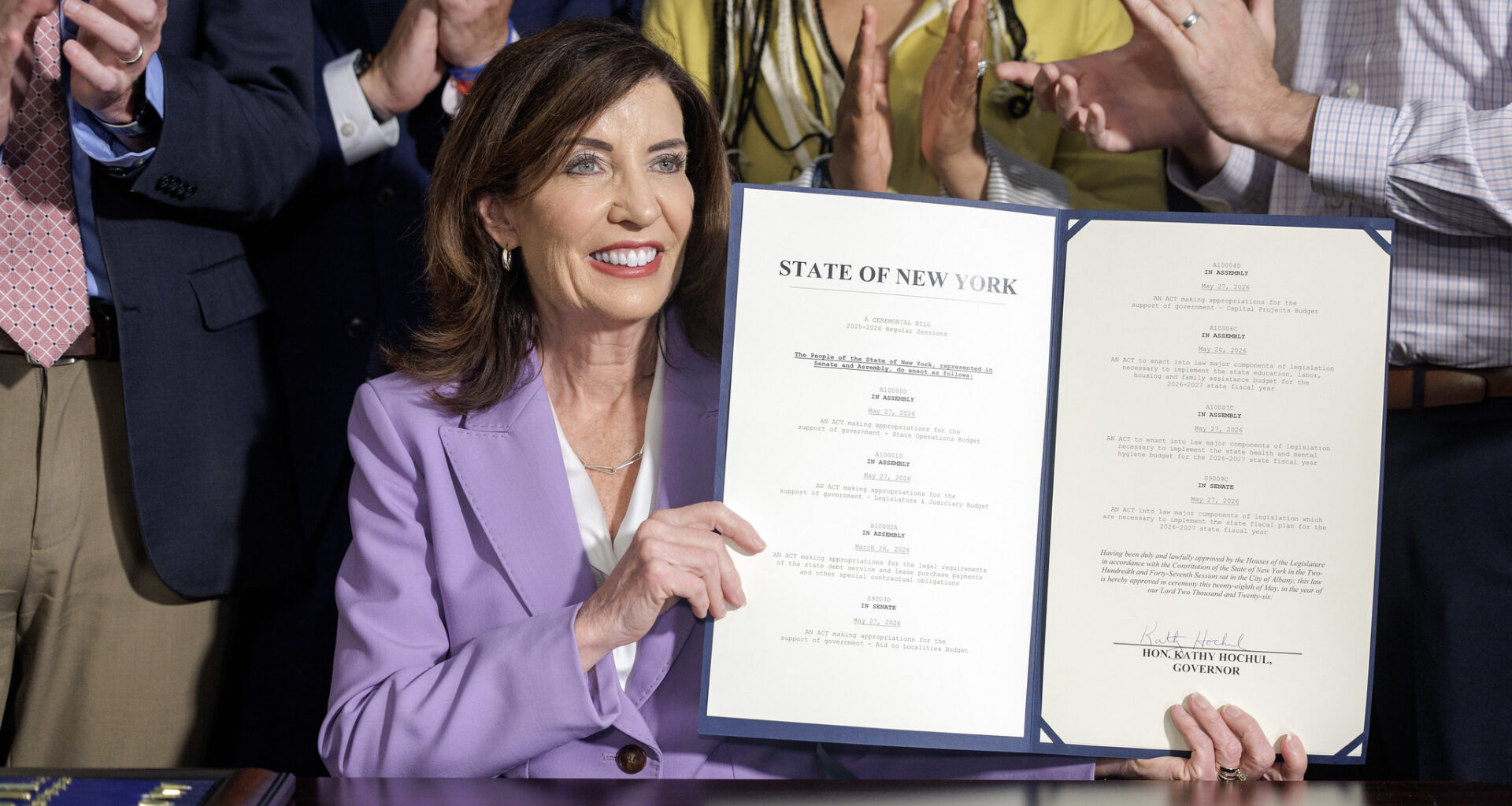
Gov. Kathy Hochul has signed New York State‘s $268.5 billion budget into law after lawmakers passed the measure late Wednesday, nearly eight weeks after the April 1 deadline.
“Every proposal included in this budget was a fight for New Yorkers and their future,” Hochul said in a news release about the 2027 budget. “Working with my partners in the Legislature, we delivered an ambitious agenda that will lower costs for hardworking families, keep New Yorkers safe and create opportunity for all.”
The budget increases childcare and prekindergarten funding by $1.7 billion, bringing total fiscal 2027 spending to $4.5 billion, as the governor seeks to put New York on a path toward statewide universal childcare.
It also adds more than $850 million in new housing capital to address the housing shortage. That includes $250 million to expand affordable housing development, accelerating the construction of thousands of additional affordable homes and transformative projects.
In addition, the budget includes $750 million as part of a greater $3.75 billion commitment for water infrastructure, including for modern sewar systems in order to build new neighborhoods and revitalize urban centers. Also included is $1 billion for one-time energy rebates for utility ratepayers, among other measures.
The budget includes reforms that are meaningful for economic growth on Long Island and across the state, said Stacey Sikes, acting president and CEO of the Long Island Association.
“The budget includes long-overdue reforms to stimulate much-needed housing and infrastructure development, pragmatic adjustments to the state’s climate policies to provide more flexibility in developing a reliable and affordable energy grid that can support business expansion and new jobs, and expanding access to childcare,” Sikes said in a written statement.
“These measures represent important steps toward improving the state’s business climate. At the same time, the budget significantly increases overall spending compared to prior years, and the LIA continues to support careful management of future cost drivers,” she said.
To New York State Senate Minority Leader Rob Ortt, the budget failed.
“This budget not only failed miserably on timeliness and fiscal responsibility, but it also does nothing to address the real affordability crisis facing New Yorkers,” he said in a written statement.
“It fails to rein in skyrocketing energy costs. It refuses to roll back unrealistic and expensive so-called ‘green’ energy mandates that are driving up utility bills for families and businesses alike. It also fails to crack down on the fraud, waste, and abuse that continue to plague New York’s Medicaid system,” he added.
Marc Herbst, executive director of Long Island Contractor’s Association was glad to see the funding for infrastructure.
“These investments are essential to maintaining and modernizing the roads, bridges and public works that keep Long Island’s economy moving and support thousands of good-paying jobs in our community,” he said in a written statement.
“Now, it is time to turn our attention to the next priority: a robust, forward-looking capital plan for the New York State Department of Transportation. Investing in Long Island’s infrastructure is an investment in our safety, our economic competitiveness, and our future. We look forward to working with state leaders to ensure Long Island receives the resources it needs to build a stronger, safer region for generations to come.”
The budget includes auto insurance reforms, utility cost accountability, pied-à-terre tax on luxury second homes in New York City, restrictions on Immigration and Customs Enforcement, funding for public safety, a state-level deduction for tipped income up to $25,000, and more.
“Families across New York are struggling to keep up with everyday costs,” New York State Comptroller Thomas DiNapoli said in a written statement. “This budget helps ease some of that burden. It also makes important investments in healthcare, housing and education, and gives critical aid to New York City and upstate communities. The budget takes action to alleviate utility cost burdens and takes steps to reform the rate-setting process to elevate consumer affordability concerns. I was pleased to see new protections for our immigrants that will help inoculate our communities from some of the hurtful policies that continue to come from the Trump administration.
“We’re evaluating the procurement changes that increased the thresholds for when contracts must come to us for review and when a contract must be competitively bid,” he added. “Our office rigorously scrutinizes state procurements and agency spending to protect the taxpayers from waste, fraud and abuse. Limiting these abilities can hurt taxpayers.”
Still, DiNapoli said, “the budget process went far past the April 1 deadline, and I’m concerned this is becoming the new norm. As spending increases, out-year budget gaps could put future priorities at risk.
DiNapoli said his office would “review the final enacted budget and release an analysis in the coming weeks.”
Details about the budget are available here.