
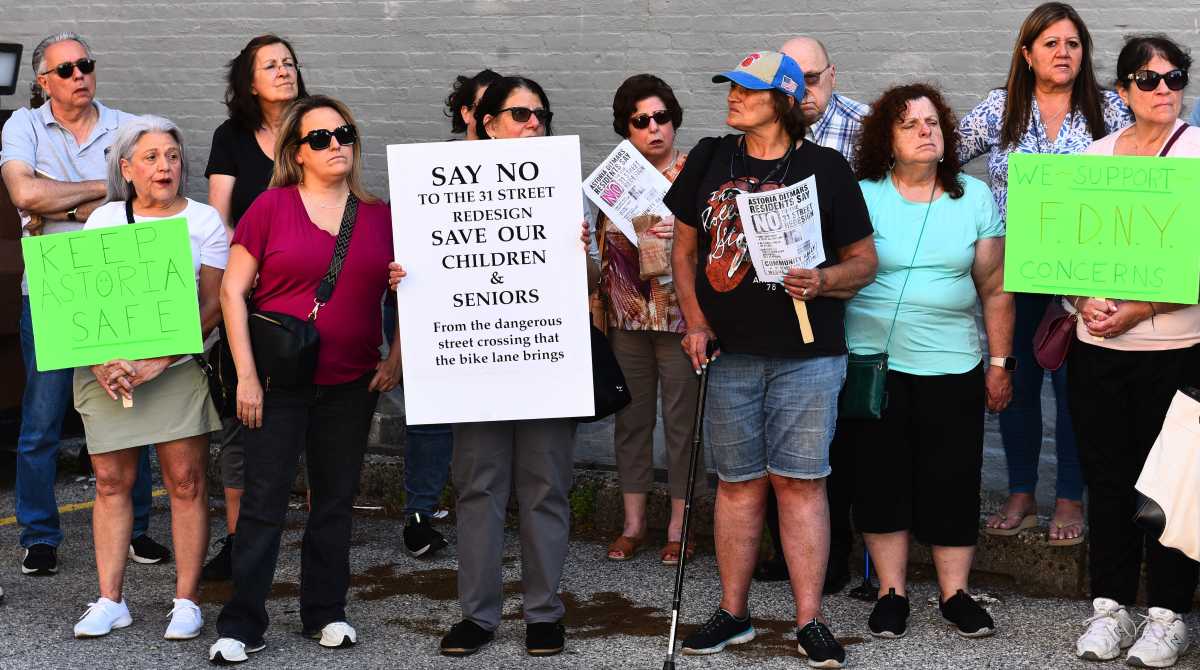
Over 100 local residents gathered in Astoria Wednesday, May 27, to renew protests against the DOT’s planned redesign of 31st Street, which would install parking protected bike lanes along a 2.5-mile stretch of the corridor from Northern Boulevard to 20th Avenue.
The DOT has proposed a massive redesign of the corridor, mostly underneath the N/W elevated subway tracks, after identifying 31st Street as one of the most dangerous corridors in Queens, pointing to three deaths and over 500 injuries along the corridor over a five-year period between 2021 and 2025.
The plan has not been without controversy, however.
DOT expands redesign plans
Last month, the Mamdani administration launched an expanded proposal for the redesign after Queens Supreme Court Justice Chereé Buggs ordered the DOT to halt original plans for the redesign in December. Buggs sided with a number of local businesses and residents who said the plan would present a hazard for pedestrians and motorists while also reducing access to local businesses and inhibiting emergency service response times.
In its initial proposal, the DOT called for curbside protected bike lanes along a mile-long stretch of 31st Street from 36th Avenue to Newtown Avenue. The agency’s expanded and updated proposal calling for a much larger redesign, stretching from Northern Boulevard to 20th Avenue, a distance of roughly 2.5 miles.
Queens Community Board 1 voted overwhelmingly in favor of recommending the new redesign following a packed and impassioned monthly meeting in April, backing proposals for curbside protected bike lanes, painted pedestrian islands to shorten pedestrian crossings, hardened daylighting and reorganized travel lanes.
The DOT also asserted last month that it has addressed the issues that Buggs raised in her initial ruling.
Opponents continue to raise concerns
Opponents of the plan, however, gathered in a parking lot near the intersection of 31st Street and Ditmars Boulevard Wednesday to rail against the redesign.
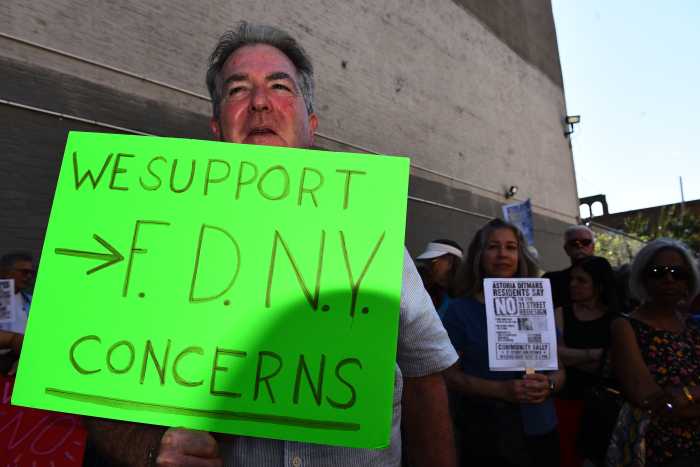 Photo by Ramy Mahmoud
The rally, organized by the 31st Street Business Association, argued that the planned redesign “won’t work,” arguing that 31st Street is one of the most congested streets in the neighborhood and that the plan would siphon vehicular traffic to smaller, surrounding streets. Attendees also argued that 31st Street is too dangerous for bike lanes.
George Delis, a former district manager for CB1, told the crowd that the redesign “makes no sense whatsoever.” Delis pointed to part of the planned redesign aiming to convert a section of the street between 20th Avenue and Ditmars Boulevard into a north-bound one-way corridor, which the DOT says would reduce turning conflicts at three major intersections.
“Where are the trucks going to go? If you live on 29th Street, if you live on 33rd Street, they’re going to be going down your street,” Delis said. “It’s a stupid plan.
“I’m not against bike lanes, but there are places where they belong and places where they don’t belong. Putting a bike lane down 31st Street, which is the most congested street in our community, doesn’t make sense.”
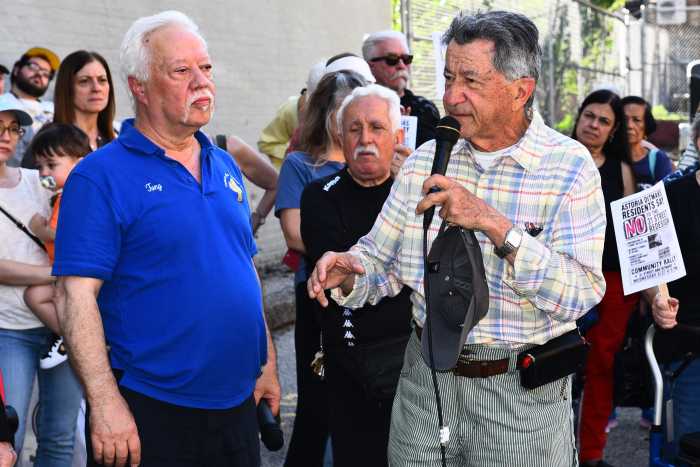 George Delis speaks at Wednesday’s rally. Photo by Ramy Mahmoud
Joe DiPietro, a long-term Astoria resident who holds Italian-American cultural events at Athens Square Park, made a similar argument during a speech, calling on the DOT to look elsewhere for a home for protected bike lanes.
“Bike lanes are nice, but there’s a place for everything. Do you put your toilet in the middle of the living room?” DiPietro said. “Try to put them in an area that doesn’t interfere with traffic. 31st Street is a nightmare.”
As part of the redesign, the DOT plans to install 8-foot-wide parking protected bike lanes on either side of the street and reduce moving lanes in both directions from 14 feet to 11 feet. The proposed redesign mostly applies to the section of 31st Street beneath the elevated N/W subway tracks.
Attendees at the rally held signs outlining their opposition to the bike lanes, claiming the redesign would make the corridor more unsafe for seniors and children as well as pointing to alleged concerns from firefighters over the project. In her ruling, Buggs cited concerns raised by the FDNY after the Fire Department informed the DOT in July that the street redesign would not permit it to operate at “full capacity.”
The DOT told CB1 last month that the FDNY has certified the latest proposal for the redesign, stating that the Fire Department has welcomed the improved access to fire hydrants that the plan will create. The DOT further stated that emergency vehicles will be able to use the eight-foot-wide bike lanes and three-foot-wide buffer zones to respond to emergencies.
Still, protesters raised concerns about the impact that the plan would have on emergency response times, arguing that narrowing the moving lanes in both directions removes space for cars to give way to emergency vehicles.
Anthony Meloni, a member of the 31st Street Business Association who helped organize the protest, admitted that the current design of 31st Street is not ideal for emergency response but added that the proposed redesign would make the corridor worse.
“It’s not great now, but it’ll be much worse later,” Meloni said.
Meloni told the crowd that a judge had rejected the DOT’s first redesign and said the 31st Street Business Association is “back in court” to fight the new proposal.
Supporters cite safety data
Some supporters of the redesign turned out at the rally to hear the arguments presented by the group, leading to some terse exchanges between opponents and advocates.
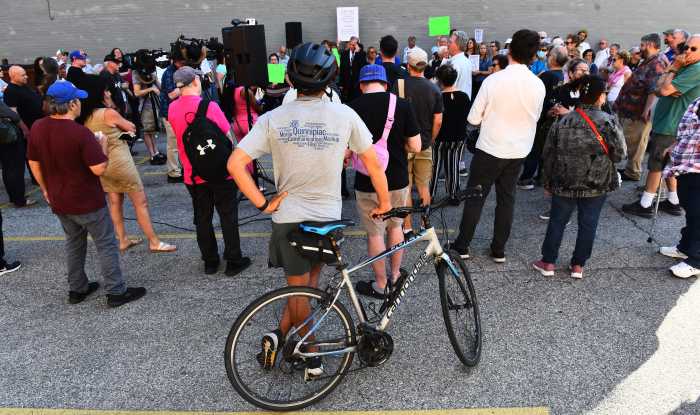 A cyclist watches on as residents protest against the redesign. Photo by Ramy Mahmoud.
Josh Brewer, an Astoria resident who was not involved in any such exchanges, said he “came out to see the circus.”
Brewer said current conditions along 31st Street make it difficult for the Fire Department to access the curb along the corridor.
“There’s been a ton of double parking along 31st Street, so they (the Fire Department) would have to literally be in the travel lane,” Brewer said.
He also countered against arguments that the redesign would make the corridor more unsafe for seniors and children, pointing to DOT data asserting that bike lanes make corridors safer for the most vulnerable road users, including seniors and children.
“Injuries and deaths go down when bike lanes are installed for those two groups, and yet you look around here and you have a bunch of seniors saying it’s going to make things somehow more dangerous,” Brewer said.
The DOT said last month that similar redesigns have resulted in an 18% reduction in pedestrian injuries and a 29% reduction in deaths and serious injuries for pedestrians. Similar redesigns also resulted in a 19% reduction in injuries to drivers and a 15% reduction in injuries to cyclists, the agency said.
“We stand by this safety project and outreach process and look forward to defending our work in court. We are grateful for FDNY’s continued collaboration in keeping New Yorkers safe,” a DOT spokesperson said after the protest.
Agency officials also said the DOT completed all legally required consultations ahead of restarting the public engagement process for the redesign, including adapting the project based on FDNY feedback after site visits.
The DOT said it also obtained feedback from 150 businesses within the project limits to address concerns from local businesses. As a result, the new project now includes measures such as truck loading zones that will allow businesses to load and receive deliveries from 7 a.m. to 7 p.m. and expanded two-hour metered parking that the DOT says will increase turnover for short parking periods and increase customer access.
At last month’s community board meeting, supporters of the project outnumbered opponents by more than two-to-one, arguing that the current dangerous condition of the corridor is no excuse not to add protected bike lanes.
Manuel Diez noted that service along the N/W subway line is often “spotty” on weekends, pushing many straphangers onto Citi Bikes on the street below.
“You find yourself in this chaos of 31st Street, where there’s columns along the way, there’s cars turning left and right and there’s double-parked cars,” Diez said. “To those that say lifelong residents know to avoid 31st Street because it’s horrible. I say, let’s fix it.”
The redesign was proposed in 2023 as part of the Western Queens Street Safety Plan, put forward by Council Member Tiffany Cabán, State Sen. Kristen Gonzalez, Assembly Member Jessica González-Rojas and then-Assembly Member Zohran Mamdani.
Gonzalez said in a statement that it is now “past time” for a redesign of the corridor.
“There have been over 500 injuries and three deaths on 31st Street over the past five years,” Gonzalez said. “It is past time for a redesign of this corridor that prioritizes street safety for pedestrians, cyclists and drivers alike… Relying on the status quo is not an option when lives are on the line.”