
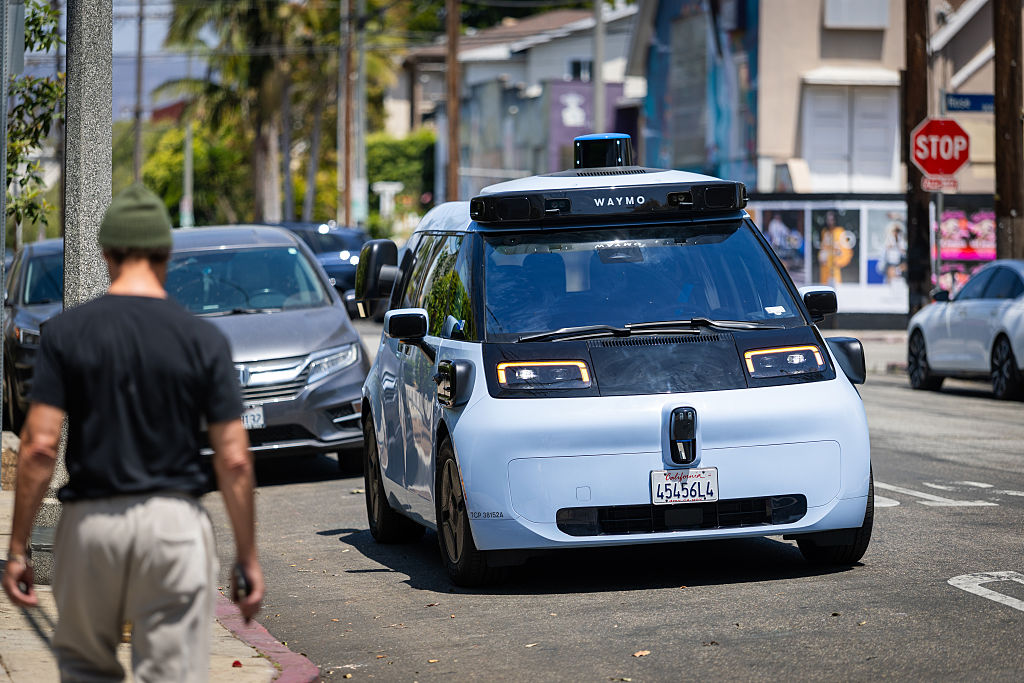
Waymo’s new autonomous vehicle, called the Ojai, drives in Venice Beach, California, on May 27. The all-electric vehicle is expected to begin limited rides with select customers in Los Angeles, San Francisco and Phoenix in the coming weeks.
Allen J. Schaben/Los Angeles Times via Getty Images
I am blind and I do not drive. That fact shapes nearly every aspect of my life in ways most New Yorkers never have to consider.

For most Americans, transportation is almost invisible. You grab your keys, get in the car or walk to your bus or metro stop, and go where you need to go. For those of us who are blind or vision-impaired, every trip begins with a series of calculations. Is the bus running on time? Will paratransit arrive within its pickup window? Will a rideshare driver accept the trip, or will they decide that accommodating a blind passenger isn’t worth the trouble?
Article continues below this ad
These are not rare concerns. They are part of everyday life.
As president of the American Council of the Blind of New York, I hear stories like this all the time. Blind and low-vision New Yorkers routinely spend far more time and energy navigating transportation difficulties than their sighted peers. We leave early because experience has taught us that something almost inevitably goes wrong. We miss appointments, are passed over for job opportunities and sometimes simply stay home because getting there is too complicated.
Transportation is the gateway to employment, education, healthcare and participation in community life. And access to it is not something we can afford to take for granted.
Make the Times Union a Preferred Source on Google to see more of our journalism when you search.
Add Preferred Source
In cities such as Phoenix, San Francisco, Los Angeles, Miami and Nashville, people who are blind and others who cannot drive are already using fully autonomous vehicles to travel safely and independently. They can request a ride when they need one and complete trips without depending on another person’s willingness to help.
Article continues below this ad
Autonomous vehicles could be one of the most significant advances in independence for blind people in generations. The following story shows why.
Last week, council members were in Albany for our annual legislative weekend, where we visited the Capitol for what we affectionately call “banging and barking” — taking our canes and service dogs with us while we talked about the issues that matter most to blind and low-vision New Yorkers.
When three of us were ready to travel from our hotel to the train station, we called a rideshare. One of us, Audrey, a Braille teacher, was accompanied by her guide dog. When the driver arrived, he insisted that Audrey’s guide dog ride in the trunk. When she refused, he refused to take us.
Another driver pulled up, saw the dog and drove away.
Article continues below this ad
We missed our train, waited hours for the next one and paid significant rebooking fees. Complaints to the company didn’t yield meaningful results.
Discrimination like this is an everyday occurrence, but it doesn’t have to be. I don’t blame the individual drivers; they’re burdened with long working hours and the high costs of maintenance and insurance for their own vehicles. But the incident illustrates why for many in our community, the option of using an autonomous vehicle would be nothing short of transformative.
This is not an argument for replacing buses, taxis or paratransit. New York needs all of those services. But New Yorkers with disabilities need another option. We need transportation that is available on demand, that does not discriminate and that offers a level of consistency and independence that many of us have never fully experienced.
Autonomous vehicles also hold promise far beyond the disability community. Human error remains the leading cause of traffic crashes, whether due to distraction, fatigue or impairment. Properly regulated autonomous vehicles have the potential to make our roads safer while expanding mobility for older adults, people with disabilities and others who are underserved by current options.
Article continues below this ad
Gov. Kathy Hochul was right to include autonomous vehicle legislation in her executive budget. It was disappointing to see that proposal, which was narrowly targeted at transit-poor communities upstate, pulled from the budget weeks later. The reasons it was pulled had nothing to do with whether the technology is safe or whether it is ready. They had to do with politics.
That pattern is exhausting and familiar: Opportunities slip away not because someone decided blind New Yorkers weren’t worth them, but because we weren’t part of the conversation.
A bill to launch a Capital Region pilot program for autonomous taxis was introduced a few weeks ago and deserves consideration. I am not asking the governor or the Legislature to rush. I am asking them not to walk away from the issue. Consider it carefully, regulate it thoughtfully and include the disability community in the conversation.
Article continues below this ad
There is little doubt that autonomous vehicles will eventually come to New York. The real question is whether we lead or whether we follow.
Rodney Stanford of White Plains is president of the American Council of the Blind of New York.