
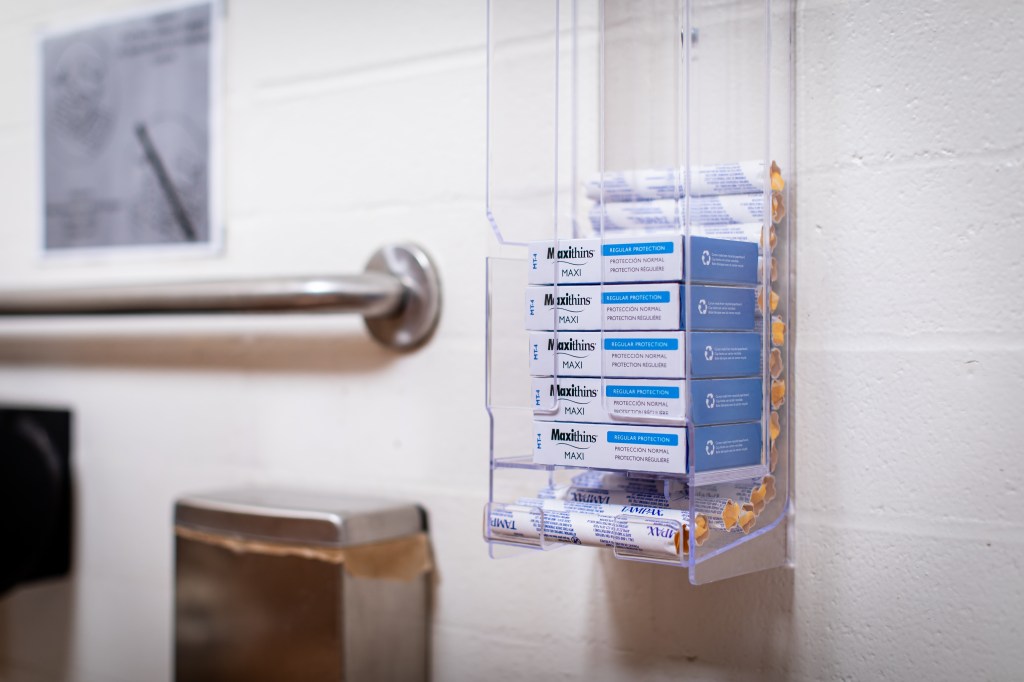
Today is World Menstrual Hygiene Day and while New York was once the national leader on menstrual equity, today many students still cannot count on finding a pad or tampon in a public-school bathroom when they need one.
As a City Council member, I have heard far too many accounts from students forced to improvise because dispensers were empty, broken, or missing. Students should not have to leave class searching for supplies, ask classmates or teachers for help, or spend the school day worried about bleeding through their clothes. Yet that remains the reality in schools across the city.
In 2016, the city enacted Local Law 84, becoming the first jurisdiction in the country to require free menstrual products in public schools, shelters, and correctional facilities. The principle was straightforward: no one should lose access to education, dignity, or public life because they cannot access basic menstrual care.
We would never accept a school bathroom routinely running out of toilet paper or soap while students were told to wait for a donation drive. Menstrual products should be treated no differently.
But a decade later, implementation is inconsistent. The Department of Education’s 2024–2025 Menstrual Equity Report states that a majority of schools reported having an adequate supply of menstrual products and being in compliance with Local Law 84. Yet students still encounter empty dispensers and unreliable access to products in school bathrooms, raising concerns that the DOE still lacks a reliable implementation and distribution process to ensure students can consistently access products.
The consequences are real. Lack of reliable access to menstrual products contributes to absenteeism, missed instructional time, and difficulty concentrating in class. Students who cannot afford menstrual products are often forced to rely on toilet paper, remain in soiled clothing, leave school early, or miss school altogether. For transgender and nonbinary students, the problem can be even more isolating when products are unavailable in all-gender bathrooms.
Last year, Period Law sued the Department of Education over the city’s failure to properly implement Local Law 84. The lawsuit is unresolved, but the larger issue is clear: passing legislation is not enough if the system responsible for carrying it out is not functioning.
This is no longer a question of whether menstrual equity matters. New York already answered that question years ago. The issue now is whether the city will ensure the law is actually enforced.
New York now needs exacting procedures and accountability to ensure menstrual products are reliably stocked in schools. That means clear responsibility for stocking products, better oversight, visible and consistently filled dispensers, staff training, and real time reporting when supplies run low.
Period Law’s research, advocacy, and litigation have helped identify where the city continues to fall short, including weak oversight and continued reliance on stopgap measures. The city should also explore more sustainable and cost-effective purchasing and product options, including reusable products alongside disposable supplies.
This should not be difficult. The city already knows how to distribute essential supplies across thousands of buildings every day. Menstrual products must be treated as essential.
New York helped establish menstrual equity as a public policy issue for the entire country. Now it needs to prove it can deliver on that promise. Students should not have to wonder whether basic products will be there when they need them. In a city like New York, that should already be guaranteed.
Brewer is a Manhattan councilwoman. Strausfeld is the founder and executive director of Period Law, a legal nonprofit.