
by Michelle Mullen
At the height of the anti-war movement in the 1960s, flowers became more than decoration. They were carried into protests, tucked into hair, painted onto posters and raised as symbols of peace against violence and political upheaval.
Now, decades later, the New York Botanical Garden is revisiting that legacy through its sprawling new exhibition, “Flower Power,” which transforms the garden into a vibrant blend of contemporary art, horticulture and social history. The phrase itself, once associated with the counterculture movement, eventually became shorthand for an entire generation’s vision of activism and radical optimism.
The show starts off in the Art Gallery of the garden’s Mertz Library Building, rather than in the gardens or the Haupt Conservatory. Michaela Wright, director of exhibition content and interpretation, said the exhibit is intended to recover the movement’s deeper political and cultural roots.
“We wanted to start the exhibition with a little bit of historical grounding,” she said, pointing to artifacts such as first-edition copies of influential feminist texts, like Betty Friedan’s “The Feminine Mystique.” “Flower Power has some pretty literal origins that we wanted to make sure we nodded to.”
According to Wright, the phrase can be traced back to Beat poet Allen Ginsberg, who in 1965, during the Vietnam War era, published an essay in the underground newspaper “Berkeley Barb.” In it, Ginsberg proposed a different strategy for anti-war demonstrations: protesters carrying masses of flowers to make demonstrations more visually striking and emotionally resonant.
Wright explained that Ginsberg viewed flowers as a kind of visual language, one capable of contrasting the violence of war with symbols of peace, humanity and life itself. The imagery quickly spread through newspapers and television broadcasts nationwide, giving rise to the now iconic image of the “flower child.” As photographs of young demonstrators carrying flowers circulated through the media, flowers became intertwined with the broader counterculture movement and its ideals of nonviolence and social change.
The exhibition spills across the botanical garden grounds, where towering painted canopies ripple above walkways like oversized petals and crocheted flowers wrap around trees. New outdoor installations by seven artists unfold throughout the garden, while inside the conservatory, kaleidoscopic floral sculptures rise above vibrant tropical greenery. Music drifts through the site, indoors and out, transforming the botanical garden into something closer to an immersive art landscape than a traditional exhibition.
For Patrick Nowak, the garden’s manager of exhibitions operations, the goal was to create an exhibition that explored not only the visual beauty of flowers, but the emotional and cultural meanings attached to them.
“What was most important to me was that we had a balance of artists that we worked with who had a diversity of skills and mediums,” Nowak said. “These issues happen everywhere, and art happens everywhere, and people are inspired by flowers everywhere.”
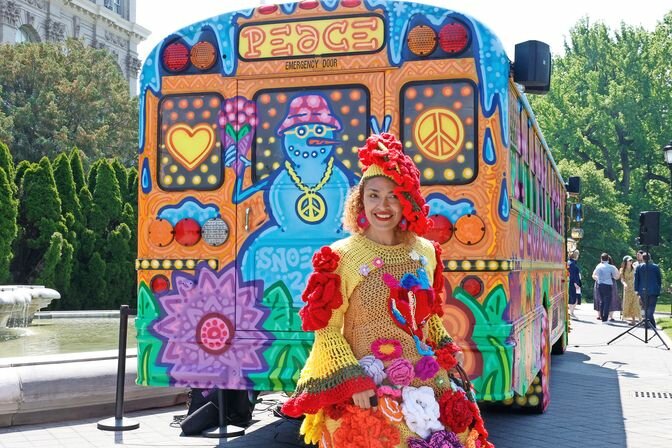
Among the artists featured throughout the grounds is Carlos W. Encarnación, whose brightly painted van installation sits outside the Enid A. Haupt Conservatory. Encarnación said he drew inspiration from the playera flower, which he described as both a tribute to Puerto Rico and to the women who raised him.
“Flower Power, for me, is an invitation to embrace and celebrate the historical, symbolic, and cultural presence of nature in our lives,” he said.
Encarnación created the work using a combination of masking, freehand painting and linocut prints with acrylic and gouache paint, completing the installation over the course of four to five days.
Nearby, artist Carmen Paulino’s colorful crocheted flowers and peace signs are woven directly into fences and wrapped around trees throughout the grounds. Created entirely by hand using yarn and fiber, the sprawling installation took roughly two months to complete.
“When I think of Flower Power, I think about patience, growth, and the beauty that comes from nurturing something over time,” Paulino said. “Just like planting a seed, crochet requires care, time, and trust in the process.”
Among the exhibition’s most striking works are giant suspended canopies created by German artist William Hochweber, whose brightly colored fabric structures stretch above visitors like enormous blooming flowers.
Hochweber, known for immersive festival installations across Europe, said his creative process is largely intuitive, beginning with broad concepts and evolving organically as he paints directly onto fabric without detailed sketches. Using elastic custom fabrics and acrylic paint applied through an airbrush gun, Hochweber hand painted each canopy himself, coating both sides to intensify the color saturation and help the pieces withstand months outdoors.
The result is a ceiling of swirling rainbow tones and organic patterns that shift overhead with sunlight and wind. Hochweber said he wanted the individual canopy pieces to resemble flowers themselves — each slightly different on its own, but visually cohesive together — while also creating an immersive scale that makes visitors feel small beneath them.
Unlike the temporary festival installations Hochweber usually creates, this exhibition will remain on view for nearly six months. To mirror the changing landscape of the garden itself, Hochweber designed three versions inspired by different times of year, which will rotate throughout the exhibition — beginning with softer spring greens before shifting into vivid summer rainbow palettes and eventually earthier autumn tones.
“The whole garden is constantly changing,” Hochweber said. “All the plants are different in different seasons.”
Alongside the physical beauty of flowers, organizers said the exhibition’s deeper focus remains on how flowers function as symbols — emotionally, politically and spiritually.
Wright noted that by the mid-1960s, Ginsberg had become deeply influenced by Zen Buddhism, where flowers already carried longstanding symbolic meaning associated with peace, enlightenment and rebirth. That spiritual symbolism, she said, helped flowers resonate across a range of movements and communities beyond anti-war activism alone.
The show also traces how flowers spread into women’s rights movements and broader liberation campaigns inspired by civil rights organizing and the Black Power movement. While the various factions of the 1960s counterculture often held different political beliefs, Wright said they were connected by a broader desire to reshape society and imagine alternative futures.
For visitors wandering beneath painted canopies and towering blooms this summer, the exhibition offers something both nostalgic and contemporary, Wright said.
“Flower Power” will be on display through Oct. 18.
Keywords
New York Botanical Garden,
Flower Power exhibition,
Bronx art exhibition,
1960s counterculture,
anti-war movement,
Allen Ginsberg,
flower child,
immersive art,
botanical garden exhibit,
contemporary art,
peace movement