
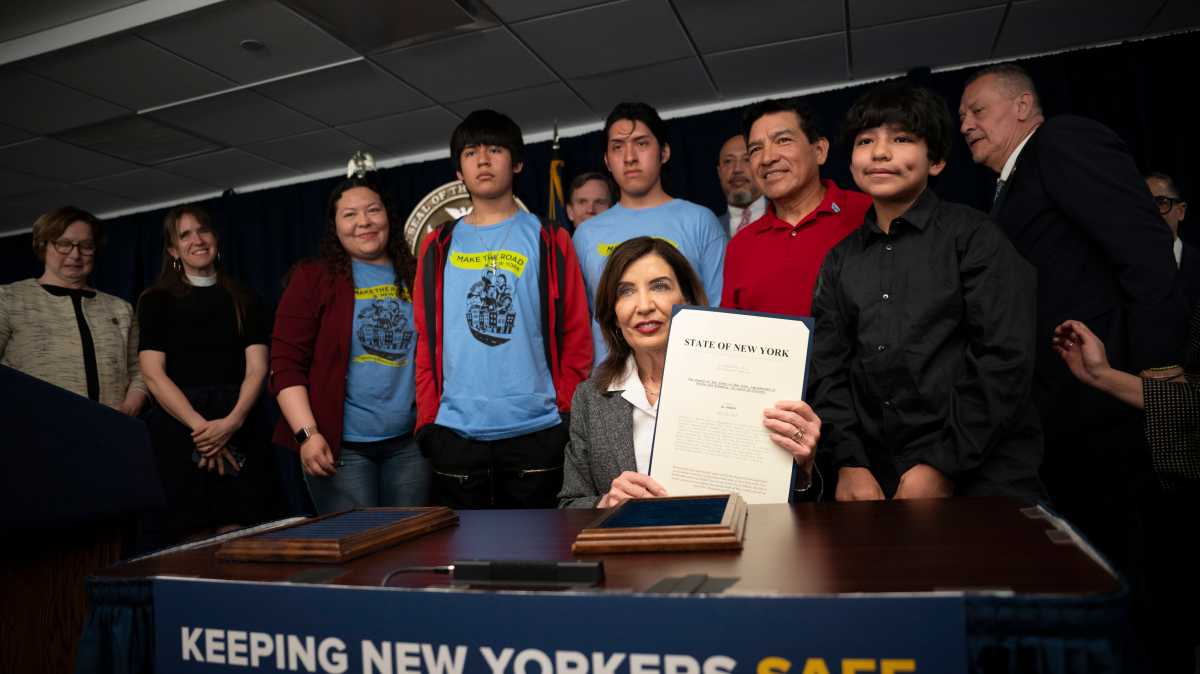
The measures, included in the state’s fiscal year 2027 enacted budget, prohibit state and local agencies from using public resources for civil immigration enforcement; block local governments from entering into agreements that deputize police and corrections officers to carry out federal immigration work; and limit immigration authorities’ access to schools, hospitals, houses of worship and other sensitive locations without a judicial warrant.
The package also creates a state-law mechanism allowing New Yorkers to sue federal, state, and local officials for alleged constitutional violations.
Speaking at her Midtown office on Friday, the governor repeatedly pointed to masked immigration agents as a central target of the legislation.
“We don’t need law enforcement wearing masks,” Hochul said. “We don’t need any of our law enforcement wearing masks. We don’t need our local police wearing masks. We don’t expect our state police to wear a mask, and you will not see that.”
What the law enforcement mask ban means
The mask ban applies to state, local, and federal law enforcement officers while they are interacting with the public. The law includes exceptions for necessary tactical equipment, sunglasses and medical masks.
Willful violations would be an infraction, while subsequent willful violations would be a misdemeanor, according to the governor’s office.
Hochul said the state was banning masks because they had been used “as a technique of intimidation.”
Asked by reporters how the state would enforce the law against federal officers, Hochul said enforcement would fall to the state attorney general’s office. An administration official said courts could issue injunctions requiring compliance, with further consequences if such orders were ignored.
Hochul acknowledged the state expects litigation, but said officials believe the law was written broadly enough to withstand a challenge because it applies to state, local, and federal law enforcement, rather than singling out ICE agents.
The package also prohibits local governments, state and local police, and state and local corrections agencies from entering into 287(g) agreements or similar arrangements with the federal government that allow local personnel or facilities to be used for civil immigration enforcement. Local governments would also be barred from paying for or helping operate immigration detention facilities.
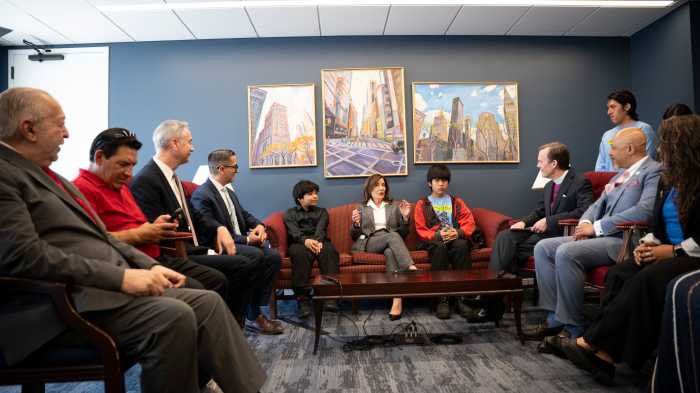 Gov. Kathy Hochul meets with immigration advocates, faith leaders, educators and New Yorkers affected by federal immigration enforcement at her Midtown Manhattan office Friday before signing a package of laws restricting ICE operations in New York.Photo by Lloyd Mitchell
 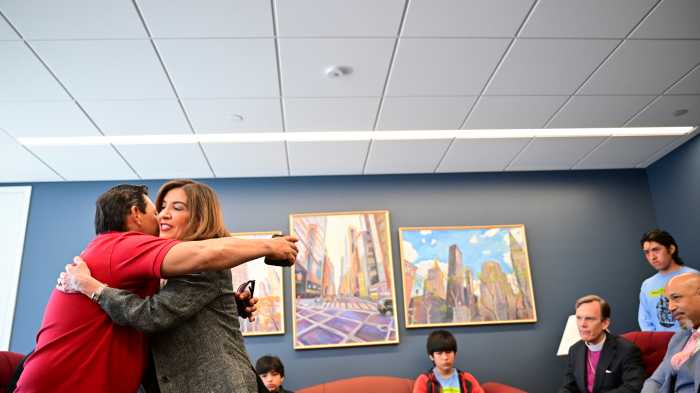 Gov. Kathy Hochul embraces a man at her Midtown Manhattan office Friday after he described being held in immigration detention for eight months, saying, “It was terrible. I am not a criminal.”Photo by Lloyd Mitchell
Another provision requires state- or locally operated sensitive locations to deny immigration authorities access to nonpublic areas unless they present a judicial warrant or court order. The protected locations include schools, health care facilities, houses of worship and other locations described by the state as sensitive.
The legislation also restricts state and local civilian agencies and public schools from using employee time or other public resources for civil immigration enforcement. Officials would be barred from questioning or investigating people solely for civil immigration purposes unless required by law or a judicial warrant.
‘New York is not a sanctuary for criminals’
Hochul sought to draw a distinction between civil and criminal immigration enforcement, telling reporters that New York would still cooperate in cases involving dangerous criminals.
“My job is to protect people in the state, and their rights are being trampled on by this rogue agency,” Hochul said. “I need to step in and do something.
The governor also pushed back on the idea that the measures make New York a haven for criminals. “If they need to go after criminals, I’m not stepping in and saying we’re prohibiting that. That’s that’s the difference here,” she said.
“I’ll be clear, and I’ll say it now, I’ll say it 100 times: New York is not a sanctuary for criminals,” Hochul said. “And we will cooperate when crimes are being committed, going after dangerous criminals.”
Immigration advocates praised the package as a sweeping rebuke of the federal government’s deportation agenda. Murad Awawdeh, president and CEO of the New York Immigration Coalition, said the measures would help protect families from detention and deportation by ending 287(g) agreements and limiting schools’ and state and local agencies’ cooperation with ICE.
The new laws come as Democratic officials in New York and other states have increasingly clashed with the Trump administration over immigration enforcement, with disputes centered on courthouse arrests, local cooperation with ICE, and enforcement actions near schools, churches, and other sensitive locations.
Hochul said she hopes the package becomes a model for other states.
“This is a statement of who we are as New Yorkers,” Hochul said. “When it gets tough, there’s no one tougher than New Yorkers to stand up and fight back.”
Immigration advocates praised the package as a sweeping rebuke of the federal government’s deportation agenda. Murad Awawdeh, president and CEO of the New York Immigration Coalition, said the measures would help protect families from detention and deportation by ending 287(g) agreements and limiting cooperation with ICE by schools and state and local agencies.
The Department of Homeland Security criticized the package, calling it a “flagrant attempt to endanger” federal officers and saying the administration would not follow what it considers an unconstitutional state restriction on federal law enforcement.
A department spokesperson said in a statement to amNewYork that ICE officers wear face coverings to protect themselves and their families from threats, and argued the new law would make New Yorkers less safe by limiting arrests of people the agency describes as “criminal immigrants.”
“To be crystal clear: we will not abide by unconstitutional bans,” the spokesperson said. “The Supremacy Clause makes it clear that state and local sanctuary politicians do not control federal law enforcement.”
The spokesperson also defended courthouse arrests as “common sense,” saying they conserve law enforcement resources and are safer because people entering courthouses have already been screened for weapons.