
Haze
David Zwirner
September 25–November 1, 2025
New York
American figurative artist Sasha Gordon’s (b. 1998) Haze exists between narrative and sensation, where disorientation refuses resolution. The show presents a loose sequence of paintings depicting a protagonist subjected to increasingly brutal hazings by three towering antagonists. Yet Gordon deliberately undermines chronology, hanging the works out of order to prevent the show from reading as straightforward storytelling. What emerges instead is a psychological landscape where consciousness flickers in and out, where the body becomes both instrument and obstacle, and where meanings multiply rather than clarify.
The exhibition marks a major pivot in Gordon’s practice. Now twenty-seven, the artist has grown weary of the questions about representation that she believes would never be posed to white painters: inquiries about why she depicts Asian figures, why her subjects bear her likeness, what political statement she intends to make. While themes of queerness, Asian identity, and bodily presence are embedded in the work, Gordon has moved toward more psychological terrain. The experiences that informed her earlier explorations of selfhood now manifest as effects—dissociation, disorientation, the strange detachment from one’s own physical form—instead of as explicit subject matter.
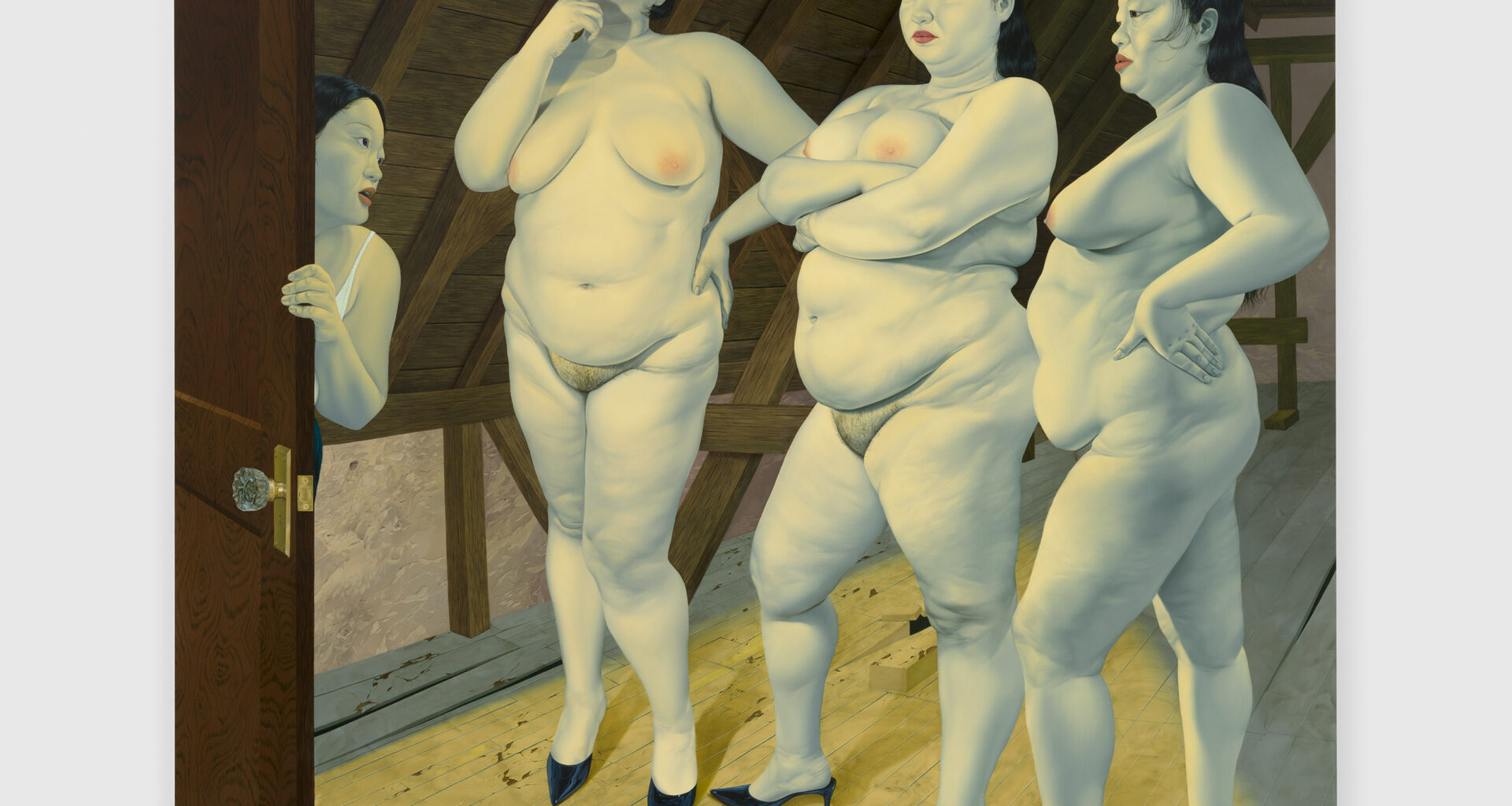
This evolution is immediately apparent in Whores in the Attic (2024), which depicts three women crowded into a wooden structure, their pale, monumental bodies illuminated by harsh yellow light. Wearing only black heels, they stand in attitudes of casual menace—one is smoking, and all three project an otherworldly presence. Gordon describes them as alien beings who have crashed to Earth. The painting establishes the exhibition’s tonal register: campy horror filtered through an aesthetic of deliberate unsettlement, where familiar architectural spaces become stages for violence.
The narrative begins with It Was Still Far Away (2024), where the protagonist cuts her toenails in a park as an explosion blooms in the background; her headphones insulate her from the chaos. This opening draws inspiration from a scene in the Korean horror film The Host (2006), in which a woman is absorbed in personal grooming as a creature tears through a panicked crowd. Gordon saw this collision of intimate mundanity with catastrophic disruption as the catalyst for the entire exhibition. In a smaller subsequent oil-on-linen painting titled Trance (2025), the protagonist delicately consumes her toenail clippings, like sacred pills.
What follows is a series of ordeals that Gordon frames as both torture and ritual initiation. In Husbandry Heaven (2025), one of the three women force-feeds the protagonist with an ambiguous expression that might suggest care or compulsion. Behind them, two other women perch on rock pillars like judging witnesses, creating what Gordon describes as external pressure. Petrified (2025) shows the protagonist dragged through mud by a rope of her own pubic hair, trails marking the repeated circuits of her body’s passage. The hazing culminates in a water-tank drowning titled Pruning (2025), where the main subject’s eyes finally meet the viewer’s gaze, her knees pressed against glass, breaking the fourth wall.