
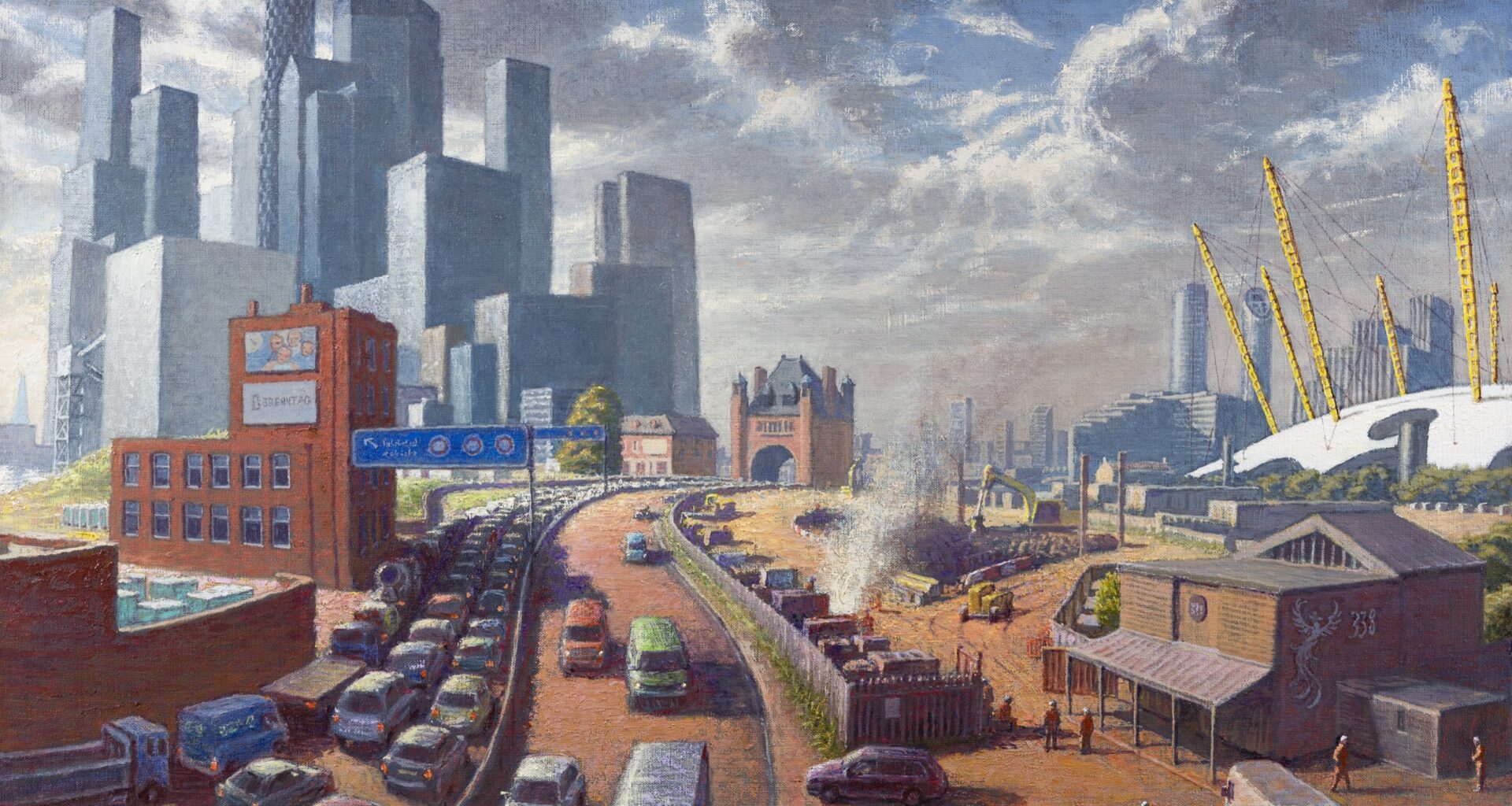
England Road
Natasha O’Kane Sussex Contemporary Art
October 14–19, 2025
London
Many renowned art writers also make artworks. Meyer Schapiro painted, Clement Greenberg and Leo Steinberg made drawings, Arthur Danto did woodcuts, and Roger Fry, Cezannesque paintings. Julian Bell is well known for reviews, as well as for his books What is Painting?; Mirror of the World: A New History of Art; monographs on Pierre Bonnard and Vincent van Gogh; and, most recently, Natural Light: The Art of Adam Elsheimer and the Dawn of Modern Science. Born in 1952, Bell is the son of artist and art historian Quentin Bell and the grandson of the painter Vanessa Bell and the art writer Clive Bell; he is the grandnephew, also, of Vanessa’s sister, Virginia Woolf. As a small child, he posed for his grandmother and Duncan Grant in their Bloomsbury home, which now has become a registered pilgrimage site. But by the time Bell started making art himself in the 1970s, this grand family tradition didn’t provide much guidance for him. Lucian Freud and his fellow School of London figures had become famous, but their best-known successors, the Young British Artists, hadn’t yet started to show. Living far from this trendy London world, learning on the job, Bell painted local land- or townscapes, pub signs, and portrait commissions. The dominant art school theorizing, to quote What is Painting?, involved a “systematic suspicion of pictures,” and the whole system in which they were marketed. Bell’s viewpoint was very different: You paint because “you want something present before you, on which you can focus your love for someone absent. You want a focus for your lust, in the absence of a partner. You want a focus on earth for your devotions to a god up in heaven.” Bell’s father noted that in the previous generation, Vanessa Bell had painted subjects that “seem to be replete with psychological interest, while at the same time firmly denying that the story of a picture had any importance whatsoever.” But her grandson has no such instinct to repress narrative. Here, then, he broke with Bloomsbury antecedents.
Like most artists, Julian Bell is keen to show his newest works. But his own art, which has been regularly exhibited in England, has been shown in this country only once, about ten years ago. And so, reviewing for a predominantly American readership, I need to bring readers “up to speed” by very briefly sketching his recent development. Let’s start with “When the City is Built,” twenty-six 20-inch-high canvases exhibited in 2019 that brought together many of his leading concerns in a far-ranging synthesis. Meant, he says, as a “hymn to the great twenty-first-century city which is London,” each picture, with a terse one-word title, stands alone as a work of art. Taken together, this sequence of works features a group of recurring protagonists, exploring their intimate experiences together with their lives in the public sphere. Just as Virginia Woolf’s Mrs. Dalloway tells one day in the life of that city, so these paintings tell of a single summer’s day in contemporary multicultural London. Too frequently we treat artworks which deserve serious contemplation as if they were flickering photos, just momentarily visible on our computer screens. Bell’s demand that we supply narratives for some of his compositions is a response to this situation, for providing those stories for his paintings requires that we take time. We need to look at the figures, size up the situation, and create a story.
“This Land, This Road,” the present successor to that show, takes us out of the city. A marvelous video, accessible on Bell’s website, provides interpretations. Approaching the Tunnel (2024) and M40 (2024) take us into London, while The Sheds at Banbury (2025) shows the oddly nondescript industrial warehouses at the city’s outskirts. A Yard in the Woods near Ludlow (2025) reveals the kinds of almost hidden places in the woods of these sites, while Exercises at Imber (2025), reworking an earlier painting destroyed in a studio fire, reflects on Britain’s role as a belligerent nation. Bell compares it to Elvis Costello’s 1983 song about the reconquest of the Falkland Islands, “Shipbuilding,” in which the protagonist is a British mechanic who—now that there’s war—finds work again and so is able to pay his bills, building the ships that’ll carry his son off to get killed. I especially enjoy the metallic textures of the tanks, and the contrast with the patchy blue of the sky. Decaying weaponry can be attractive. And Crop (2022), Heap, and Oak (both 2024) take us close up to this landscape. Many of these unkempt, uncared for places—England at its most gloriously bland—proved difficult to access.