
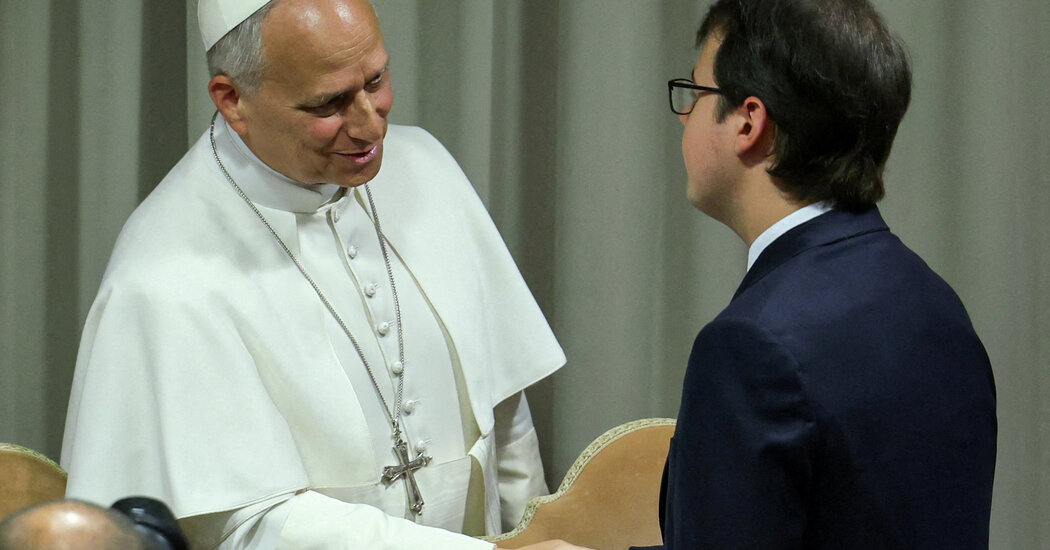
Popes have the privilege of taking a long view on things. A very long view.
Leo did that in his A.I. encyclical, “Magnifica Humanitas,” by situating this moment within the sweep of the church’s history. He referenced many bygone popes, the Tower of Babel, the ancient walls of Jerusalem. He also invoked longstanding Catholic social teachings, such as respect for the dignity of people and concern for the poor.
At more than 42,000 words, it was broad and sometimes gauzy. But it also included very specific policy proposals. Leo called for transparent model development, better educational programs, job protections and, above all, government regulation of companies. Those proposals, and his political and structural critiques, have been dissected extensively and everywhere over the past week; I share my reading list below.
I’m most interested, though, in what guidance the encyclical offers for individuals wrestling with how to use it, at home and at their jobs. So I called a priest for help. Father James Martin is a Jesuit and best-selling author who was a consultant to the Vatican’s communications team. Together, we tried to juice the encyclical for personal moral direction, for Catholics and non-Catholics alike.
A blurry line
I, like a lot of people, use A.I. every day. My chatbot console stays open on my laptop, and I turn to it hourly with questions, both inane and substantive. Help me brainstorm a get-well gift for a friend. Turn my garbled notes into a clear summary. Please transcribe this conversation I just had. It’s helpful, very often. But I’ve started to notice that my impulse to turn to it has become Pavlovian. I face a question, and I react by brain-dumping my thoughts to A.I.
I feel myself becoming more reliant on it. And that’s made me question where the line is: What can I ask of an agent without hurting myself, my brain or my creativity? Yes, my company has guidelines. I always write every word of Believing on my own, and same goes for everything I publish for The Times. But I still find myself lost in this new wild west, searching for more moral clarity on our digital frontier.
Religion is good at that. It famously, and controversially, provides frameworks that govern action. Islam has Shariah law, outlining halal (permissible) and haram (forbidden) conduct. Judaism has its mitzvot, or commandments. Buddhism has the eightfold path.
So what are the Ten Commandments for A.I.? Father Martin and I tried to outline a code of conduct, based on the encyclical.
Thou shalt do no harm
This is the most straightforward.
The German philosopher Martin Heidegger once argued that technology is not neutral, but it fundamentally shapes our perception of reality. Pope Leo did the same. He framed A.I. as a tool that is imbued with the ethics of its user — not as “morally neutral.” He wrote: “Every technical tool embodies choices and priorities through what it measures, ignores and optimizes, and how it classifies people and situations.”
In that sense, chatbots and agents should be used to help, not hurt, humans, Father Martin said. In an A.I. era, the golden rule means using chatbots to treat people as you would want to be treated. That means no deepfakes, slander, defamation, attacks or abuse to others online. “That would be a very easy thing to avoid,” he said.
Thou shalt reject a doctrine of efficiency
The encyclical also insisted we are more than our outputs. “The value of persons,” Leo wrote, “does not depend on what they achieve or produce.”
Martin and I discussed this, debating how people should respond to professional pressures that urge them to excel by being efficient — write more memos, code more quickly.
He shared a lesson from his time working in a slum in Nairobi, Kenya, when a woman he was helping asked him to stop and stay for tea. He had other people he needed to visit, and he politely declined. “She said, ‘Oh, I forgot you’re an American, you’re always in a hurry,’” he told me. “The value for her was human interaction. And that was something that I failed to give her.”
He worried that, in the pursuit of efficiency, we deprioritize human interaction, and in doing so hurt our mental health and weaken social ties. Go to the checkout lane instead of the self-scanner, he urged. Call a friend before turning to an A.I. therapist. Ask a boss for help more often.
Having more human interaction can sound trite, and a little Pollyannaish. People are busy. They just need to scan their cereal and get on with their day. I get it. I’m the same! But the pope makes the case that we degrade ourselves — and each other — if we don’t at least try to prioritize messy, clunky human contact in the face of so much algorithmic temptation.
Thou shalt value suffering (!)
Chatbots can make life easier. That may not always be a good thing, Leo said.
They can “encourage excessive reliance and the search for ready-made answers, and weaken personal creativity and judgment,” he wrote. This risks harming our capacity for original thinking. It also makes us less patient toward illogic and imperfection. That is a problem, he said, because there is intrinsic value in wrestling with difficulty — ideas, problems, relationships.
“To eliminate suffering entirely would mean, in the end, extinguishing love and desire as well,” Leo wrote. “Those who love and desire cannot avoid passing through trial and suffering.”
This guidance is perhaps the least straightforward to enact. Martin and I wrestled with it, and we landed on the idea that it might be more valuable to ask: What will I lose in this moment by using A.I.? Instead of, what will I gain?
It’s a familiar question, one that situates A.I. misuse — or overreliance — within a lineage of sins. Yes, you can gain pleasure and advantage by cheating and lying. But in the long run, you lose dignity and self-respect. The same may be true of using A.I. to solve every problem.
“It wouldn’t be a temptation if it weren’t appealing,” Martin said. “It’s recognizing that the most insidious temptations are the ones that seem good on the surface and that you can rationalize.”
What else should be in the Ten Commandments of A.I.? (Thou shalt write your own emails. Honor thy chatbots and agents.) Let me know here.
My reading list
People need meaning, and intense, world-shaping work is one of the oldest ways to find it; that part is not new and often not sinister. What is different here is that this particular work sits so close to the old questions — what are we, where did this come from, what comes after — that you cannot do it long without staring into them. They are not building God because they miss Him. They are building something that has brought them, unexpectedly, to the edge of where He would be.
Your feeds
I was genuinely shocked but also thrilled that hundreds of you sent me screenshots of your Instagram For You pages. The bravery!
I have many thoughts for a future newsletter about what these screenshots reveal about how we form our beliefs. But the main takeaway is: Our brains are being melted by the same puppy videos, appearing everywhere. (And for some reason, this quiz: “Am I German or Autistic.”)
Here is one standout contributor, who had none of the above. Jason Homa’s For You page is full of Baroque church architecture. Lucky you, Jason!
TrendingPilgrimage
I asked you, after my pilgrimage to Svalbard, where you find cathedrals in nature. So many people wrote in to say that wherever they are they find — or make — a holy place. That’s aspirational! Others were more specific:
Iona, a Scottish island. — Audrey Sausman (I keep hearing about people going on pilgrimages here.)
The American Basin in Colorado. “It is the strongest ‘thin space’ I have experienced.” — Julie Miley Schlegel
Smith Rock in Oregon. “The rock wall rises out of the ground like church steeples.” — Bobbie Parisi
The Chapel of the Transfiguration in Jackson Hole, Wyoming. — Dorothy Shore (I need to go!)
“My cathedral is found in South Arkansas under towering pine trees sighting bluebirds, red cardinals, sparrows and mockingbirds. I remember running to the dogwood tree as a child, long gone, to take solace when upset.” — Stella Pradeau
What I’m …
Loving: The Pantheon in Rome on Pentecost Sunday. People throw thousands of rose petals into the ancient, open oculus. See a video.
Reading: I recommended “John of John,” by Douglas Stuart, a few weeks ago. It’s about a Presbyterian crofter and his family on Harris, a Scottish island. It’s also about leaving home, the impossibility of a true return — and the lies that keep a world intact. Now that I’m deep into the book, I’m re-recommending it. Every scene is devastating and dazzling. If you’ve read it, email me? I want to talk about it.
Marveling at: This gorgeous chapel in China, called the “shadowless church.” It’s made of thousands of white aluminum beams.
Watching: “The Interview” with Laurie Santos, the Yale professor whose free online happiness class I tried to take during the pandemic. She and my colleague talk about the difference between hedonic and eudaimonic happiness. “Eudaimonic happiness is bigger. It’s about living a good life,” Santos said.
Needing: Your help. There is a bird outside my window that sings at all hours. It’s loud, shrill and specific. I have the recording, but no app or expert has been able to help me identify it. Can you?
One Last Thing
I met with a graduate student in Islamic studies this week. We were getting lunch near my office in London, and every time I left the table to get a new fork or a napkin, I came back to find him reading his book.
I love people who have intense obsessions, niche interests and an insatiable appetite to explore them. The third time, I said, please, you must tell me what you’re reading.
It was “The Blind Owl,” by Sadegh Hedayat, a Persian masterpiece about love. The Wikipedia page alone completely delighted me. Here’s a quote from the book:
The sun, like a golden knife, was steadily paring away the edge of the shade beside the walls. The streets were enclosed between old, whitewashed walls. Everywhere were peace and stillness, as though all the elements were obeying the sacred law of calm and silence imposed by the blazing heat. It seemed as though mystery was everywhere and my lungs hardly dared to inhale the air.
Happy Eid al Adha to those who celebrated over the past week. See you next Sunday!
Sign up here to get this newsletter in your inbox. And if you like it, share it with your family, friends or congregation.
Feedback, feelings? We’d really love to hear from you at believing@nytimes.com.
The editor of Believing is Jodi Rudoren. Harrison Hill is our photo editor.