
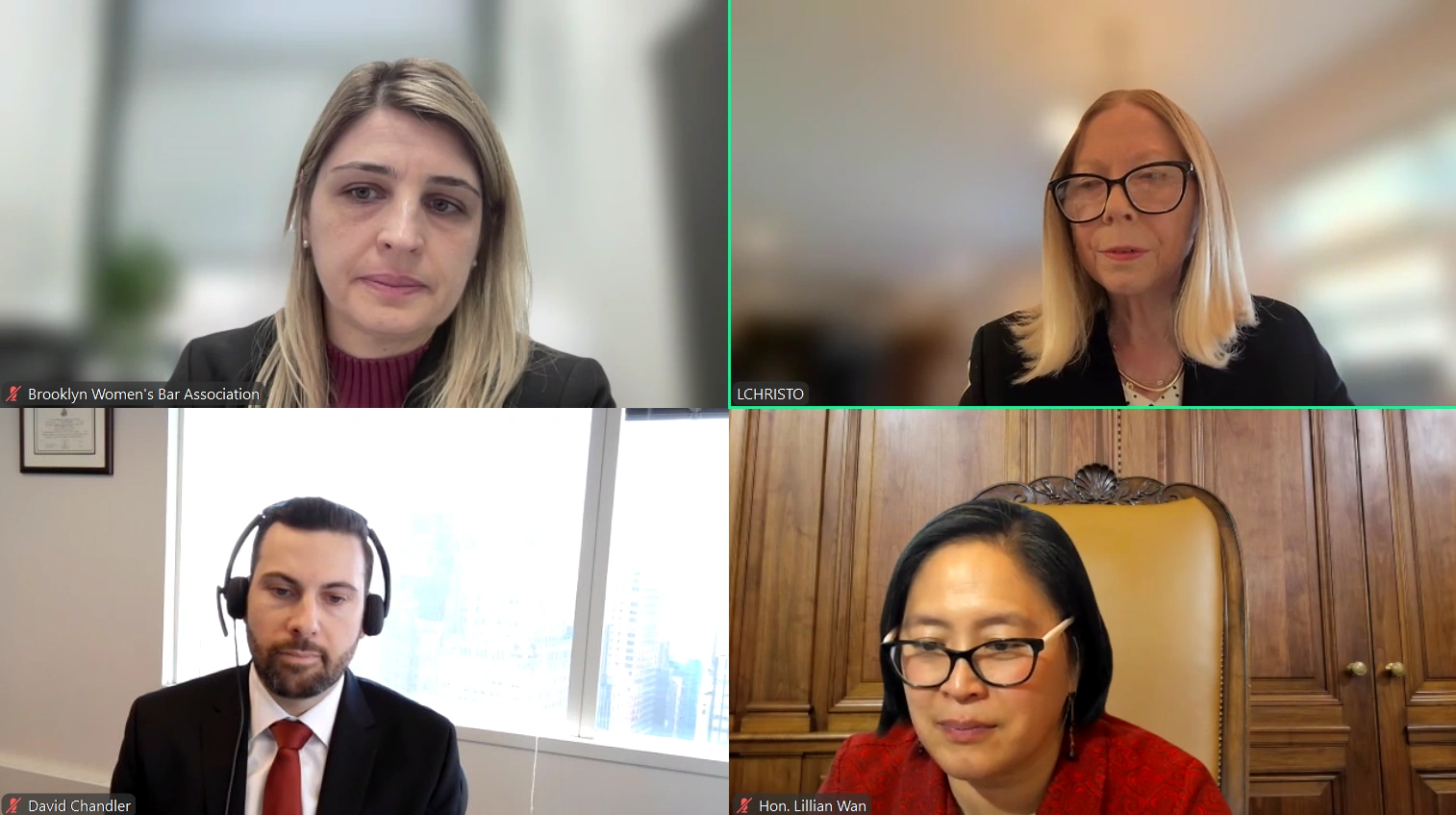
 The Brooklyn Women’s Bar Association hosted a virtual seminar to teach lawyers how to handle client money kept in escrow accounts on Monday, Oct. 27, 2025.
The session was led by Justice Lillian Wan of the Appellate Division, Second Department, featuring Justice Linda Christopher of the same court and David Chandler, the chief counsel to the Grievance Committee for the Second, Eleventh and Thirteenth Judicial Districts.
They discussed how New York lawyers must properly manage client escrow accounts under Rule 1.15 of the New York Rules of Professional Conduct, which sets the standards for handling, safeguarding and accounting for client and third-party funds.
It requires lawyers to keep the money in a separate, properly labeled escrow account and maintain detailed records for seven years.
The discussion covered recordkeeping, check clearance, account labeling, staff supervision and common mistakes that lead to disciplinary action.
“Ignorance of the rules does not excuse an attorney’s failure to comply therewith,” Chandler said, noting that even an honest mistake like spending money before a check clears can get a lawyer disciplined or suspended.
Justice Christopher, who spent more than 20 years in private practice before becoming a judge, focused on the most common errors that get lawyers in trouble.
She said that lawyers often don’t steal money, but rather make simple bookkeeping mistakes. Something as small as giving an escrow account the wrong name can change the outcome of a disciplinary case, Justice Christopher explained.
“What I think is probably one of the majority of the cases that we see in front of us are the cases I like to call the sloppy bookkeeper cases,” Justice Christopher said.
 David Chandler, chief counsel to the Grievance Committee for the Second, Eleventh and Thirteenth Judicial Districts. Screenshot via Zoom
“Basically, in my mind, these are good lawyers who are just busy, they’re distracted, maybe uneducated about how to conduct their escrow accounts. And they don’t realize the do’s and don’ts of escrow accounting.”
Justice Christopher also gave practical advice. Lawyers should review their escrow accounts at least once a month, keep complete records for seven years and double-check that client checks have cleared before spending any of the funds.
“You cannot go to the ATM and withdraw money,” she said. “You may not commingle your personal funds with fiduciary funds.”
Both speakers warned that lawyers can’t shift responsibility to others. If a bookkeeper, secretary or even a family member handles client funds, the lawyer still faces discipline if anything goes wrong.
Justice Christopher pointed to one well-known case where a lawyer’s brother stole millions of dollars from client accounts and the court still suspended the lawyer for failing to supervise him.
Justice Linda Christopher has been an associate justice of the Appellate Division, Second Department, since 2017. Before her appointment, she spent more than 20 years in private practice in Nyack, New York, focusing on matrimonial and family law and later served as a Family Court judge and supervising matrimonial judge in the Ninth Judicial District. She has also presided over the Rockland County Integrated Domestic Violence Court and has lectured widely on family law and professional ethics.
Chandler oversees investigations and prosecutions of attorney misconduct and supervises disciplinary hearings before Special Referees. Before joining the Grievance Committee, he served as a Sullivan County Assistant District Attorney, where he prosecuted felony and sex crime cases. He earned his law degree from the University at Buffalo School of Law.