
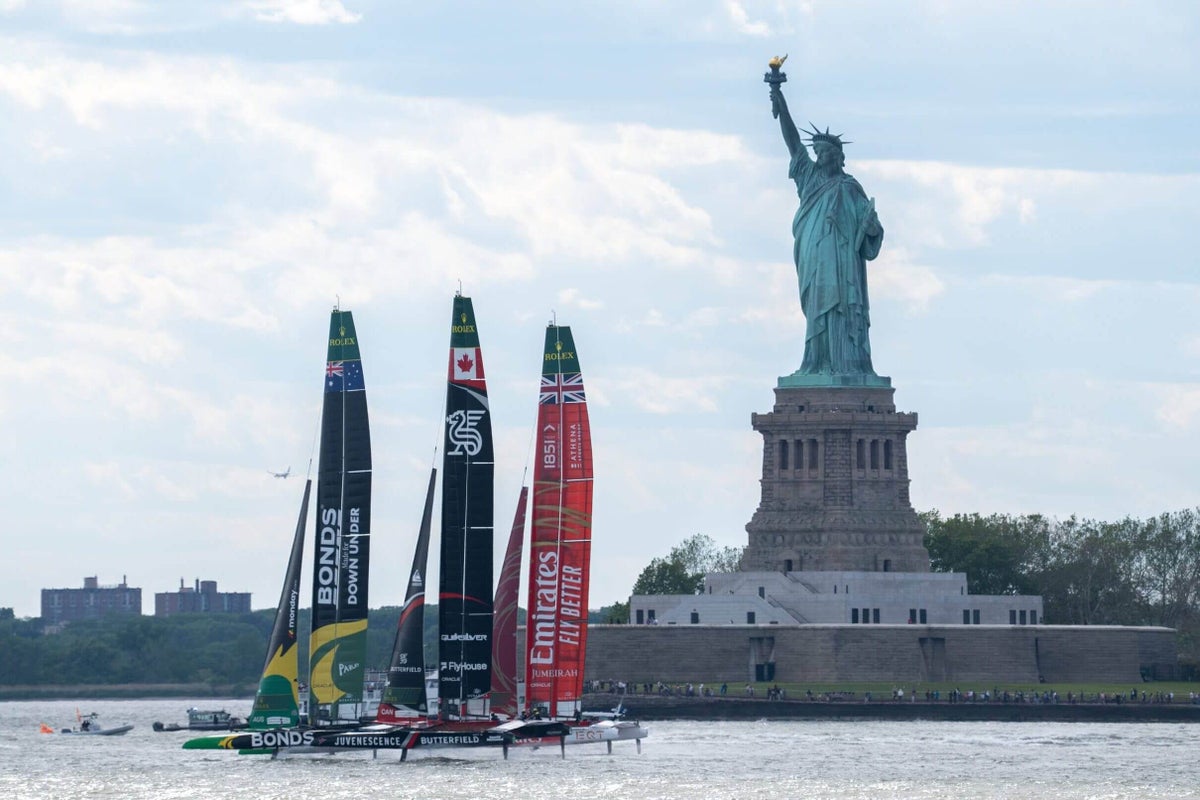
Editor’s note: This story is part of The Athletic’s coverage of SailGP, an international sailing competition that has been likened to Formula 1 on water. Follow SailGP here.
Taylor Canfield and his U.S. team were doing all the right things to send them on their way to a first victory on home waters in SailGP. After finishing second in Sunday’s first of three fleet races at the New York Sail Grand Prix, and easily winning the next, all the Americans needed was an average start in the shadow of the Statue of Liberty. An average start would have most likely been enough to secure what looked like a certain place in the three-way fight for overall honours.
But then it all unravelled so quickly for Canfield. Instead, somehow it was Tom Slingsby who emerged from a bruising day of unreliable wind and an unhealthy dose of boat-on-boat carnage to steer Australia to victory in the three-boat final. The British team pushed the Aussies hard all the way to a controversial finish, to end up in second, with Canada finishing third in Giles Scott’s first final of the 2026 season.
Aussies defy their bad fortune
A carbon-crunching, three-way crash on the start line of the final fleet race will dominate people’s memories of a mad Sunday, making Australia’s victory of resilience somewhat of a footnote at the end of a wacky weekend. More of the crash in a moment.
There were so many times over the weekend when it looked like Australia’s great run of form and fortune had finally expired. Yet just two days after Slingsby’s celebrity team co-owners — Hugh Jackman and Ryan Reynolds — announced a Disney+ docuseries following the team’s progress through the SailGP season, the Bonds Flying Roos continue to go from strength to strength.
Slingsby knew he’d enjoyed his share of luck, too, however. After a big nosedive Saturday put them out of action, the shore crew had worked most of the night to repair and ready the green-and-gold boat for action Sunday. Then, when the boat hit a piece of unidentified debris in the Hudson River while getting in some practice before the racing began, one of the rudders broke. The Aussies were looking unlikely to make it in time for the first race, but, again, the repair team worked their magic and got the wounded Roos up and running again.
“New York’s always been a bit of a wild one for us,” Slingsby told The Athletic. “We’re pleased to have scored a victory here in the city where our co-owners (Jackman and Reynolds) live. This is not the usual race track that plays to our strengths. We liked the bigger courses where we can make our boat speed advantage work in our favour, so we’re really happy to have won here on a short course.” Hanging out with those Hollywood superheroes seems to be working well for Slingsby.
The rain in Spain
Where the Australians recovered from technical breakdowns by the skin of their teeth, Spain, on the other hand, suffered hydraulic problems that meant Los Gallos were unable even to start the first race. A particularly tough pill to swallow for Diego Botin after his team won two of Saturday’s three high-wind races, albeit only four boats made it onto the boiling waters of the Hudson River on a severely compromised day for SailGP. However badly things went for the Spanish, at least they weren’t involved in that crash.
The crash
After they finished the first two fleet races so strongly, American dreams unravelled in the blink of an eye. Italy’s skipper Phil Robertson realised he was getting to the start line too soon. To avoid crossing the line early, his only option was to turn right and get his F50 along the length of the line. The 27.5m wing sails create a huge blind spot. The U.S. team, with all five sailors on the windward side of their boat, didn’t spot the unexpected change of direction by the Italians. The American boat skewered the front of the Italian obstruction. Meanwhile, a split-second later, the Brazilians — with nowhere to go — smashed into the back of the Italian boat. All three F50s were not locked together as the other nine boats foiled away down the race track.
Confirmation soon came through that no one had been injured, just the boats, which would play no further role in the competition. An hour later, Canfield was surprisingly upbeat considering the disaster that had ruined an otherwise well-executed day.
“We had two really great races and started the boat really well, but then things can come down to that one bad moment,” he told The Athletic. “For all of that, we’ve got to look at some of the positives we had today.” As for the crash: “I don’t think anyone is looking to get crashes here. We just need to make sure we’re looking after each other and looking after the boats.”
Are split fleets the answer?
That depends on whom you ask. After the horrific Auckland crash, SailGP said we’d see a lot more ‘split fleets’ — dividing the pack into two groups as a means of reducing high-traffic moments of risk.
Nathan Outteridge, Australian skipper of the Swedish team, told The Athletic: “We were meant to do split fleets this weekend, and then they changed it after yesterday’s blowout. But I think what we’re seeing now is, with all these small courses, it’s not a whole heap of space. It was a cool event, but it was a shame we only got one day of racing.”
Danish skipper Nicolai Sehested had another point of view. “I disagree with Nathan,” he told The Athletic. “You can have crashes in a split fleet as well. In the split fleet, you’ll still have six boats, so you can still have the same thing that happened today, and the same goes for the situation with France and New Zealand in Auckland. It’s two boats next to each other, so I don’t think split fleets is the solution.”
On to Halifax
It’s three weeks until the next SailGP Grand Prix weekend in Halifax, Nova Scotia. Three weeks to digest what happened over a frenetic weekend. This is the weekend when New Zealand are set to make their return to the league after missing all the events since the crash with France in Auckland in February. But just as the Kiwis are set to return, will the badly damaged Italian boat be able to get repaired in time? We thought it would be 13 boats in Halifax. It might still be 12.