
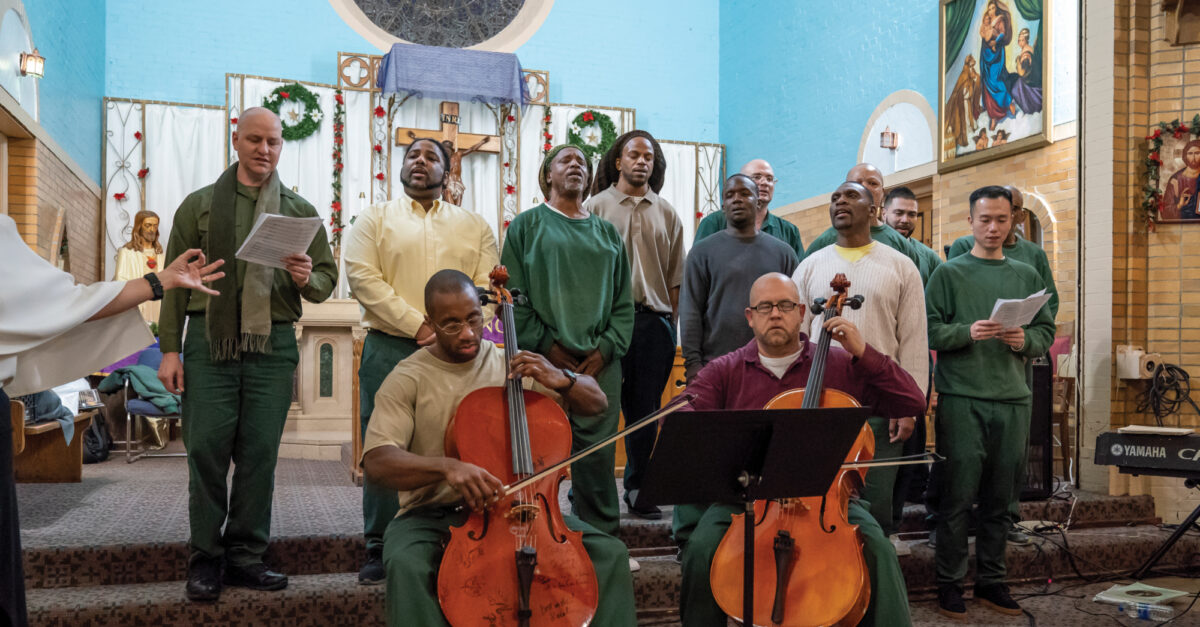
When Carnegie Hall launched a music program for incarcerated men at Sing Sing Correctional Facility in Ossining, New York, Manuel Bagorro knew it would be a learning experience—not just for the participants, but for the staff as well. “We were very much in the diagnostic phase, feeling our way and trying to decide what would be most responsive to need,” recalls Bagorro, an arts organizer and longtime creative advisor to Carnegie Hall’s Weill Music Institute. Initially, Musical Connections was conceived as a series of concerts at the maximum-security prison. But Bagorro and his colleagues soon realized the residents of Sing Sing wanted to do more than listen to music—they wanted to make it, too.
“We learned immediately it was important not to make assumptions about musical interests or ability,” Bagorro says. “We discovered there was a prison band that got together whenever they could. It was very ad hoc and unsupported, but with some very gifted people. So what started as a concert series grew into workshops, ”fostering songwriting, improvisation, and collaboration. “It became clear very quickly that there was enormous musical ambition. There was a real drive to create and to use their voices to express something that they didn’t have any other outlet for.”
This spring marks 15 years of music making at Sing Sing. For the first time, Carnegie Hall is sharing the power of the program with the public through a trio of video playlists called Sing Sing Voices. Featuring a wide array of songs (jazz, rock, hip-hop, contemporary classical, and un-categorizable) written by Musical Connections participants, these playlists focus on three themes: Inner Transformation, Exploring Identity, and Reimagining Change.
Celebrated artists who have lent their time and passion to the project—opera star Joyce DiDonato, Afro Latin jazz great Arturo O’Farrill, and acclaimed rapper Common—introduce these selections and discuss how being involved with the program has enhanced their own lives.
Common calls his experiences with Musical Connections “a gift,” adding that “being able to go to Sing Sing and connect with the human beings in there, introducing somebody to something they never knew existed, and then for them to be able to join you later is a true journey.”
The impact of Musical Connections is impressive. Over a decade and a half, music workshops have yielded more than 300 original songs performed by participants and professionals at over 50 concerts at Sing Sing. The recidivism rate for alumni is significantly lower than for the general population—“by triple digits,” according to Ayanna Cole, Carnegie Hall’s director of social impact programs. There is an alumni advisory committee as well as an alumni band, The Freedom Trap, and three alums have since landed jobs at the Hall.
But those numbers don’t tell the whole story. The individual outcomes are even more profound. “The men talk pretty openly about the ways that creating music and community at Sing Sing have contributed to their personal growth,” says Cole. “Their family members have said the same thing. I’ve had spouses tell me that the music helped to open conversations. And I’ve had men say the process of making music has made them better fathers. Those types of examples are holistic. They’re harder to document, but they’re probably even more important.”
Change is a word that comes up frequently when talking to Musical Connections participants about the benefits of the program. According to Paul, who is still at Sing Sing, “I want my music to show that it helped me change my life and gave me a new outlook on how I live my life now.” Meanwhile Ivan, an alum and member of the Musical Connections Advisory Committee, says that “this body of music is also about the joy of change …It’s an opportunity—a very rare opportunity—to pour some light into the world.”
In many songs, the writers reckon with who they were before incarceration, who they are while composing, and who they hope to become—particularly once they leave Sing Sing. Creating music is intertwined with their “process of healing, seeking forgiveness, and thinking about ways to repair damage done and be a different person than the one who was arrested,” says Cole, who worked as a television producer and social worker before joining Carnegie Hall a decade ago. “Their songs pour out of places of deep regret. Most of the men in the program were approximately 17 years old at the time of their arrest. Now they’re in their 40s. It’s clear from the process of music making that there’s a journey of maturation and transformation.”
The professional artists who work with these men also find themselves moved by the experience. DiDonato recalls that the first time she visited Sing Sing and sang an aria, one of the residents approached her to say, “I didn’t know opera existed before you came here. Now I want to know everything there is to know about it and I have to write one.” A few years later, she returned and they performed a duet from an opera he composed.
Cole hopes these stories and the playlists, much like the Oscar-nominated movie Sing Sing about the theatre program created by Rehabilitation Through the Arts, will give skeptics a chance to see how the arts can play an integral role in preparing incarcerated individuals for successful re-entry. “For anyone who wonders why Carnegie Hall is even doing this, people pay for the crimes they committed and then they come home,” says Cole. “Who do you want to have returned to society? You want someone to come home who’s going to support their family, contribute to their community, and help all of us develop a better world.”
“Music is the most unbelievably beautiful thing, but it’s just a vehicle,” says O’Farrill. “The most important thing is to try and understand others—for people to see and be seen … and heard.”