
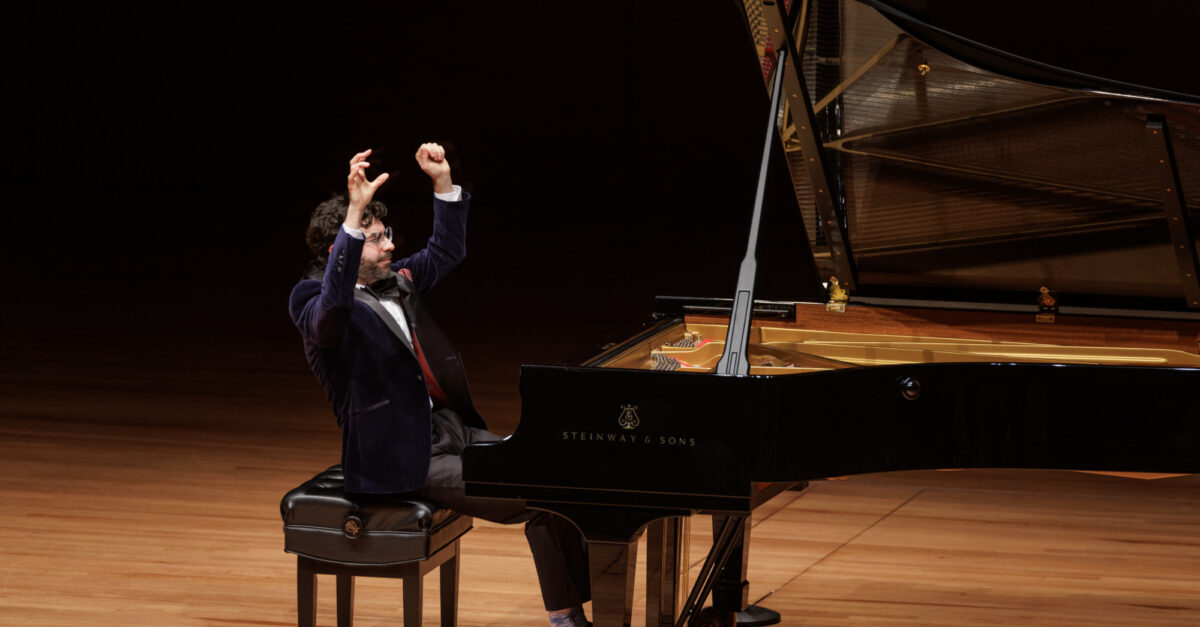
The beloved annual tradition of summertime chamber music at Alice Tully Hall returns this year with six Summer Evenings performances. I spoke about the series with pianist and composer Michael Stephen Brown, who will be performing on the third installment, taking place on July 14.
This is an ambitious program, spanning nearly two centuries of chamber music from Haydn to Bernstein. Can you talk about how the program came together?
Michael Stephen Brown: A few years ago, we did a program at CMS called Voices of the Americas, with soprano Jessica Rivera, cellist Nick Canellakis, percussionist Ian Rosenbaum, and Gilles Vonsattel also on piano. It was Nick’s and my creation—we loved playing Bernstein’s Meditations, Gershwin’s Cuban Overture, and other pieces like Copland’s El Salón México, plus works by Alberto Ginastera, Osvaldo Golijov, Tania León, and others. We wanted to present different voices from the Americas, both north and south, to weave this tale of cross-pollination of cultures. This Summer Evenings program is an offshoot from that, with a second theme of Haydn, Mendelssohn, and Brahms.
In Haydn’s late piano trios, one of which is on this program, there is a shift away from the older trio sonata conventions and toward the true representation of each instrument that we associate with the trios of the later Classical period. Is there anything that changes in your approach to the piano part across different stages of a genre’s evolution?
In the Haydn (and in the Mendelssohn), you get very piano-centric works. The cello in the Haydn is certainly much more equal to the violin than it was in his early trios. But no matter how you slice it, it’s piano-forward. This one is a mini piano concerto: it’s full of dazzling pianistic difficulties. Remember, the piano is still growing up as an instrument during this time; the light action that those forte pianos had certainly helped.
Do you rehearse a piece differently when there is one clear leader in the group?
Whoever is playing piano definitely leads the ensemble. But you have freedom to be spontaneous. For example, the last movement has repeats, so you can do different dynamics and timings to bring across the humor and wit of the piece. It’s always a discussion; you don’t want it to sound like a reading session, but you want the freshness as if you’re discovering the music for the first time.
The program also features selections from Brahms’s popular Hungarian Dances in the original four-hand version. Of all the ensemble types, where does four-hand piano rank for you? What are the challenges and what do you look forward to?
Four-hand piano is a huge part of what I do—I always find myself playing four hands and I’m writing a four-hands piece at the moment. Playing the piano is sometimes an isolating and lonely activity. When I was at school at Juilliard, it was a way to connect with people; we’d say, “Oh, let’s read some four hands! Let’s read a Beethoven symphony or a Mozart string quartet!” Virtually everything has been transcribed for four hands because it was a means of distribution, a way to get your music out there before recordings.
But it is challenging. Sam [Hong] and I are friends, but we’re different pianists with different sounds and different concepts of pedaling. We have to feel the space that we’re sharing together, and that takes a lot of coordination. There’s choreography to figure out: who’s going to go up with their elbows, who’s going to go down? Will we crash into each other? It’s like someone else is brushing your teeth for you. It could be strange, but you can also learn a lot from the people you play with. I love doing it, I think it’s one of the best things you can do as a pianist.
This summer marks America’s 250th anniversary, and we have two major American composers on the program: Gershwin and Bernstein. Could you talk about what these composers mean to you and to American music as a whole?
Together with Copland, they are the founding fathers of our American 20th-century style. Leonard Bernstein is my childhood hero. He was a composer, a conductor, a pianist, a raconteur, a teacher, an educator—just a pioneering figure who wrote incredibly beautiful and sublime music. The fact that he was a composer was something that inspired me the most growing up. I’m also a New Yorker and can feel Gershwin’s imprint on the Upper West Side, and Bernstein’s as well.
You are also a composer; where do you see American music heading, for the next 25 or 250 years?
I wish I could foresee the next 250 years! I do think about what music lasts and what music doesn’t, or what music comes in cycles. Sometimes composers have a moment where everyone’s playing their music, and then something happens and their work stops being performed. So much of it is also due to performers taking an interest in a composer’s work, like Vladimir Horowitz championing Samuel Barber’s Piano Sonata through his legendary recording. Now, every pianist plays the Barber Sonata. Had Horowitz not done that, perhaps that wouldn’t be the case, even though it is an amazing piece. For me as a performer-composer, I’m always interested in learning new pieces and commissioning new pieces from others. I think that’s the way forward—to keep supporting the creation of new art and see what sticks.
The Meditations are from Bernstein’s Mass—a fascinating work that combines sacred music with rock, Broadway, and seemingly everything in between. Rooted in liturgical texts, it is also a profound political statement. Can you talk about how the meditations fit into the larger context of the work?
I think he wanted to do something incredibly grand, with unbelievable forces of music, big instrumentation, chorus, and even organ. But despite this, it has a direct, personal quality, and for me this transcends the religious aspects. I listen to the piece as a personal expression of his own troubles. The Three Meditations are incredibly effective as piano and cello pieces. I think they’re very otherworldly, very ethereal, almost modernistic—not what you would expect from the Leonard Bernstein who wrote West Side Story. It’s a later style, very personal and direct.
CMS’ Summer Evenings series always strikes a balance of familiar and lesser-known programming. What are you most looking forward to about the series this year?
I just love the Summer Evenings! I always love CMS, it’s like family tome. But there’s something special about the summer that everyone gets excited for. It’s a different crowd, a lot of people who haven’t attended before, which is perhaps the most exciting thing. It’s the middle of July, New York is buzzing, it’s a little too hot, but it has a major vibe. It’s always packed, and the crowd is always super loud and enthusiastic; they’re genuinely thrilled to be there. Anyone who says that classical music is dying should go to CMS’s Summer Evenings—it’s proof of the contrary!