
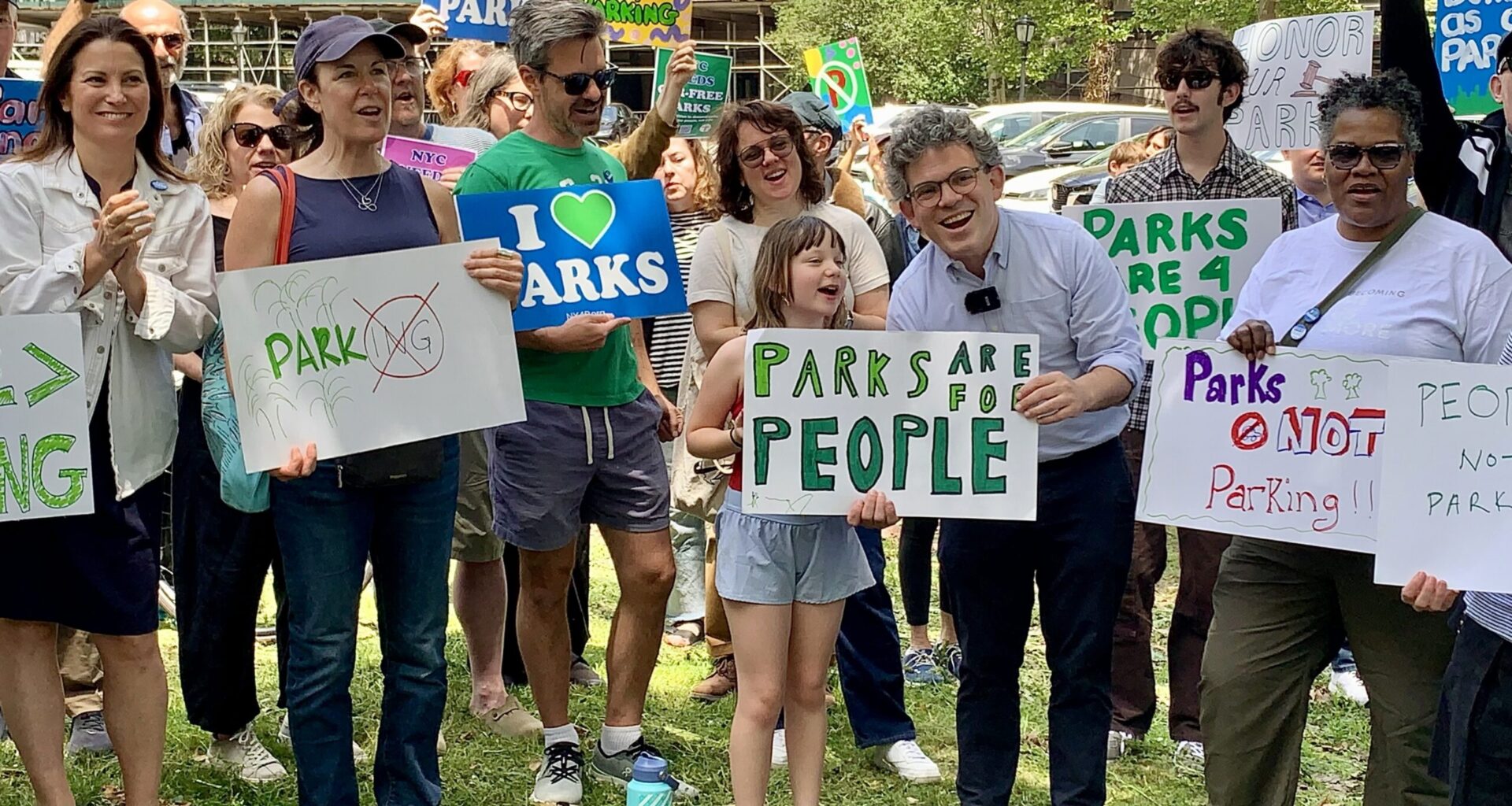
DOWNTOWN BROOKLYN — Local officials and community members gathered Sunday in Downtown Brooklyn’s Columbus Park to demand that Kings County Supreme Court judges and staff give up their private parking lot — situated since 2008 on public parkland next to the courthouse and Borough Hall.
“Where’s our park? Right here,” the crowd chanted, waving handmade signs reading “Parks, Not Parking” and “Parks Are For People.”
Locals want to convert the asphalt lot to green space as part of an $80 million plan to redesign Columbus Park redesign.
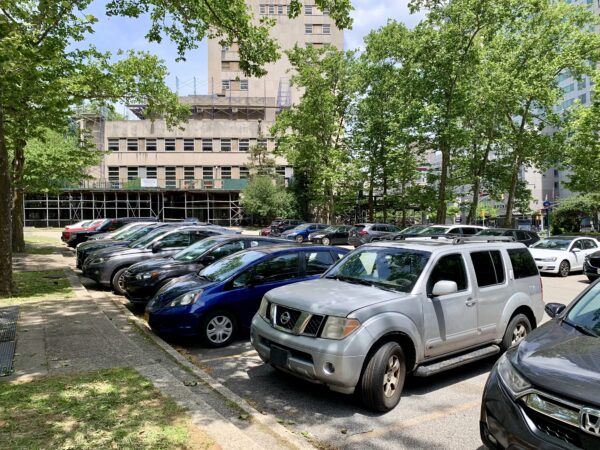 The disputed parkland used by Kings County Supreme Court judges and staff as a parking lot. Photo: Mary Frost/Brooklyn Eagle
Rose Ryan, a “born and raised Brooklynite” who lives nearby, told the Brooklyn Eagle she was “infuriated about the use of public space by these people, especially in such a transit-rich neighborhood where we have five subway lines just outside the parking lot and two up the block. It’s appalling.”
“Some people spend way too much time on their phone,” said Public School 261 student Octavia. Spending time in the park “could be a beautiful way” to get outside and soak up some Vitamin D, she suggested.
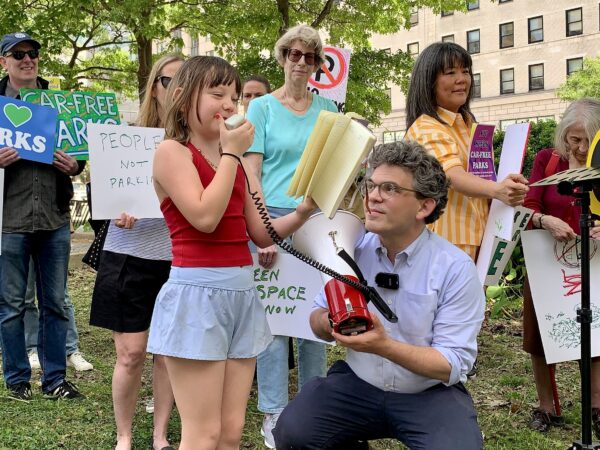 Octavia, a student at P.S. 261, speaks out while Councilmember Lincoln Restler assists with the megaphone. Photo: Mary Frost/Brooklyn Eagle
Borough President Antonio Reynoso and Councilmember Lincoln Restler have allocated $21 million towards Phase 1 of the project, which includes the parking lot. The redesign was hashed out last year by Reynoso, Restler, the Downtown Brooklyn Partnership and the design team WXY Architects, in consultation with landscape architect Michael Van Valkenburgh.
However, the Office of Court Administration opposes the idea of the judges moving their cars elsewhere for security reasons, citing an increase in threats to the judiciary.
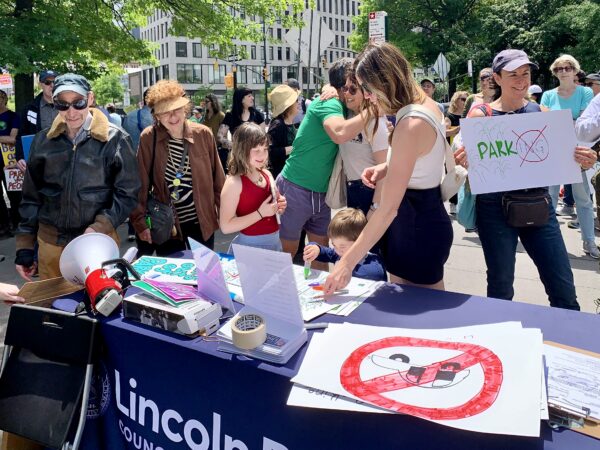 Attendees at Sunday’s Columbus Park rally make signs and sign petitions. Photo: Mary Frost/Brooklyn Eagle
The Justices already gave up one-third of their parking spots in 2008 in return for a guarantee to retain the remaining spaces, Judge Richard J. Montelione, chair of the Board of Supreme Court Justices of Kings County, wrote in an op-ed in the Brooklyn Eagle on May 23, 2025.
“Back then, the major issue was the security of justices. It is an even more prominent concern now with the security threat significantly increased,” he said.
The Brooklyn Eagle has reached out for comment.
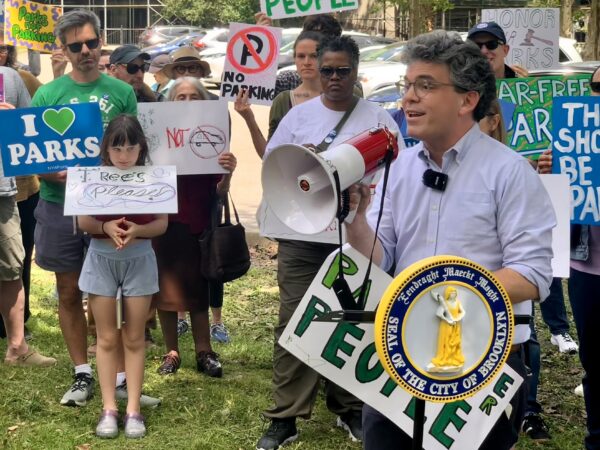 Councilmember Lincoln Restler, right, said the time has come to “evict the judges.” Photo: Mary Frost/Brooklyn Eagle
‘They can damn well take the subway’
Restler told the crowd the time has come to “evict the judges,” who have been offered numerous alternative places to park their cars.
“Reynoso and I have met with the judges’ Office of Court Administration six-plus times and offered every different option under the sun,” Restler said, ticking off the offers the judges have so far refused: parking space in the nearby Marriott Hotel; additional free on-street parking; space with Brooklyn Law School; space in a nearby co-op.
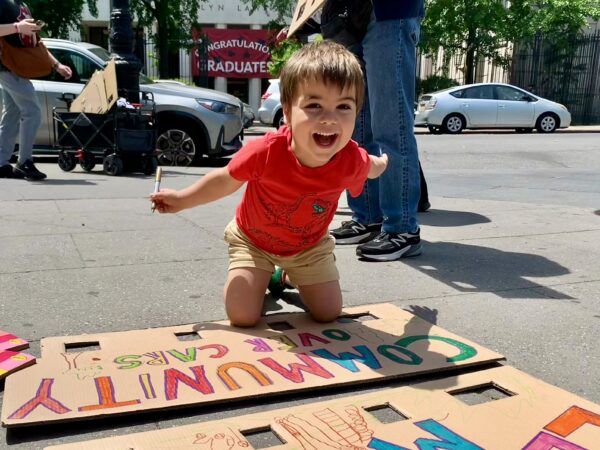 Hank, age 4, helps with the signage. Photo: Mary Frost/Brooklyn Eagle
“We’ve even offered valet parking where judges could drop off their cars here and be taken somewhere else,” he said. “The judges have reflexively said no to everything. They are selfishly insisting on hanging on to this parkland that our community desperately needs.”
On top of that, the judges and staff are already entitled to 250 free parking spots nearby, including 170 on-street spots and 80 more in a parking garage two blocks away.
Downtown Brooklyn has a drastic shortage of parkland, Restler said. The 2004 Downtown Brooklyn rezoning wasn’t expected to generate as much housing as it did — it was intended to encourage more office and commercial space. Instead, more than 25,000 apartments were built (and most were luxury, according to a Pratt Center study).
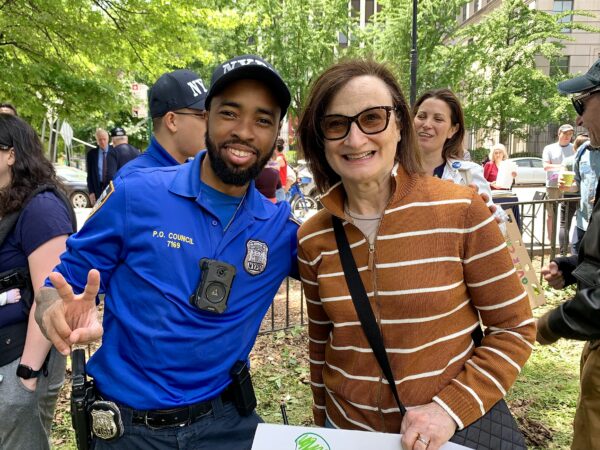 Community Affairs Police Officer Wallace Council with Regina Meyer, president of the Downtown Brooklyn Partnership. Photo: Mary Frost/Brooklyn Eagle
“If the city had anticipated that they were going to build over 25,000 apartments, then the city would have been on the hook to build two big new parks the size of Fort Green Park,” Restler said. “But because they thought it was going to be commercial space, they weren’t required to build new parkland. And so, we need this park desperately.”
He also pointed out that many of the judges live within walking distance.
“Let them take the subway!” someone from the crowd shouted.
“They can damn well take the subway,” Restler answered. “We are telling the judges in no uncertain terms, it’s time to go. We can do this nicely, or we can do this the hard way. But there’s no if, ands or buts.”
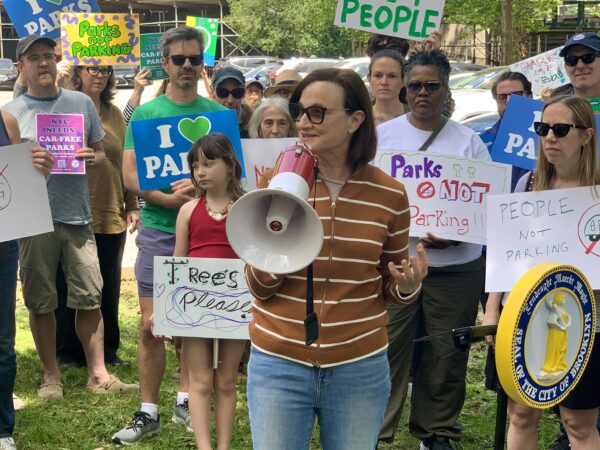 Regina Meyer, president of the Downtown Brooklyn Partnership. Photo: Mary Frost/Brooklyn Eagle
Best location in the city for a park
“This location is one of the best in New York City, certainly one of the best in Brooklyn, for a new park,” said Regina Meyer, president of the Downtown Brooklyn Partnership, which was one of the prime movers behind the park’s redesign.
Columbus Park could be so much more, she said. “It could have a playground; it could have a dog run. It definitely needs a skate park.”
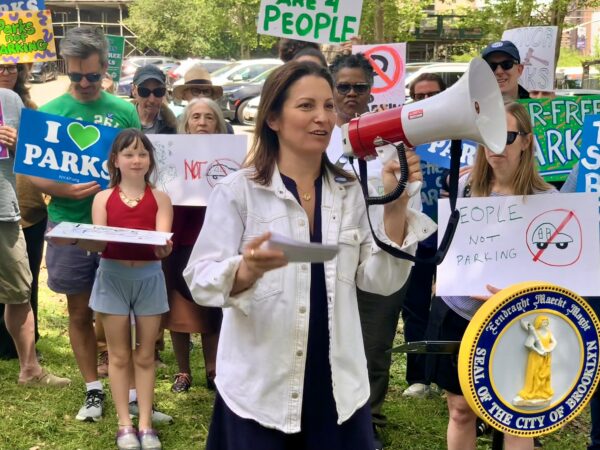 Brooklyn Heights Association Executive Director Lara Birnback. Photo: Mary Frost/Brooklyn Eagle
Brooklyn Heights Association Executive Director Lara Birnback had a message for the judges: “You’re in contempt. And you’re on the losing side of this issue.”
Kathy Park-Price of New Yorkers for Parks said that Downtown Brooklyn and nearby neighborhoods include only about 6% parkland compared to a 23% citywide average, making the lack of green space “an emergency.”
If converted to parkland, the lot “would serve thousands” versus a few dozen judges, she said.
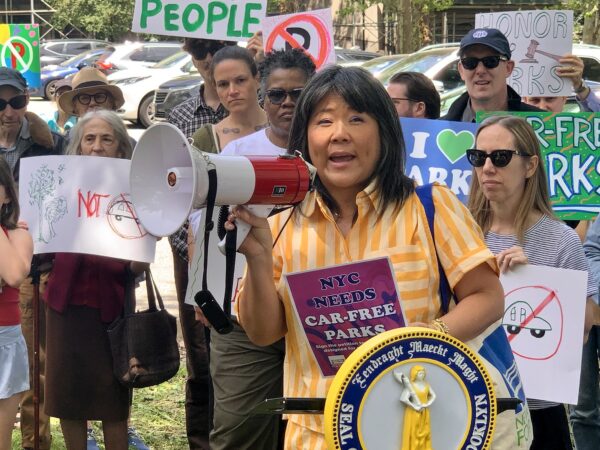 Kathy Park-Price of New Yorkers for Parks. Photo: Mary Frost/Brooklyn Eagle