
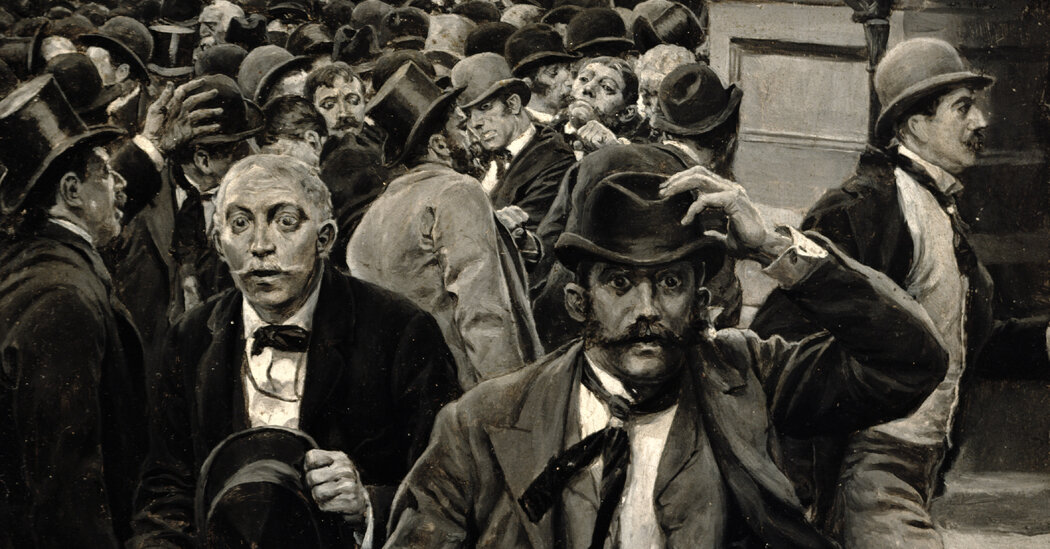
And yet their successful navigation of the tumult ironically fed into the wider hallucination that “Jewish bankers” were behind the sudden scarcity of money, especially in Austria and Germany, where the word “antisemitism” was popularized around 1880. In the 1890s, pushing back against a loan from the Rothschilds that would ultimately help stabilize the American economy, the populist demagogue and Nebraska congressman William Jennings Bryan had the House clerk read aloud from “The Merchant of Venice.”
The wider cast of speculators, bankers, journalists and politicians in “1873” are nearly all corrupt, venal, duplicitous, stupid or some combination thereof. The cumulative effect is impressive. Without ever coming out and saying so, Ahamed presents a world-spanning financial system that was rotten to its core, a machine that ran on lies, bribes and greed, busily manufacturing its own political opponents. Though their specific targets were often wrongly chosen, from Nebraska to Vienna, resentful workers, farmers, artisans and shopkeepers blamed the financial elite for the crash and the long deflation, forming movements of anticapitalists around the world.
A longtime banker and hedge fund adviser, Ahamed knows what he’s doing. His history of the more familiar Great Depression of the 1930s, “Lords of Finance,” won the Pulitzer in 2010. For a reading world still pummeled by the crisis of 2008, it was the right book at the right time.
Does his new history resonate as strongly? Here again Ahamed tells his story with an easy fluency and a high velocity, while navigating less familiar terrain with great confidence. In the introduction and occasionally throughout, he gestures to our present predicaments. But he never quite shows, as he suggests in his subtitle, how the Great Depression of 1873 made the modern world.
There is a wide popular sense that we are living through a second Gilded Age. Our rulers, from the president to the tech oligarchs, sometimes openly express longing to return to the late 19th century; pushing for lower interest rates to get cheap money to lay down warehouses full of processors the way railroad magnates once rolled out miles of track.