
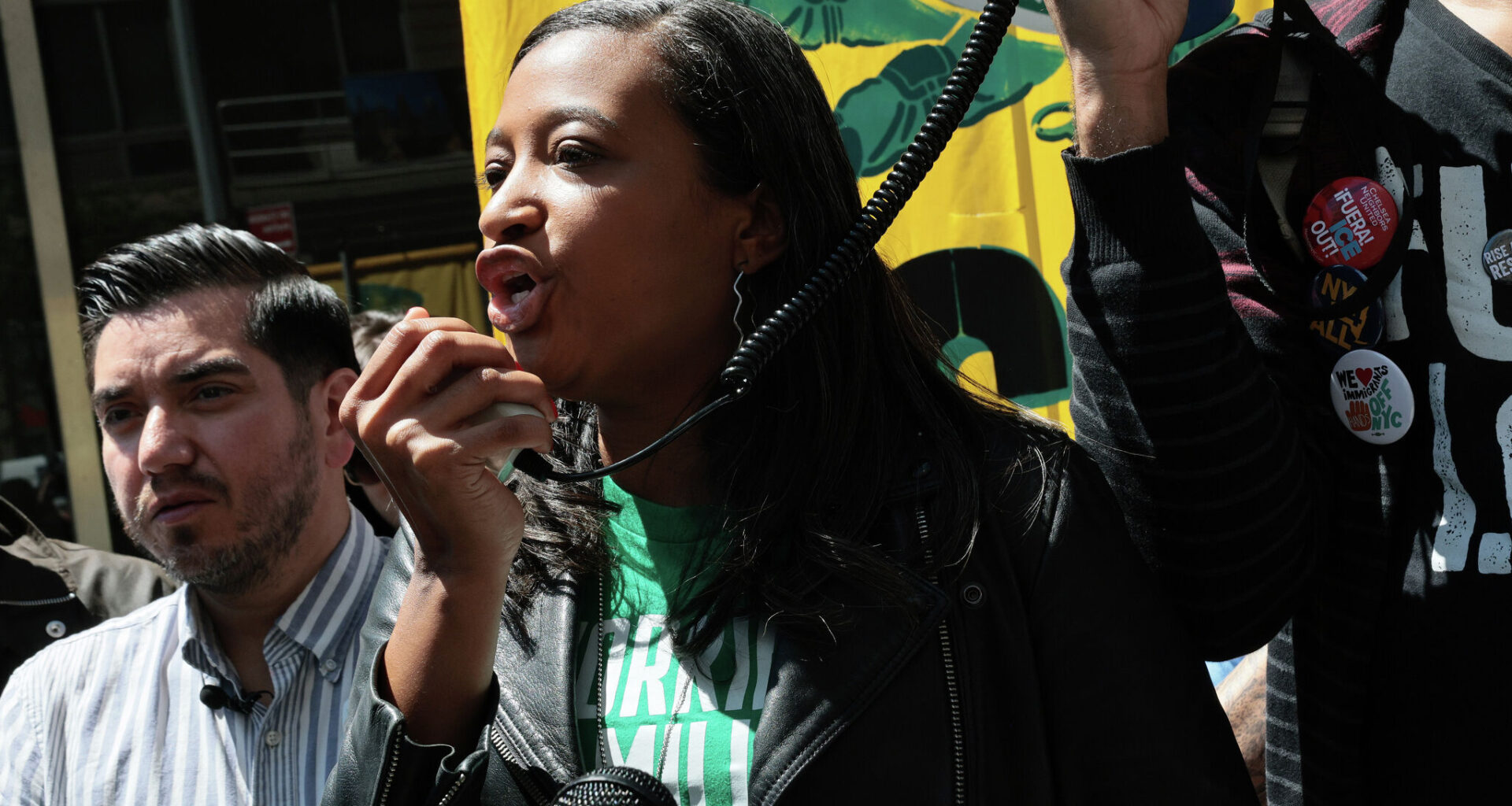
Jasmine Gripper, state director of the New York Working Families Party, said the party is beginning to disenroll candidates it believes are trying to hijack its ballot line.
Michael M. Santiago/Getty Images
ALBANY — Thomas J. Kenny would be the youngest member elected to the state Assembly in decades if voters choose him to represent a district that includes portions of Saratoga, Washington and Warren counties.

The 22-year-old Amazon warehouse employee’s candidacy, however, is being challenged by the Working Families Party as being part of an alleged ballot hijacking scheme designed to siphon votes from an incumbent Democrat’s ballot line.
Article continues below this ad
The race is an early test of a law Democrats approved last year in response to alleged spoiler campaigns targeting the Working Families Party ballot line. It is also exposing limits in how quickly the party can act to disenroll someone from the party.
Even if the party succeeds in removing Kenny from the party, election deadlines mean he could still remain on the November ballot.
Removing someone from a political party — which the new law enabled — can be slow, costly and, in some cases, have no practical effect on the election, said Joe Burns, a former deputy director of election operations for the state Board of Elections.
Make the Times Union a Preferred Source on Google to see more of our journalism when you search.
Add Preferred Source
The law signed by Gov. Kathy Hochul in December allows the Working Families Party to disenroll members believed to be “not in sympathy” with the party, subject to a hearing and court review.
Article continues below this ad
It’s a similar process afforded to major political parties in New York. The bill was criticized by Republicans as a power grab that fosters anti-democratic voter suppression to help the Working Families Party.
A screen grab of the campaign of Thomas J. Kenny, 22, who is running for the 113th Assembly District. The Working Families Party says he hijacked their ballot line.
Thomas J. Kenny campaign website
“The law was a step in the right direction for helping us to control our line, but it does not solve all of our problems,” said Jasmine Gripper, state director of the Working Families Party.
Assemblywoman Dana Levenberg, a Democrat representing parts of northern Westchester and Putnam counties, said she has discussed possible changes to the law with the Working Families Party.
Article continues below this ad
“I think that we thought this would help and now the question is, are we seeing that it’s not helping? I don’t know,” said Levenberg. “I guess we’ll have to see if we need to do a better job.”
What the law did
The Working Families Party has been a bastion of progressive ideology since it was formed in New York in 1998, when it sought to align itself with organized labor. It has since expanded into other states and is one of the four political parties that appear on the ballot in the Empire State.
New York’s fusion voting system allows candidates to appear on multiple ballot lines, creating opportunities for so-called spoiler candidates.
Article continues below this ad
For decades, both Republicans and Democrats have run spoiler candidates on the Working Families Party line. Those are candidates who may obtain enough signatures to secure a ballot line, but do not actively campaign. Even without a campaign, many voters will select those candidates based on their party affiliation but without knowing they are only on the ballot to pull votes from other candidates.
The Working Families Party was involved in crafting the bill. They brought it to Levenberg, who believed it would halt ballot line hijacking because it could allow the party to intervene during the petitioning process.
The legislation was prompted, in part, by the 2024 race in New York’s 17th Congressional District, where Anthony Frascone secured the Working Families Party ballot line against Democratic candidate Mondaire Jones. Party officials accused Republicans of backing Frascone to siphon votes. He received 2% of the vote in a race Jones lost by 6%.
Gripper said the Frascone race underscored the need for more control over the party’s ballot line.
Article continues below this ad
Assembly Republicans opposed the bill, arguing it shifted power to state party leaders and expulsions over ideology.
Burns shares that criticism.
“Many New Yorkers, they would assume these were trials over someone’s personal beliefs, trials over somebody’s philosophy and what constitutes a Working Families Party in good or bad standing,” said Burns, who is now a partner with Holtzman Vogel, a political, regulatory and litigation firm.
Why the new law may be ineffective
Kenny switched from the Conservative Party shortly before running on the Working Families Party line.
Article continues below this ad
Kenny, who refused to agree to an in-person or telephone interview, has denied allegations that he is a sham candidate. Local party organizers said he has not contacted them, and he has not filed fundraising paperwork or publicly listed campaign events.
To remove Kenny, a ballot challenge had to have been brought within a limited statutory window, which ran out in April.
A lawsuit partially funded by incumbent Assemblywoman Carrie Woerner’s campaign challenged his residency and an abrupt party switch failed. A spokesman for Woerner’s campaign said they will not appeal the judge’s decision.
The narrow legal timeframe is partly what sank a legal challenge against Frascone and could provide a glimpse of what could happen in future ballot hijacking cases.
Article continues below this ad
In 2024, a state Supreme Court justice dismissed a challenge brought by Democratic leaders in Westchester, Rockland and Putnam counties a month before the election.
The judge ruled the challenge came months after the statutory deadline and that an inactive campaign was not enough to disqualify a candidate.
Party officials, while focused on competitive races for now, plan to take action against Kenny ahead of the general election, Gripper said. They also plan to warn voters that he is not affiliated with the party.
Article continues below this ad
The party is first focusing on an alleged ballot hijacking attempt in a state Senate district that includes parts of Rockland County. Republicans there are forcing a Working Families Party primary election with a write-in candidate, Gripper said.
There are other judicial races in Orange and Niagara counties that the progressive party aims to pursue disenrollment proceedings. It has two weeks to do so before early voting begins June 13.