
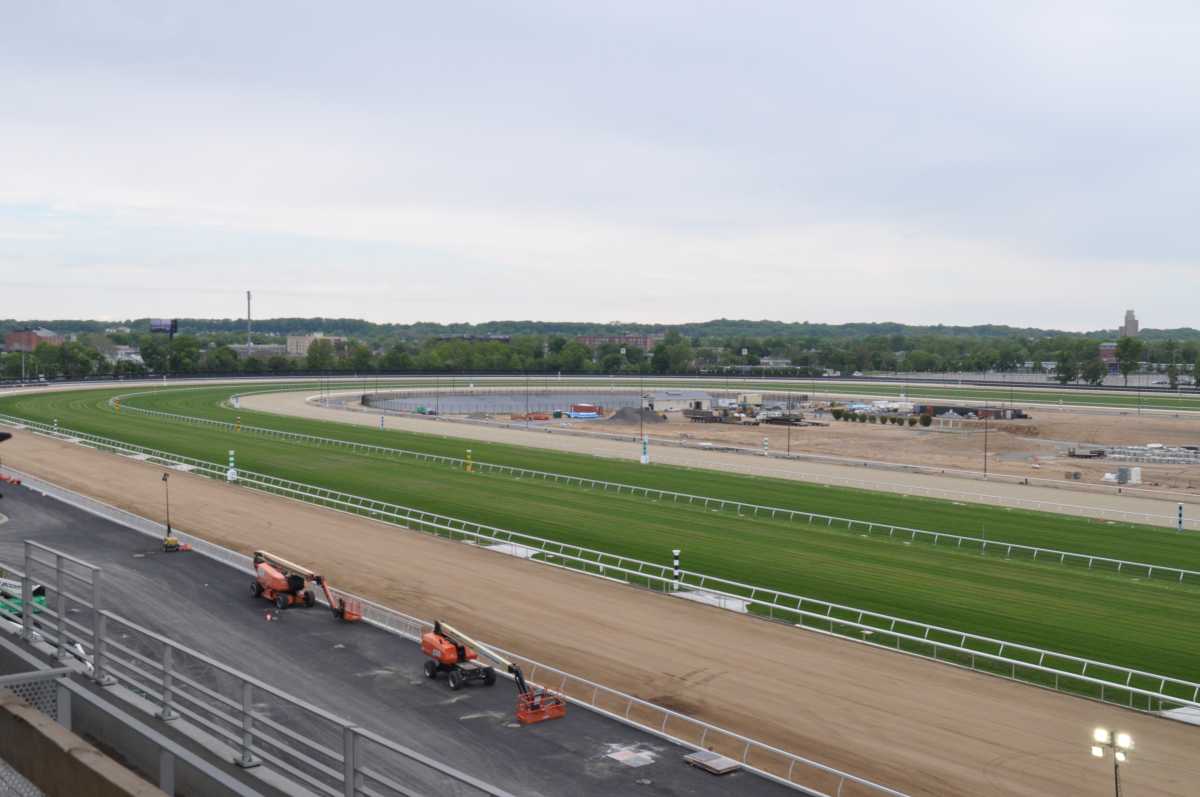
After more than two years of sweat equity, $450 million in capital, and years of planning by the New York Racing Association (NYRA), New York City fans will soon be able to enjoy a modernized Belmont Park that will usher in a new era of thoroughbred racing in the state with the promise of a more fan-friendly experience for every visitor, all year long.
The new Belmont Park — complete with a smaller, yet far more state-of-the-art grandstand overlooking a brand new racecourse and a paddock rivaling some of the world’s best racing venues — is quickly rounding into form. A “soft opening” of Belmont Park will happen on Sept. 18, the date when the big track on the Queens/Nassau border will become NYRA’s downstate base.
The new Belmont will be open for racing about 11 months of the year, rain or shine, in both the warmth of summer and the chill of winter.
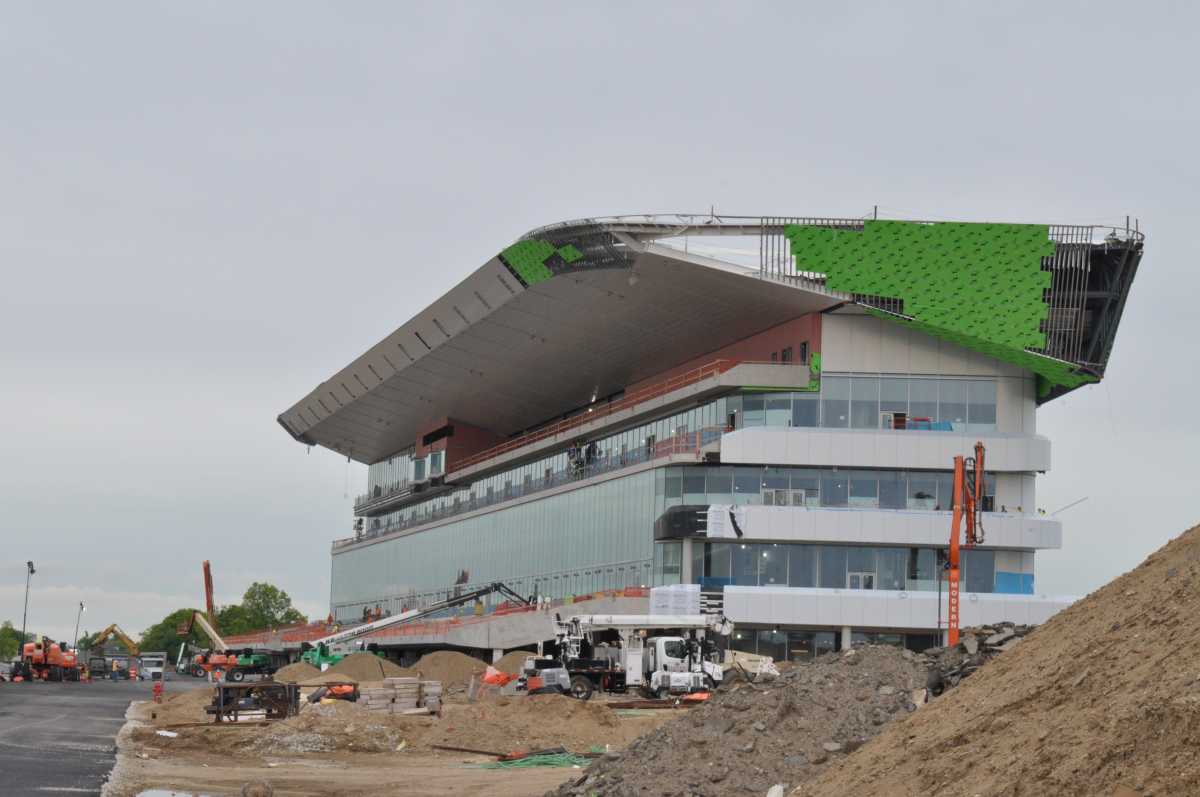 The grandstand stands five stories tall, with the upper floors featuring luxury boxes that the old Belmont lacked, and are in high demand for major events such as the Belmont Stakes and the Breeders’ Cup World Championships, which Belmont Park will host next year after a 22-year absence.Photo by Robert Pozarycki
amNewYork got another look at the new Belmont Park on the rise during a recent tour of the facility with NYRA President David O’Rourke, Vice President of Communications Patrick McKenna and Assistant Project Director Shea Linnane.
O’Rourke said the new Belmont is being built with the fans in mind, and replicating some of the experiences at Saratoga — which features a more open backyard where fans can picnic, but also suites and opportunities for fans to connect with jockeys and see the horses up close and personal.
“We were a little constrained down south. Aqueduct really has no backyard at this point. Belmont’s was small. When they built the [UBS] Arena, we had to concede some space. It was a good move, but it required us to shrink the backyard from roughly seven acres to about four and a half,” O’Rourke told amNewYork in an interview. “What we really wanted to do was get that exposure for the general admission crowd to the horses. So we’ve expanded the paddock, it’s essentially the exact same size as Saratoga, slightly more than half of it is open to the general public, so you’re gonna get close to the horses.”
Luxury boxes and more open space at the new Belmont Park
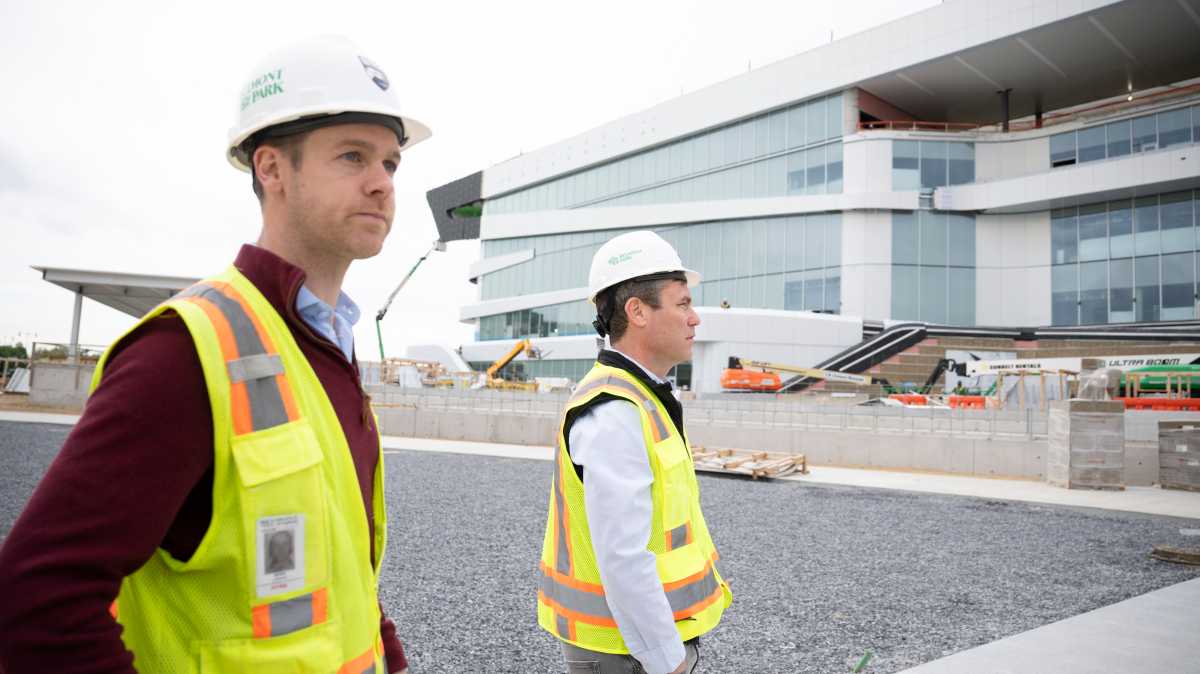 NYRA Assistant Project Director Shea Linnane and President David O’Rourke look at construction underway at the new Belmont Park.Photo by Lloyd Mitchell
When amNewYork recently visited the site on a recent, gray May morning, crews were hard at work on the interior of the new five-floor, 250,000 square foot grandstand overlooking a brand new racetrack. According to NYRA, an army of 300 construction workers and 100 support staff are toiling six days a week to get the new venue ready for its first day of racing in September.
The grandstand stands five stories tall, with the upper floors featuring luxury boxes that the old Belmont lacked, and are in high demand for major events such as the Belmont Stakes and the Breeders’ Cup World Championships, which Belmont Park will host next year after a 22-year absence.
The Champion Suites, as NYRA calls them, sit largely on the upper floors of the grandstand, with private balconies overlooking the track and paddock. The suites can accommodate between 16 and 50 guests and feature climate-controlled interiors, multi-screen TV displays, conference rooms and wagering terminals, among other amenities.
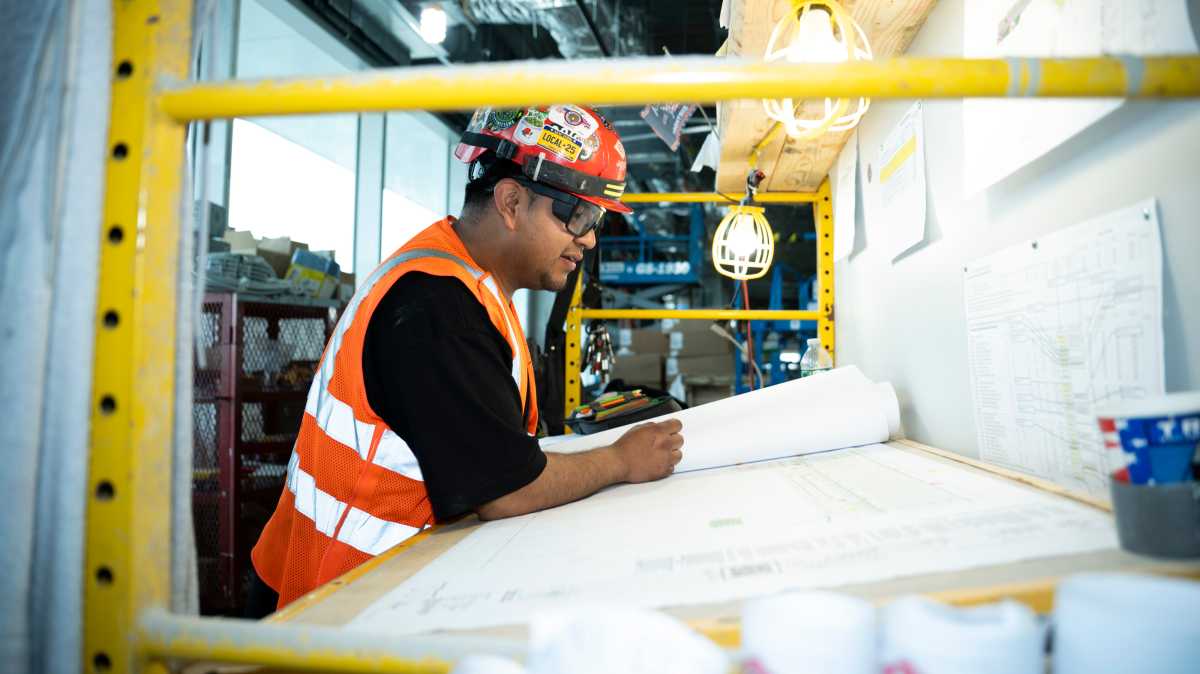 According to NYRA, an army of 300 construction workers and 100 support staff are toiling six days a week to get the new venue ready for its first day of racing in September.Photo by Lloyd Mitchell
More than half of the boxes have already been sold, NYRA officials told amNewYork. Even so, as O’Rourke told this publication, the new Belmont will have something for everyone — from expanded backyard and green space for fans to picnic during a day at the races, to sports bars and a top-line food court.
“We’re going to have 20 acres of green space. So that alone just starts to open up. Where do you want to put your camping chair? A lot of possibilities,” he said. “We’re going to have one of the better food courts available around this area for sure. … We just stole some ideas from Saratoga that we thought worked really well that we could integrate here, and I think that’s gonna really create, you know, a similar vibe where you’ve got something for everyone.”
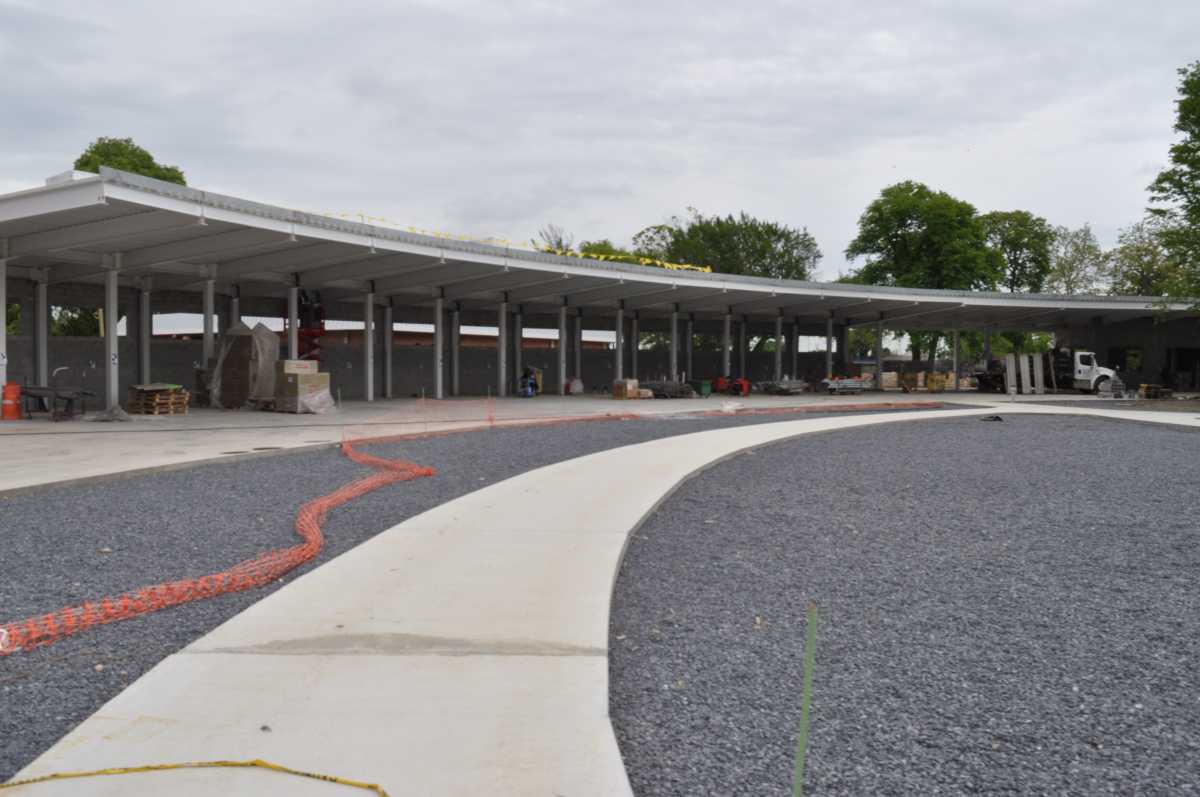 The bigger and brighter paddock at the new Belmont Park begins to take shape.Photo by Robert Pozarycki
The tour began behind the grandstand with the new, modern paddock. The tight circle where horses from Count Fleet, to Secretariat, to American Pharaoh had been saddled before achieving immortality as Triple Crown winners has been replaced with a larger, much more open walking ring accompanied by a semi-circle saddling area adjacent to a lounge for jockeys, trainers, and owners.
Across the way is a large canopied television booth from which “America’s Day at the Races,” the joint Fox Sports-NYRA broadcasting venture, will host racing programs from Belmont Park. The historic Japanese white pine, which has weathered more than a century of change, stands off to the side of the paddock, preserved to last another century.
While the exterior of the new grandstand nears completion, work continues on the inner structure. The first and second floors will be ready by the soft opening day this fall; the upper floors will be ready next spring in time for the 2027 Belmont Stakes.
The old Belmont Park facility had two sections: a grandstand to the west of the finish line for general admission, and a clubhouse to the east of the finish line with finer accommodations for VIPs. The same principle applies to the new Belmont, but on a vertical dynamic: the higher you go, the more accommodating the experience, though at a higher price.
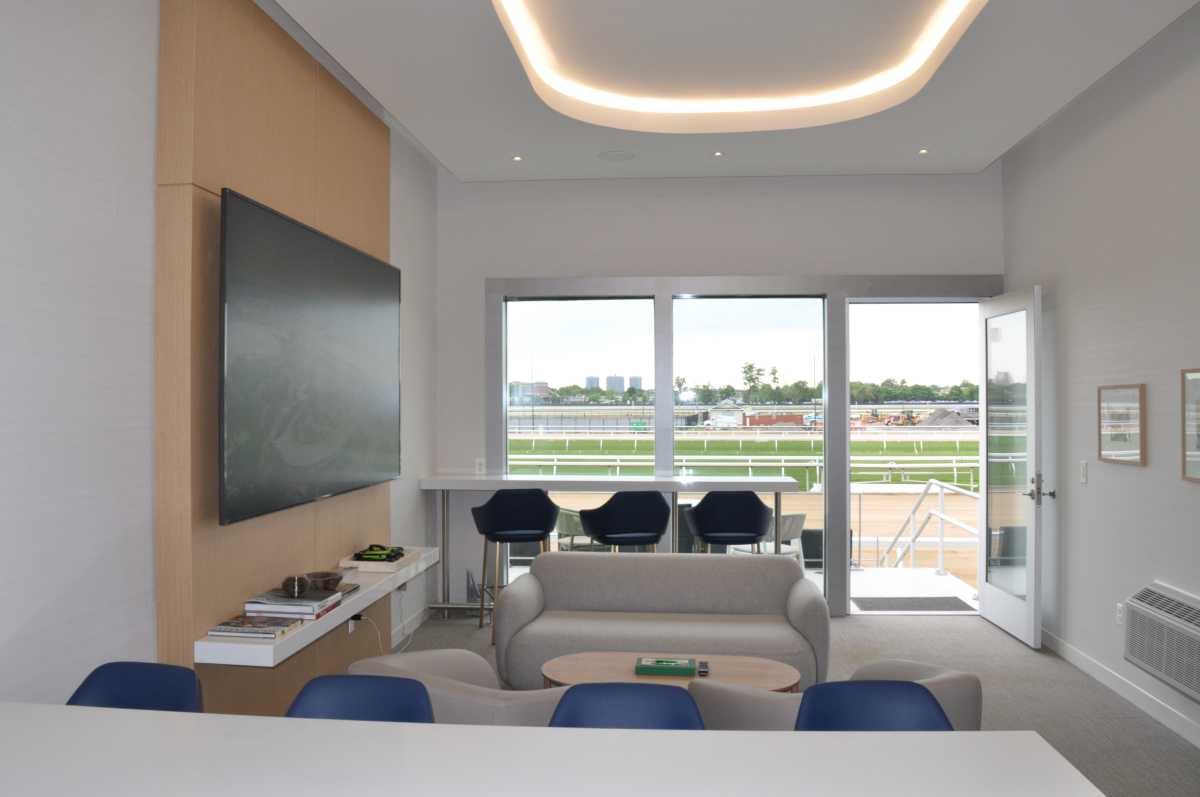 A model of the Champion Suites at Belmont Park, currently on display near the top of the stretch.Photo by Robert Pozarycki
 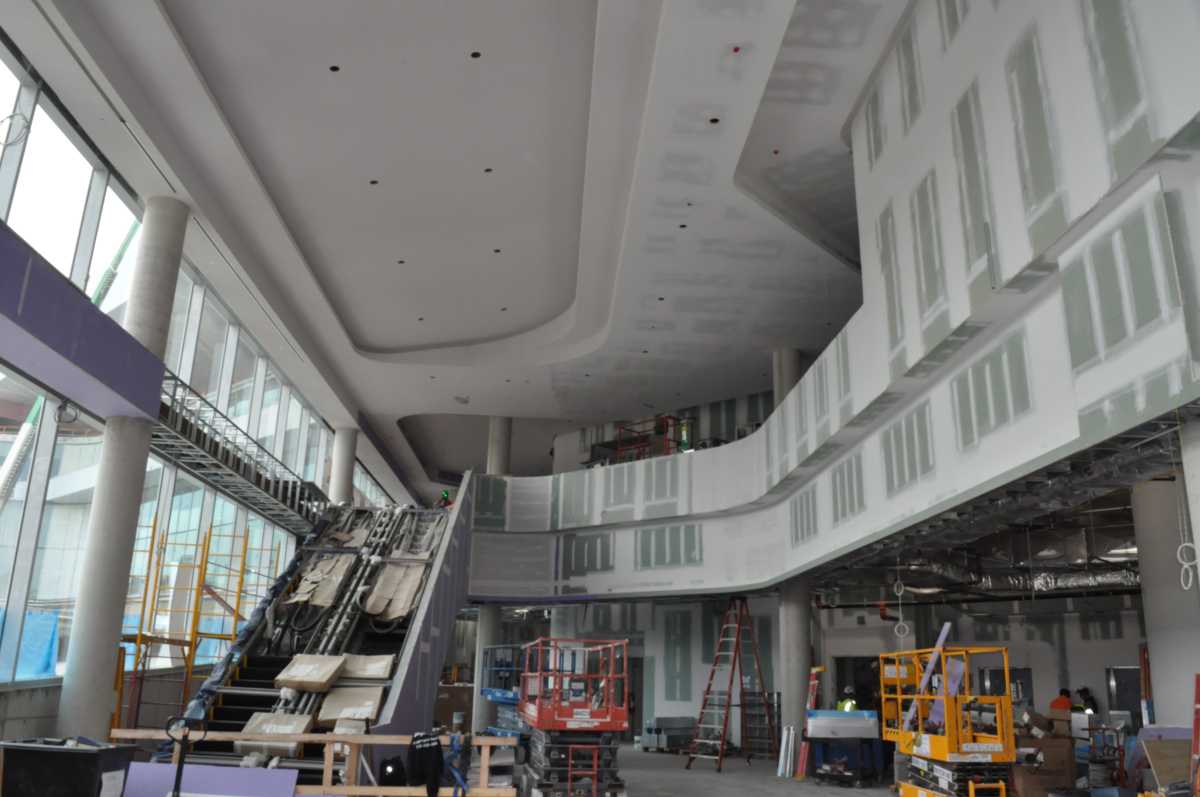 The grand lobby of the eastern wing of Belmont Park, still under construction.Photo by Robert Pozarycki
General admission will be on the first floor, which will feature a major food court as well as Big Red’s, a full-service sports bar on the southwestern corner of the building, just across the way from UBS Arena, home of the Islanders.
Outdoor box seats and a turf club will be on the second floor of the building, with luxury suites and a massive restaurant on the third floor, and more suites on the fourth floor.
Changes on the Belmont Park racing surfaces
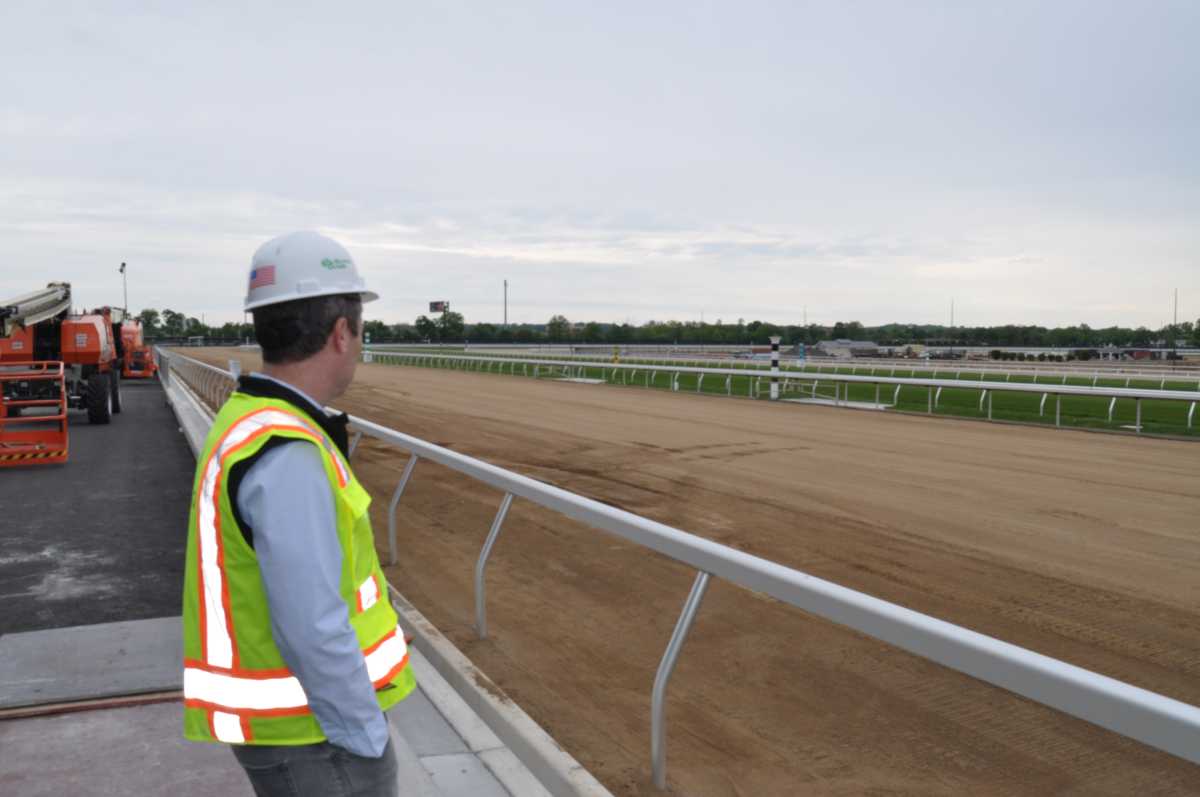 NYRA President David O’Rourke looks out at the new Belmont Park main track.Photo by Robert Pozarycki
But as work continues on the massive floors, the tracks, which they overlook, are very close to being ready for racing and training. The main track, known as “Big Sandy,” is 1 ½ miles long, just as it had been before, but with a slightly readjusted finish line; as a result, the home stretch is now nearly a quarter-mile long between the quarter-pole and finish line.
Within the main track are two lush turf courses lined with 60 acres of sod grown on Long Island, and one of the most critical features of the new Belmont Park: a one-mile synthetic course made of Tapeta, a mix of sand, wax and carpet fibers that remains fast in all weather and is considered safer for horses.
The Tapeta course will be primarily used for winter racing between December and March, and it is as critical to the future of NYRA’s winter meet as having a climate-controlled grandstand at the new Belmont Park, NYRA officials said.
The new Belmont Park will replace Aqueduct Racetrack in Queens, which is closing for good on June 28 after more than 130 years of racing. Recent Aqueduct winter meets have seen not only dwindling crowds on track but also a dwindling horse population, making it challenging for NYRA to contest races with large fields that attract wagering interest locally and nationwide.
In addition to providing a safe place for horses to compete in the winter, NYRA sees the synthetic course as a means to enhance the racing product. It hopes to attract more competition from Woodbine Racetrack in Toronto, which primarily runs on synthetic and does not race in winter, while keeping local horse owners on the NYRA circuit rather than making a winter migration to Florida.
“The way our circuit is that in the winter, we’re just all dirt, so we’d lose a lot of those horses, whether they’d go to Florida or down south somewhere, or they’d go to the farm,” O’Rourke said. “So, you know, what the data shows us and what we believe will occur here is that the New York-breds will get more opportunity year-round, specifically New York-breds, on that Tapeta surface because there’s a high crossover between grass and Tapeta.”
One notable feature of the synthetic course is the addition of floodlights around the track near the rail; NYRA officials say they will be used only for early-morning training.
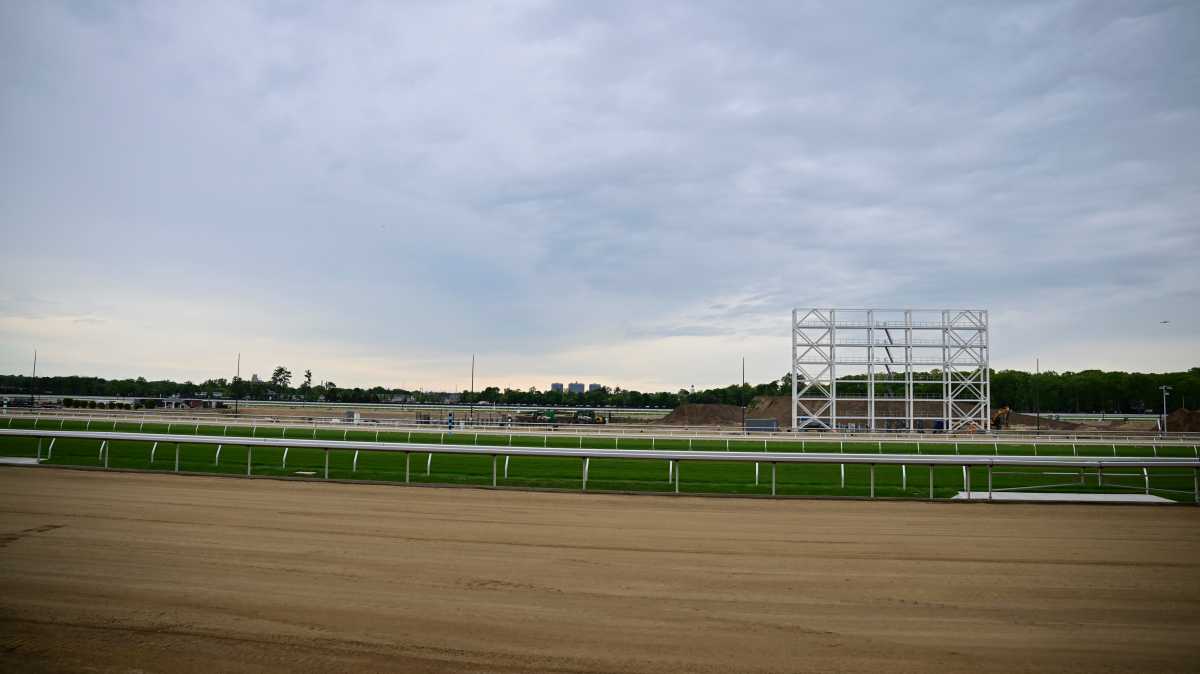 The Belmont Park infield will feature a massive LED screen measuring 65 feet high by 115 feet wide, which will post odds and display video from around the track.Photo by Lloyd Mitchell
Technology is a big feature the new Belmont Park. The infield will feature a massive LED screen measuring 65 feet high by 115 feet wide, which will post odds and display video from around the track. The building will also feature 620 televisions throughout the complex. Even the furlong markers around the main track and turf courses are topped with 360-degree cameras to enhance the video experience of each race.
In the end, O’Rourke sees the new Belmont Park as being the finishing touch on a newly developed corner of Queens and Nassau County — which includes the UBS Arena and Belmont Park Village, a high-end shopping mall — as a year-round destination for New Yorkers to enjoy for decades to come.
“You’ve got an arena, one of the newer and better arenas in the country, specifically when you start getting into the sound systems and the ability to throw concerts. The mall across the street is starting to gain traction,” he said. “We’ve got an integrated facility now with racing, hockey, concerts, and events, other functions now that we can collaborate with the other members of this campus and keep it active year-round.”
To learn more about the new Belmont Park, visit nyra.com/belmont.