
In Sri Lanka, the mutton roll, deep-fried and as stocky as a robusto cigar, is part of a great sprawling genre of snacks called short eats, or shorties. They’re intended for the in-between, to be eaten swiftly on train platforms and in the prized free moments after school, bought off tuk-tuks by the side of the road. At Lungi, you get two to an order, burnished sheaths crackly from bread crumbs and giving way to a rich shambles of lamb and potatoes, laced with curry power roasted dark.
The ratio of crisp to tender is exacting. This is a culture that understands the importance of snacks, and of devoting the time and labor necessary to perfect them.
A couple of mouthfuls in, the chiles start to thrum. At first it’s just a sear, then it builds and keeps building, until you wonder if this is what dragons feel, fire forever in their mouths.
Could Lungi be, technically, the hottest restaurant on the Upper East Side?
Historically the neighborhood has favored French and Italian restaurants, later coming around to Japanese. Now Thai places dot the streets. But there is still a sense of flavors recalibrated for a cautious audience.
The servers at Lungi dutifully ask what spice level you prefer. Best to answer: However the cooks like it. Here heat is a flavor among flavors, never the totality of a dish, and changes from plate to plate, sometimes brash and swaggery, sometimes just a prickle.
Lungi stands a few doors down from a smoke shop and a dry cleaner, on a block not far from the Queensboro Bridge. In 2024, the owners, Mervyn Winston and the chef Albin Vincent, converted what had been a regionally agnostic Indian small-plates spot into a restaurant dedicated to the culinary traditions of southern India and Sri Lanka, whose cuisine is still a rarity in Manhattan.
The transformation follows the trajectory of Indian food in major American cities in recent years. Where northern Indian cooking was once dominant, albeit often in hodgepodge, deracinated forms, a vanguard of restaurants, including the acclaimed Semma, Kanyakumari and Chatti in New York, have turned the focus to the south.
Mr. Vincent grew up in Kanyakumari, mainland India’s southernmost point. His parents died when he was 6, and he was raised by his grandparents, who had lived for 25 years in Colombo, Sri Lanka’s largest city. To help bring his memories of his grandmother’s kitchen to life, he recruited Andru Simethy as executive chef and Bibymon Joy, a dosa specialist, from Kerala; Thirunavukkarasu Mayagalan, a sous-chef, from Tamil Nadu; and Rushdhun Ramzy, representing Sri Lanka and turning out those golden mutton rolls night after night.
Hoppers are lunar-white pancakes with upturned sides reaching for the ceiling, as if preparing for levitation. They’re made with rice left to soak overnight, then ground with a stone and rested another night to ferment, until bubbly. No yeast is added, just coconut milk, and then the faintly sour batter is ladled into a appachatti, akin to a wok. The batter clings to the slopes, growing sheer as it crisps, and pools at the bottom, spongy and plush, a ready bed for a poached egg if further gilding is desired.
Almost every incarnation of carbohydrates at Lungi is worthy: string hoppers, rice flour thickened with hot water and squeezed through a sieve into a heap of freestyle squiggles, somehow airy and chewy at once; or Malabar parota, gossamer layers of dough gone rakishly ruffly, like a croissant collapsed in on itself and lolling its own richness. A dosa inspired by Rameshwaram Cafe, a southern Indian chain, is cooked on lower heat so it stays soft, the fermented dough opening with a thousand eyes. It comes with a sift of milagai podi, a tangy-hot blend of roasted lentils, seeds, chiles and hing (a spice also known as asafoetida), so potent that the British colonials called it gunpowder.
For baby shark, you must come on Friday, Saturday or Sunday. Here “baby” simply means small: The species in question is the milk shark, slender in snout and body, with big haunted eyes and a glum, downturned mouth. Once steamed, the flesh is lifted off the bones and flaked until it’s as fluffy as crab, then scrambled like eggs.
The menu’s procession of curries show how a single set of spices can yield exponential shadings. A mob of mushrooms gains brightness from Guntur chiles, as volatile as habaneros but tempered by floral notes of guava. Chestnut-like black chickpeas loosen up with patient simmering alongside milder but meatier Byadgi chiles, almost neon in color and tasting of deep-forest mushrooms and charcuterie.
Textures testify to the kitchen’s vigilance: giant prawns taut and springy, beef and goat gone silky and supplicant, eggplant melted down with vinegar until sticky-sweet. Short-rib curry with a menthol edge of star anise is presented with the shucked rib, as proof that it was cooked on the bone, all the marrow leached.
Chutneys and sambols — tomatoes taken down to their most concentrated tang, a tangle of onions caramelized and smacking of cinnamon, grated coconut with a sun streak of lemon juice — are neither extra nor ornamental, but complete the meal.
At the end, you’ll want warm, cardamom-heady spoonfuls of payasam, a soup of coconut milk, slippery vermicelli and creamy cashews, or wattalapam, a coconut milk custard that comes with a hunk of jaggery sunk in — the dark sap of the date palm, boiled down until only its concentrate is left. It’s a mirror version of sugar, mellow and deep, without the sharp ache at the end that makes you reach for more.
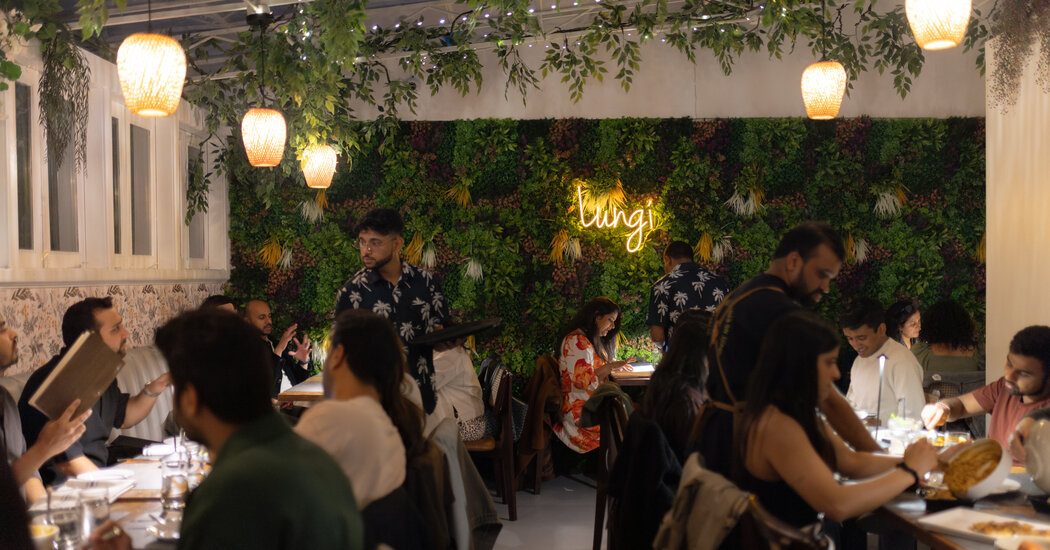
In vibe, Lungi can’t quite compete with higher-end Indian restaurants that have opened in the past year, like the palatial Musaafer, decked out in mirror mosaics and Mughal arches, or the maximalist mansion that is Ambassadors Clubhouse. The storefront is awkward, split into two long narrow slots and an enclosed skylit patio in the back.
Shaggy greenery fills a wall, with Lungi’s name in cursive LED lights, the kind of Instagram-ready backdrop you might find in a boba shop or a villa on “Love Island.” The rest of the décor is more muted, with a cool palette of whites, browns and dovish grays.
Service, on my visits, was a roll of the dice: either focused and knowledgeable or drifty and blank-eyed. One understaffed night, the bathrooms were a gantlet of wastebaskets so stuffed, they spilled over.
Know this, and come anyway. Breathe in the scent of curry leaves. Let the chiles rewire your nerves. You are here to eat.
Ligaya Mishan, our chief critic based in New York City, writes starred reviews of restaurants in New York and beyond. Tejal Rao, our chief critic based in Los Angeles, writes starred reviews of restaurants nationwide. Briefer starred reviews of New York restaurants are written by our contributing critics Mahira Rivers and Ryan Sutton, and first appear weekly in the Where to Eat newsletter (subscribe here).