
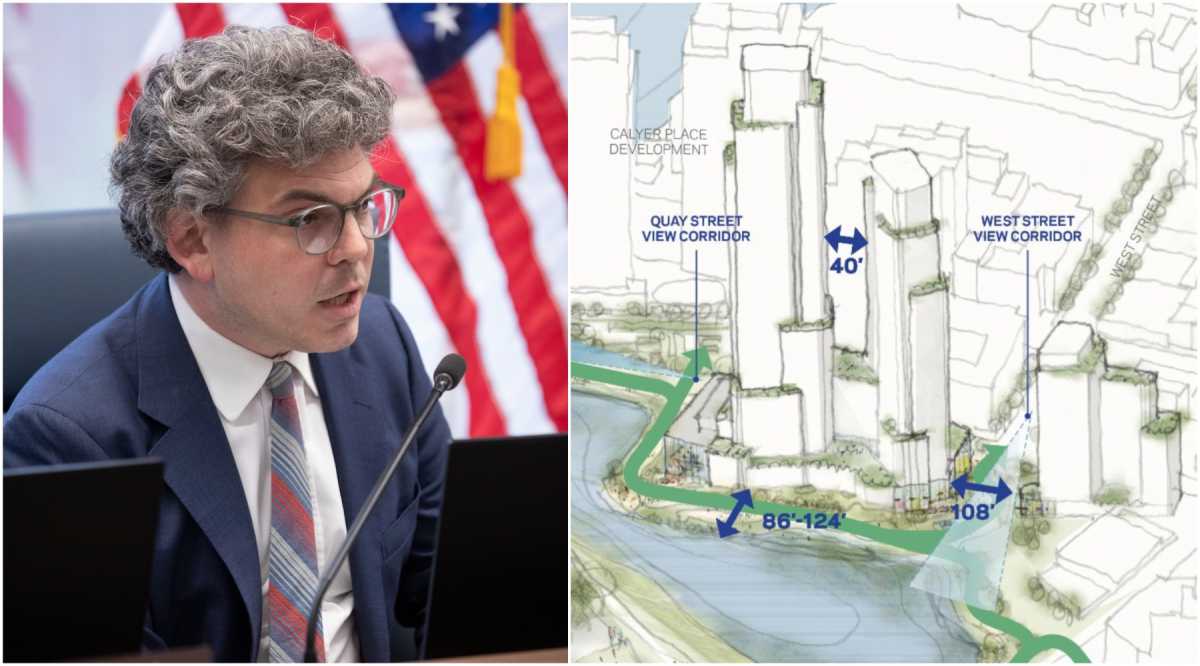
The fight over proposed high-rise development Monitor Point ramped up last week as the project finally came before the City Council.
After scoring a long-term lease of an MTA-owned plot of land at 40 Quay St. in 2021, developer Gotham Organization is seeking a rezoning to make way for three high-rises with a combined 1,150 units.
Monitor Point would be 40% affordable, developers say, and would include a new home for the Greenpoint Monitor Museum and waterfront public space. The deal also includes the relocation of the MTA wash site currently at the lot.
But some Greenpointers — including Council Member Lincoln Restler, whose vote will be critical to the rezoning — say the development doesn’t do enough for the community to justify a rezoning of publicly-owned land.
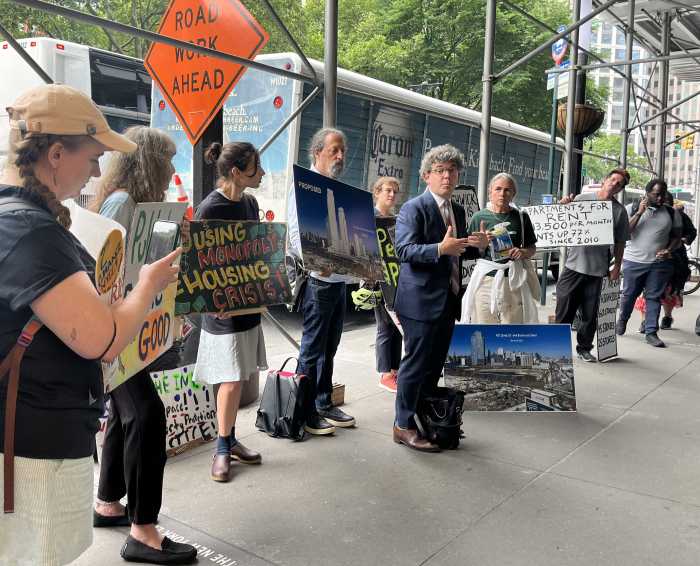 Restler joined locals rallying against Monitor Point on May 27. Photo by Kirstyn Brendlen
A pair of opposing rallies sprang up outside City Hall ahead of the May 27 hearing.
Outside the Council’s office building at 250 Broadway, about two dozen opponents with hand-painted signs called the project “reckless” and slammed developers for seeking to build in an ecologically-sensitive flood zone.
Across the street, a larger group — made up primarily of members of 32BJSEIU, Laborers Local 79, and housing group United Neighbors Organization — said Monitor Point would create “dozens” of good-paying permanent jobs and more affordable housing for an infamously-expensive neighborhood.
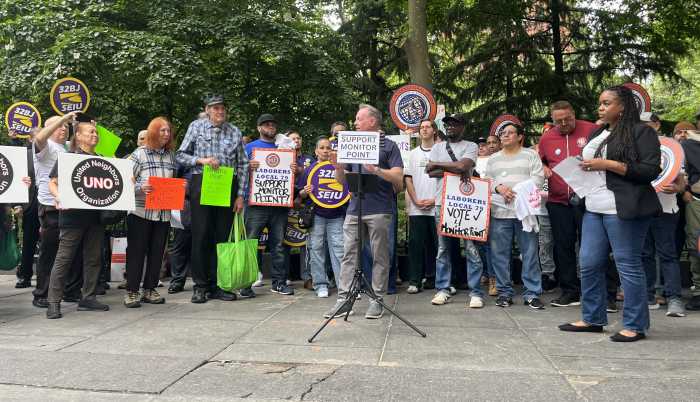 Union members and north Brooklyn locals rallied in favor of the project ahead of the City Council hearing. Photo by Kirstyn Brendlen
Developers, Restler face off over affordability and community benefit
At Wednesday’s roughly four-hour hearing, Bryan Kelly, president of development at Gotham, described Monitor Point as the “definition of a public-private partnership,” noting that the MTA and the Monitor Museum are co-applicants on the application.
Selling the development rights to Gotham would give the museum enough money to build a roughly 18,0000 square-foot facility, said Monitor Museum rep Eugene Travers, plus an endowment for its operation.
“Gotham is responsible for the maintenance and insurance of the waterfront open space in perpetuity, so it won’t be a financial drag on the museum,” Travers said. “So, we’re really excited about this. We think it’s going to be a local and regional destination and really the crown jewel of the Brooklyn waterfront.”
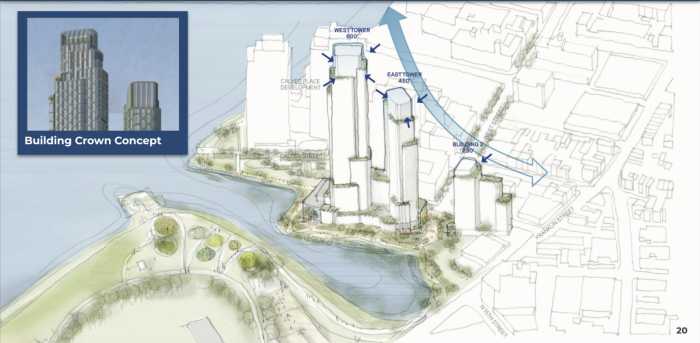 A rendering of the proposed Monitor Point towers, just north of Bushwick Inlet Park. Image courtesy of Gotham Organization/City Planning Commission
The developer would lease the MTA-owned property for 99 years, part of a plan developed to generate revenue for the transit authority. Gotham would pay to relocate both the MTA wash site at 40 Quay St. and a separate MTA facility currently located at the future Box Street Park.
Kelly called the MTA facility a “wall to the waterfront,” and that the small parcel of land owned by the museum is prone to coastal erosion. Monitor Point, he said, would generate funds for the MTA, protect the coastline and bring 460 permanently-affordable homes to the neighborhood.
The smaller East Building would be all-affordable, and subsidized by the city’s Department of Housing Preservation and Development, with 200 units priced between 40-100% Area Median Income, or between $1,215-$3,037 per month for a one-bedroom.
Additional affordable units in the West Building would be priced between 40-80% AMI.
“This site today that the MTA owns is zoned only for market-rate condos,” Kelly said. “The zoning change does add a tremendous amount of density in light of a housing crisis, but 50% of the new floor area will go to deep affordability.”
The lot is currently zoned R6, a “medium-density” district that allows “all forms of residences” with caps on building height. Developers can build taller if they include qualifying affordable housing.
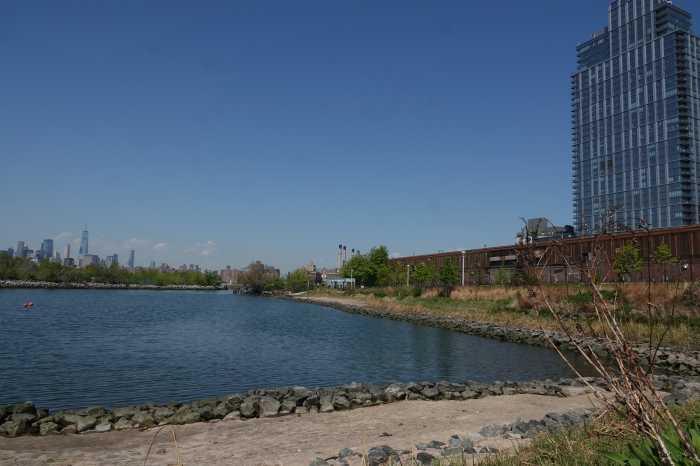 Bushwick Inlet Park, with the existing low-slung MTA facility at right .Photo by Kirstyn Brendlen
Kelly said market rate units would start at around $4,000 per month for studios, with one-bedrooms between $5,000,-$6,000, two-bedrooms up to $7,800, and three bedrooms costing up to $9,500. Those units help to subsidize the affordable units that generate less revenue, he added later.
Both Community Board 1 and Brooklyn Borough President Antonio Reynoso voted to approve the project with conditions, Restler noted, including more affordable housing. He asked if Gotham is “actively evaluating ways to add more affordable housing.”
Kelly said the company is “trying to identify ways” to lower costs and increase the number of affordable units before the final City Council vote in late June.
“Council Member, you’ve got our commitment to spend the next three to four weeks to try and tick that number upward, but to be clear, from our perspective, developers are executing upon a business plan,” he said. “We also have constraints, banks, ultimately, endowment investors, institutional pension funds that invest the equity and tax credits.”
Restler, who said he has been opposed to the plan since it was first proposed by the MTA five years ago, also quizzed MTA vice president Sean Fitzpatrick on the benefits the project will bring to the MTA.
Leasing the property to Gotham would bring in an estimated $39 million over the course of the 99-year lease, Restler said, which “is the equivalent to the MTA’s operating expenses for about one half-hour of one day.” (The MTA’s adopted budget for 2025 was $19.88 billion.)
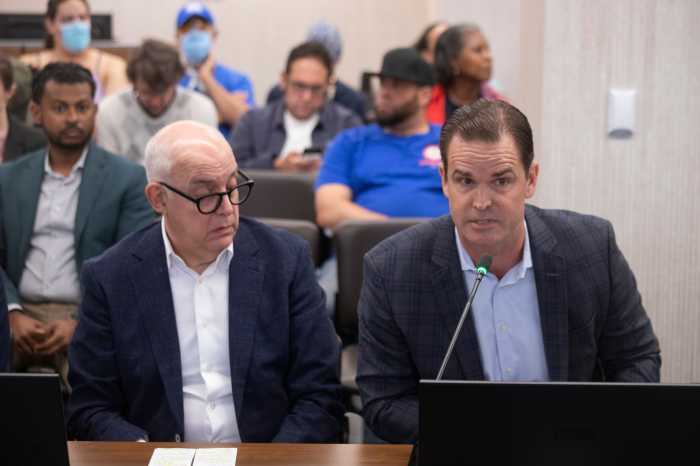 Gotham executive Bryan Kelly (right) and architect Dan Kaplan. Photo courtesy of John McCarten/NYC Council Media Unit
But Gotham is also paying to relocate the existing wash facility at 40 Quay St. and the Emergency Response Unit currently located at Box Street, which blocks the full development of Box Street Park.
Fitzpatrick said moving the wash facility would cost $60 million, though Restler noted that the agency had submitted a much smaller cost estimate in documents submitted to the MTA. Fitzpatrick said that estimate likely did not include the cost of relocating the ERU.
“The MTA committed in 2005 in writing to relocate that facility,” Restler said. “We are breaking ground this summer to finally build Box Street Park, we are only breaking ground on 85% of the park because the MTA has refused to relocate the ERU facility from our promised park space … the MTA has been a bad partner for my neighborhood and my community in failing to follow through on the promises you made to us in the Greenpoint-Williamsburg rezoning.”
In finding a developer willing to lease and develop the land and relocate the facilities, the MTA felt it had found a way to fulfill those promises, Fitzpatrick said. He said the agency structured its agreement with Gotham to include the partnership with HPD and the construction of an all-affordable building.
The MTA facility is not the only long-overdue promise Restler is seeking to fulfill. As part of the 2005 Williamsburg-Greenpoint rezoning, the city promised to construct the 28-acre Bushwick Inlet Park.
More than 20 years and millions of dollars later, the two largest parcels of the park are barren and untouched. Its most recently-finished section, which sits just south of the proposed Monitor Point site, opened to the public in April.
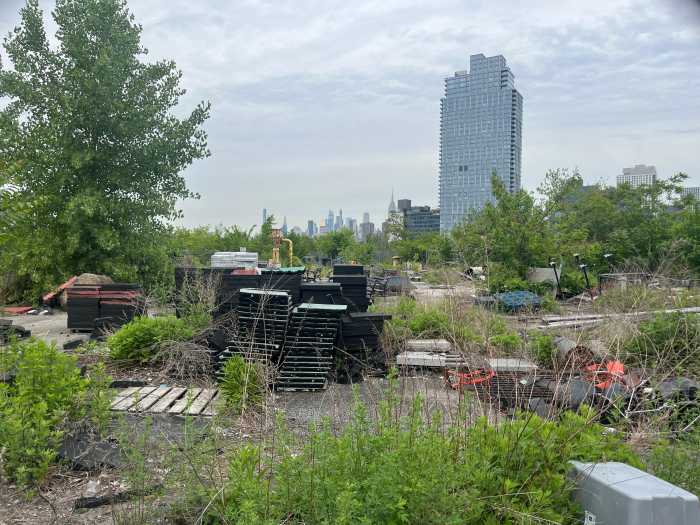 The Bayside parcel of Bushwick Inlet Park, which is untouched and undeveloped. Photo by Kirstyn Brendlen
Restler said he will not vote to approve Monitor Point without “an ironclad commitment with crisp timeline and full funding for the completion of the long-promised Bushwick Inlet Park.”
Developers say Monitor Point would include more than 51,000 square feet of public waterfront open space that would connect to the park and would include new shoreline resiliency measures, stormwater management, walking paths and seating.
Gotham has committed to providing $300,000 in funding for Bushwick Inlet Park every year for the entire term of the lease, Kelly said, starting when the buildings are finished. The funding would be “memorialized, enforced” and included in a regulatory agreement called a restrictive declaration.
Locals speak out
Nearly 100 people signed up to testify about the development at the May 27 hearing, both for and against.
Most in favor of the project cited the critical need for affordable housing in the neighborhood.
Rolando Guzman, deputy director of community preservation at St. Nicks Alliance, said many of the org’s clients are being priced out of North Brooklyn as rents in Greenpoint and Williamsburg continue to rise.
He said Monitor Point presented their project directly to the community, including the United Neighbors Organization.
“And, actually, they were very receptive. They heard about two issues. One was that we needed deeper affordable housing — inclusive affordable housing — and a higher percentage of housing,” he said. “This project … is providing 40% inclusive affordable housing on site.”
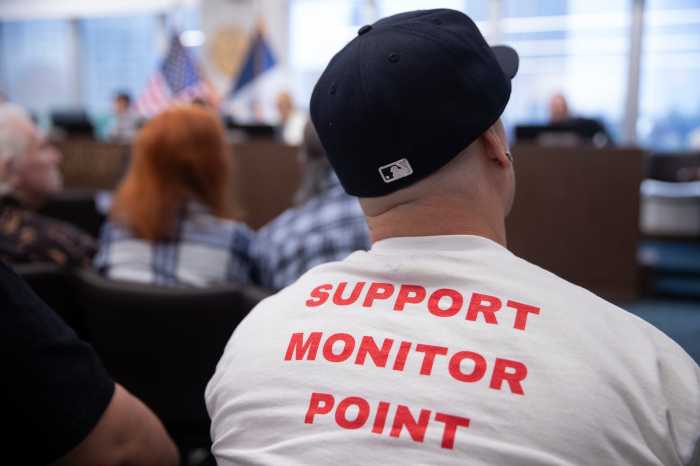 Some speakers said Monitor Point will bring much-needed affordable housing to the nabe. Photo courtesy of John McCarten/NYC Council Media Unit
“We cannot wait any longer, we need this affordable housing right now,” Guzman said.
Maisha Morales, chair of the board at Southside United-HDFC Los Sures, said she supports funding the park — but that affordable housing shouldn’t be “sacrificed” for the park.
Former HPD commissioner Louise Carroll agreed.
During her tenure at the agency, Carroll said, she came to realize that the city “cannot build its way out of the housing crisis alone,” and that it should not come down to “parks versus people.” Monitor Point “serves a bunch of different interests,” she said.
She defended the high market-rate rents, saying that the city’s Mandatory Inclusionary Housing program works because the market-rate units offset the affordable ones.
“You need market-rate housing to cover the cost of the low-income units,” Carroll said. “If you have 100% affordable housing, those rents tod not cover the operation of the building, they do not cover the replacement of boilers, they don’t cover the porters, they don’t cover anything.”
Opponents, meanwhile, said Greenpoint and Williamsburg has been inundated with luxury housing along its flood-prone waterfront and worry that the project would threaten the park and its wildlife.
“The height of the building will threaten our promise parks and the majority of market-rate apartments will create a new threshold for what a one-bedroom goes for in our neighborhood,” said Debra Funkhouser, a longtime Williamsburg resident and volunteer gardener at Bushwick Inlet Park.
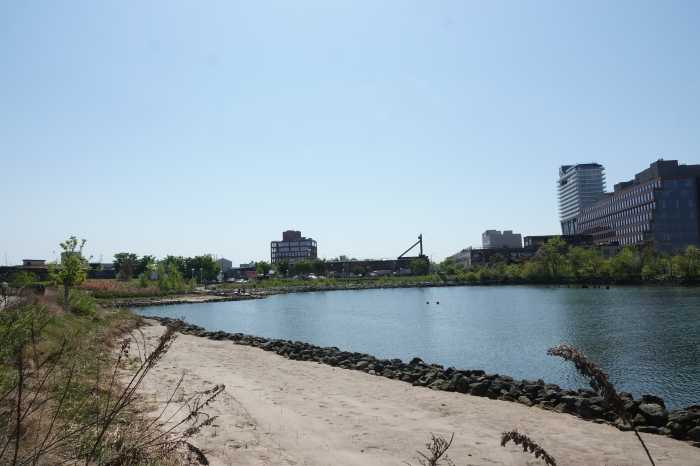 Opponents worry the new development would threaten the inlet’s delicate ecosystem and drive up rents. Photo by Kirstyn Brendlen
The inlet is a “rarity” in New York City, she said, and supports a “variety of life.” She worried how combined sewer overflow from thousands of new residents would impact the outlet and the East River.
Several speakers said the neighborhood does not offer enough park space for its rapidly-growing population. Longtime local Marissa Bohk said she feels Williamsburg and Greenpoint are “singlehandedly tackling the housing crisis,” having welcomed roughly 50,000 new residents since 2010.
The nabe’s green spaces have not kept up with the pace of that growth, she said, and the area now has just 0.6 acres of green space for every 1,000 residents, well short of the city’s targeted 2.5 acres per 1,000.
Trina McKeever, another longtime resident and a member of Friends of Bushwick Inlet Park, noted that the 2005 rezoning laid out height and setback requirements for residential buildings along the East River. If 40 Quay St. were rezoned, Monitor Point would surpass the heights envisioned for the area 20 years ago and would, in some places, come right up to the property line of Bushwick Inlet Park.
“Bushwick Inlet Park, in essence, becomes the public esplanade for the luxury development,” she said.
What comes next?
The City Council is expected to vote on Monitor Point on June 25. Kelly said at the hearing that Gotham will spend that time trying to increase affordability to help win support from Restler, whose vote is likely to influence the rest of the Council.
Just 16% of the 30,000 units built in Williamsburg and Greenpoint are affordable, Restler told Brooklyn Paper.
“We have to do better on public land. These are our rare but critically important opportunities to maximise affordable housing development,” he said. “ If we’re not going to get that affordable housing and the mayor and his administration are not committed to Bushwick Inlet Park, we should go back to the drawing board.”
If the project is voted down, Gotham could take it to the city’s new Affordable Housing Appeals Board, according to Hell Gate. Otherwise, the site would likely continue to house the MTA wash site, Fitzpatrick said at the hearing.