
Molly Warnock: We first met in 2016, in the run-up to your Model as Painting exhibition in Berlin.1 Since then, you’ve created multiple successive bodies of new work. Each deploys a specific combination of digital and analog processes to address what you’ve characterized as distinctive “forces of abstraction” in the contemporary world: the internet and digital technology. Each group nonetheless involves a specific modification of your working method. Why is it important to you that your way of making paintings should continually change?
Pieter Schoolwerth: There are different ways you can change. I like to think that the change in my work is more structural than stylistic. Stylistic change leaves the basic structure intact and just swaps in different coordinates. It doesn’t require that the viewer slow down and understand how something developed as a worldview.
I think changing one’s work on a structural level is a political act. It’s connected to the desire to continually try to find freedom in the stuff of paint, while questioning traditional notions of what a painting can be. It involves a certain restlessness, a material struggle with a specific set of tools.
At the same time, I have a passionate interest in keeping painting relevant. If young people aren’t inspired by going to museums and looking at paintings, maybe they’d rather design a game or create content for social media. Painting could fall into an irrelevant artisanal category of nostalgia culture.
I’m continually looking at my life and asking, what can I do to make painting be of this moment—not 1948, 1971, or 2012? I want the work to express what I’ve experienced in the last few months or year.
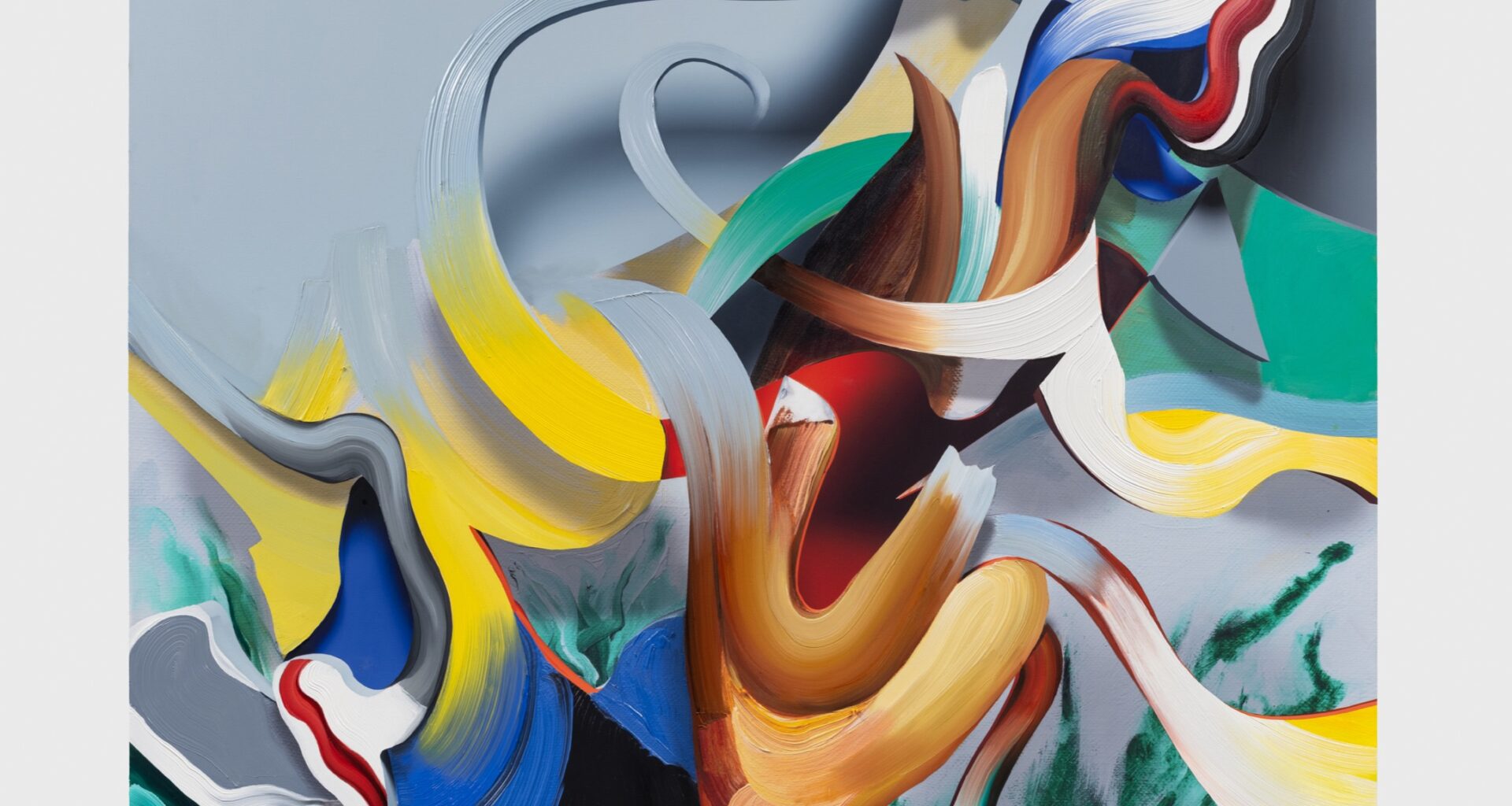
Warnock: More than in any of your projects to date, the paintings you are making right now can almost appear initially as large gestural compositions in the tradition of lyrical abstraction. Yet each is obtained through a decidedly hybrid method—by feeding a much-smaller, rapidly improvised painting through a laborious process involving photography, CG effects software, printing, and the manual re-introduction of paint. What is at stake for you in this multimedia reimagination of painterly gesture?
Schoolwerth: By forcing the initial, spontaneously improvised painting into an incredibly slow form of processing, I’d like to think that the result encodes a tension between speeds: an apparently fast and loose gestural study is compressed into the slow grind of a delicately orchestrated digital composition. This amounts to filtering conventional gesture through a contemporary lens. I like that our brains want to read the final form as fast, yet we’re forced to slow down and see its complexity.
Warnock: The results are certainly confounding, especially insofar as the brushstrokes appear to occupy different planes in a shallow, three-dimensional relief—an illusion enhanced by various shadows. This spatial play has become a hallmark of your work in the past decade.
Schoolwerth: I think there’s something uniquely contemporary about this form of shallow space that everyone who plays video games or watches animated films is familiar with to the point where we don’t even notice it anymore. And it’s not a space you can replicate through the direct application of material to a support by hand. It requires new techniques that allow for the seamless merging of a gestural mark with its own image, to pose the key question today: “Is this real?”
I like the somewhat unpredictable aspect of using new tools and giving up a bit of control just to see where I can take this. But it’s not about the technology as such. I just want to look at something I’ve never seen before.
I’m also thinking about the feeling of loss, and information being lost through the reception of art nowadays. When you see an artwork on a screen versus in person, you’re missing ninety percent of the sensory or neural effects of that thing by scrolling past it. I’m trying to build that sense of loss into the painting itself. If the final painting is already once removed from an original, then the status of the original is contingent. What happens to this thing when it’s been used up to make this other thing? That bears a direct relationship to what is lost when you don’t go to the gallery, you just see the show online.