
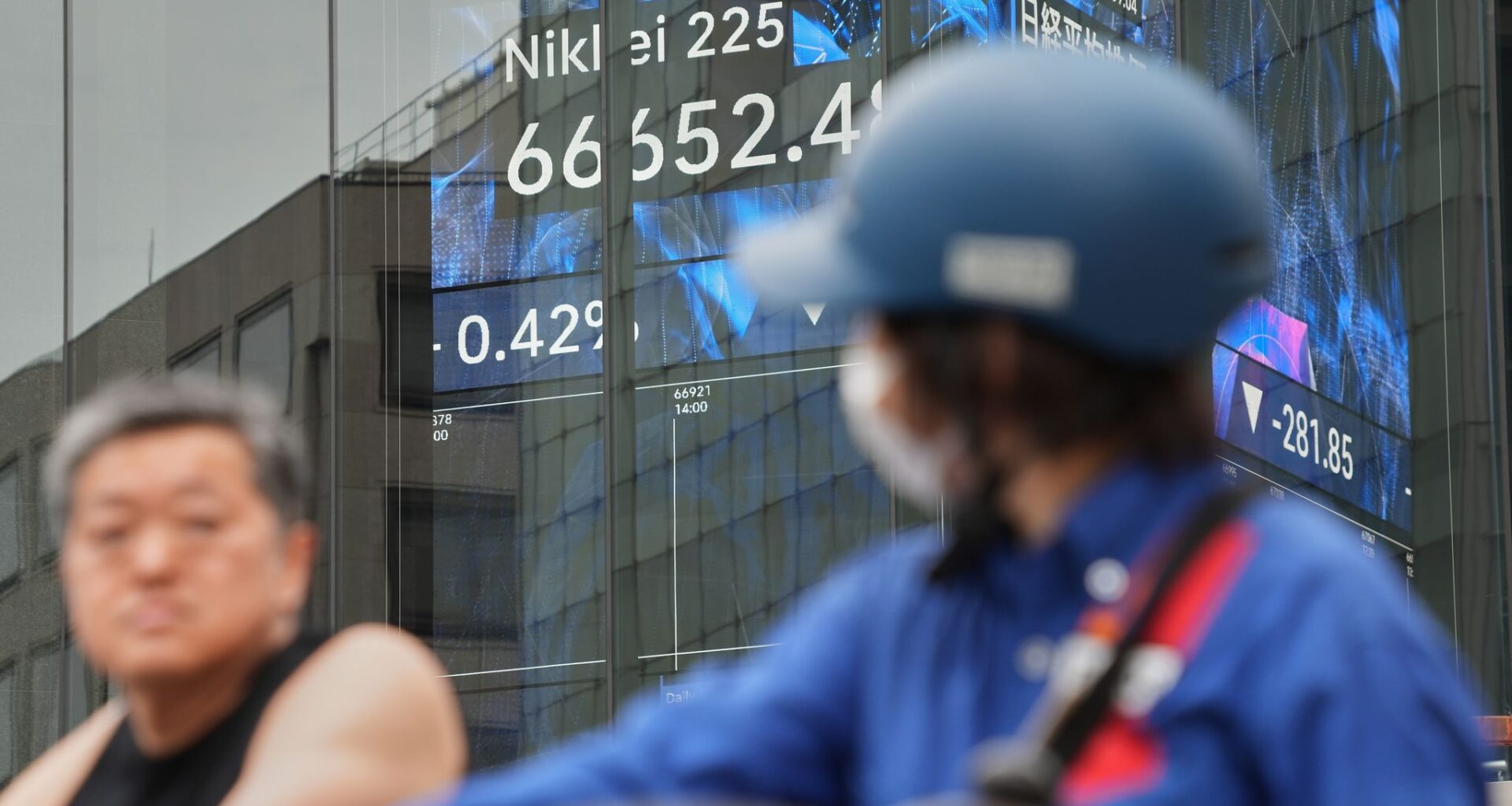
People stop in front of an electronic stock board showing Japan’s Nikkei index at a securities firm Tuesday, June 2, 2026, in Tokyo.
Eugene Hoshiko/AP Photo/Eugene Hoshiko
A person looks at an electronic stock board showing Japan’s Nikkei index at a securities firm Tuesday, June 2, 2026, in Tokyo.
Eugene Hoshiko/AP Photo/Eugene Hoshiko
People gather in front of an electronic stock board showing Japan’s Nikkei index at a securities firm Tuesday, June 2, 2026, in Tokyo.
Eugene Hoshiko/AP Photo/Eugene Hoshiko
A board above the trading floor of the New York Stock Exchange displays the closing number for the Dow Jones industrial average, Friday, May 29, 2026.
Richard Drew/AP Photo/Richard Drew
Trader Richard Cohen works on the floor of the New York Stock Exchange, Friday, May 29, 2026.
Richard Drew/AP Photo/Richard Drew
Japan’s Nikkei 225 index topped 68,000 for the first time on Wednesday after U.S. stocks pushed further into record territory.

The dollar briefly surpassed 160 Japanese yen before slipping back slightly. Oil prices rose more than $1 a barrel.
Article continues below this ad
Buying of technology shares linked to the boom in artificial intelligence has been driving rallies worldwide.
By midmorning, the Nikkei 225 was up 2.2% at 68,172.89. Shares in computer chip equipment maker Tokyo Electron gained 10.1%, while those for chip testing equipment maker Advantest gained 4.6%.
In Hong Kong, the Hang Seng lost 0.9% to 25,804.51, while the Shanghai Composite index slipped 0.2% to 4,068.77.
Make CT Insider a preferred source on Google to see more of our journalism when you search.
Add Preferred Source
Australia’s S&P/ASX 200 added 0.3% to 8,747.10 and Taiwan’s Taiex was up 1.8%.
Article continues below this ad
Markets in South Korea were closed for a holiday.
On Tuesday, winners of the artificial-intelligence boom kept driving higher, pushing U.S. stocks to more records.
The S&P 500 rose 0.1% to 7,609.78 after drifting between small gains and losses through the day. The Dow Jones Industrial Average added 0.4% to 51,307.79, and the Nasdaq composite edged up by less than 0.1% to 27,093.90. All three set all-time highs.
Article continues below this ad
A report said that U.S. employers were advertising many more jobs at the end of April than economists expected, a potential signal of continued health for the U.S. labor market.
Hewlett Packard Enterprise’s stock soared 19.5% after it reported a profit for the latest quarter that blew past analysts’ expectations. It credited demand from customers building their artificial-intelligence capabilities.
Marvell Technology leaped 32.5% for its best day since its stock began trading in 2000 after Nvidia’s CEO, Jensen Huang, suggested at a conference in Taiwan that Marvell could be “the next trillion-dollar company.” The last company to enter the expanding club of behemoths was Micron Technology, which is likewise riding the AI wave. Nvidia, which slipped 0.7%, has seen its total value top $5 trillion.
Generac climbed 5.7% after saying it signed a deal to provide backup power generators to an unnamed “leading hyperscale data center operator.”
Article continues below this ad
Such “hyperscalers” are spending tremendous amounts of money to build huge AI data centers, which are powering what proponents believe is the next great revolution for the global economy.
Alphabet is one of those hyperscalers. The parent company of Google said it’s raising $80 billion in cash to help pay for its investments by selling shares of its stock, which lost 3.9% on Tuesday.
The company is planning to spend as much as $190 billion on equipment and other investments this year. That’s more than all the stock of The Walt Disney Co. is worth, and Alphabet is forecasting its spending on investments next year will “significantly increase.”
Such huge sums raise the question about whether AI can produce the profits and productivity necessary to make all the investment worth it or if there is a bubble in AI investments.
Article continues below this ad
Analysts have been saying the broad U.S. stock market may be set for a slowdown following an unrelenting streak of nine straight winning weeks for the S&P 500, its longest since 2023.
The rally has been largely due to strong profit reports from U.S. companies, and to hopes that the United States and Iran will reach a deal to reopen the Strait of Hormuz. That would allow oil to flow freely again from the Persian Gulf and hopefully lower its price.
In the oil market, prices resumed climbing. Brent crude oil, the international standard, climbed $1.03 to $97.03 per barrel early Wednesday. It’s still well above its roughly $70 level from before the war.
U.S. benchmark crude oil advanced $1.10 to $94.86 per barrel.
Article continues below this ad
After briefly trading at 160.44 yen, the U.S. dollar slipped to 159.86 yen from 159.92 late Tuesday. The euro fell to $1.1631 from $1.1632.
AP Business Writers Stan Choe and Matt Ott contributed.
Article continues below this ad