
Open Color
A Hug From The Art World
April 30–June 13, 2026
New York
Entering A Hug From The Art World—a two-floor townhouse tucked into West 19th Street—is always a slightly disorienting experience. Unlike most white cube galleries, it is intimate, a little strange, and almost domestic. In the case of Francine Tint’s exhibition, Open Color, that intimacy becomes especially charged. The show is not simply a presentation of luminous abstract canvases; it is also a history lesson in gender, abstraction, and the uneven distribution by which artists are absorbed into, or excluded from, the canon.
Tint’s practice sits somewhere between Color Field painting and Abstract Expressionism, though neither movement quite contains it. Her paintings are foremost about color and light, but also about release: the discharge of pigment, of bodily rhythm, of a lifetime of looking and working. In these canvases, pigment and negative space become the leading forces. They do not feel composed in a rigid sense, but arrived at through intuition, meditation, and motion.
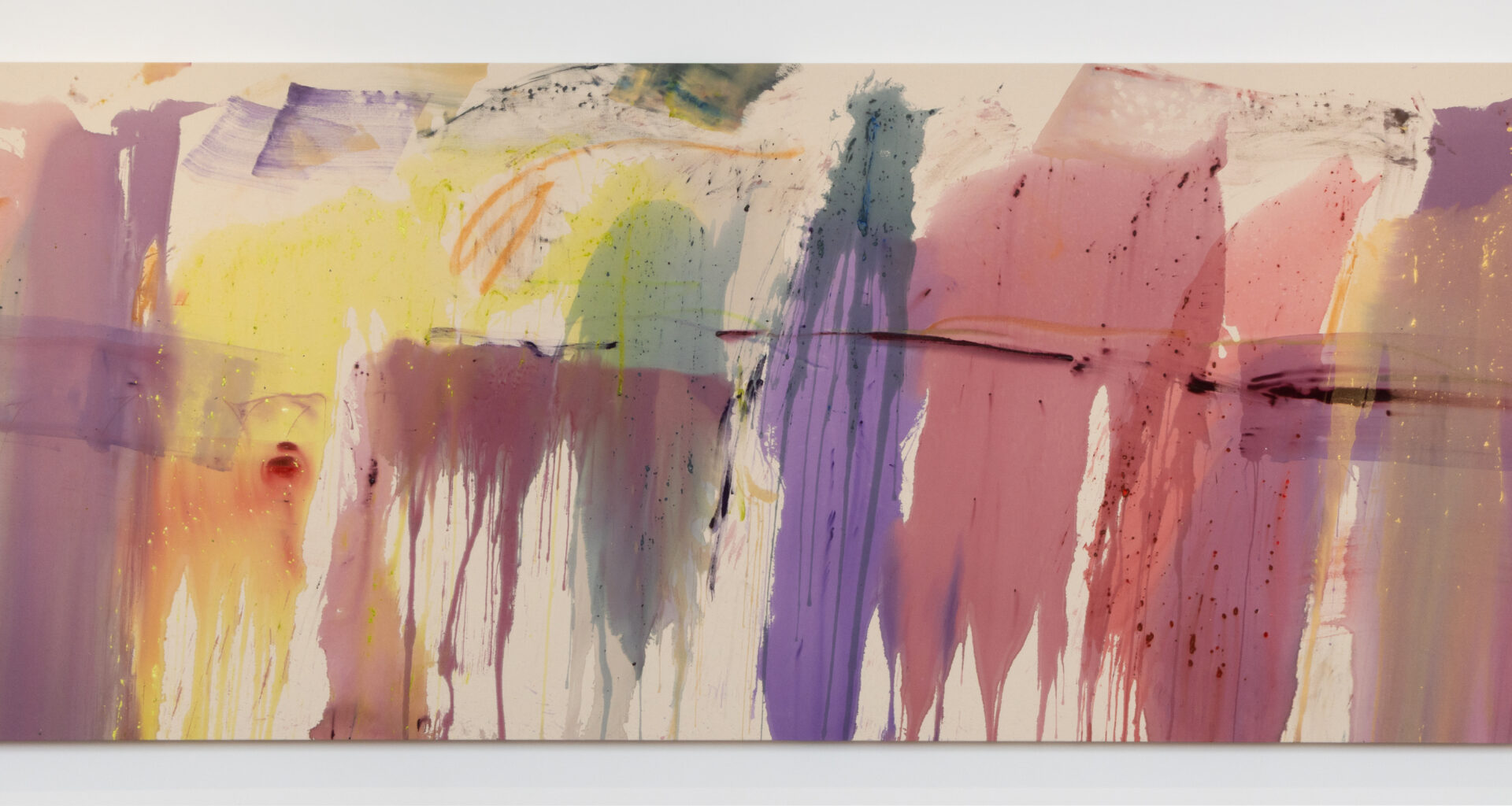
On the first floor, the viewer is welcomed by two large-scale paintings, each around fourteen feet long, facing each other: Time Release and The True Deceiver (both 2024). Their scale transforms the townhouse into something much larger, almost expansive. In Time Release, warm tonalities of deep purple, pale yellow, blood orange, pink, and green move across the canvas, shifting as the pigments drip, mix, and bleed into one another. Gestures manifesting from rollers, brushes, pours, and drips remain visible, but their effect is not one of spectacle; Tint’s marks reveal a disciplined process in which chance is carefully held by agency and restraint.
Across from Time Release, The True Deceiver feels emotionally arresting. Watered down purples, bruised reds, soft pinks, and flashes of yellow gather loose washes and translucent swaths, while brushwork moving in varied directions interrupts the surface. Near the center, these gestures begin to form a horizontal line, piercing through the softness of the field. There are splatters, stains, and denser red passages where the paint is applied with greater force. Yet, these moments do not overwhelm the canvas; instead, they activate the composition, wrestling against the softer washes and giving the painting its very tension.
Tint operates in a small studio, with unstretched canvases pinned to the wall and wrapped around the interior when more room is needed. Plastic covers the surrounding surfaces; buckets, rollers, and acrylic paint sit close at hand. These canvases do not emerge from an enormous industrial setting, but from a small room where scale is produced through constraint, physical labor, and bodily intellect. The larger works appear to carry those conditions in their proportions, extending horizontally, long and panoramic, rather than towering vertically. Tint’s process is distinct in this negotiation—her gestures are expansive yet simultaneously shaped by the limitations of space, the reach of the body, and the mediation between release and restraint. Tint moves with and against the canvas, stretching her arm, pouring, dragging, staining, and directing pigment in motions that read almost like choreography.