
The City Council continued its calls Tuesday for Mayor Zohran Mamdani to allocate $4 million in the city budget to carry out an investigation into what and when the city knew about how dangerous Lower Manhattan’s air quality was after the Sept. 11, 2001, terrorist attacks.
The council’s been asking for the money since it passed a law last year mandating a Department of Investigation (DOI) probe into City Hall over the matter. Advocates for 9/11 victims say they see funding this investigation as the only way to figure out how and why the city made the decision to tell the public that the air in Lower Manhattan immediately following the attacks was so safe that life could essentially go back to normal, and whether that messaging was in contradiction to internal environmental and public health information the city had.
“We passed a resolution in the City Council to have 9/11 information available to the public, and we couldn’t find any other way for that to happen except for this wonderful opportunity for DOI to do the work,” said Council Member Gale Brewer (D-Manhattan) at the DOI’s Tuesday budget hearing.
Advocates allege City Hall has for years stonewalled requests made via Freedom of Information Act requests and lawsuits for city records from the weeks and months immediately following the attacks, like risk assessments the city performed and communications between city agencies and the federal government that may show the city knew the air was unsafe and told people it was okay to return to the area anyway.
Without the $4 million, the city’s Department of Investigation said it won’t be able to conduct the investigation. It needs the money to hire an outside firm, which will help track down the remaining boxes of documents within the Mayor’s Office, Law Department, and other relevant city agencies, then review and analyze them.
“We would like to receive that money so we can get started,” said DOI Commissioner Nadia Shihata. “We are ready to get that started investigating the matter that you all have asked us to, all we are waiting for is the funding.”
When asked if the mayor’s office would honor the budget request, a City Hall official said it would “review this as part of the budget process.”
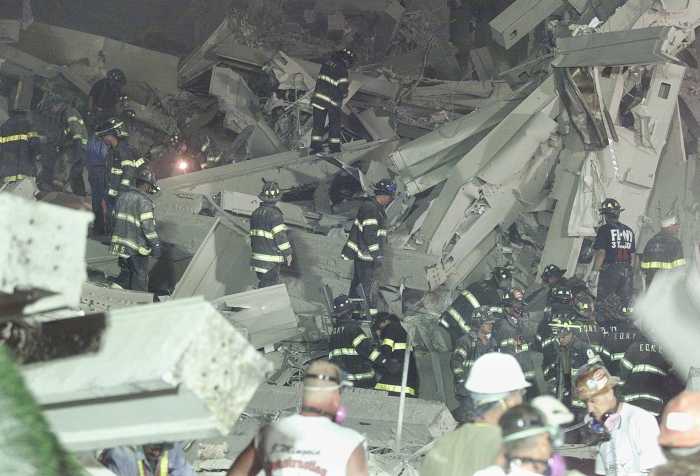 A group of firefighters search the remains of the destroyed World Trade Center in New York on Sept. 11, 2001. More than 400 firefighters have died of 9/11-related illnesses nearly 25 years after the attacks.REUTERS/Shannon Stapleton
The council believes the city has boxes of records that it is simply not turning over. Members and advocacy group 9/11 Health Watch, which sued the city over its failure to respond to FOIA requests, point to city officials initially saying there were no records at all from the period following the attack, then turning around and handing over 68 boxes of documents from the Department of Environmental Protection.
Last month, a Manhattan Supreme Court judge ordered city officials to testify on why that happened, a decision Brewer referenced as extraordinary during Tuesday’s hearing.
“The FOIL people say there are no more boxes. We know there are more boxes,” Brewer said, adding after the hearing that, “The Law Department said they could not find any boxes whatsoever regarding 911, and we just don’t believe it.”
Shihata alluded to a knowledge Tuesday that there were more boxes of records the city had that it was not publicly sharing, saying the DOI “was aware of where relevant records should be located” after receiving responses from “various city agencies,” they expected to have the “type of records that would be relevant to the investigation.”
 New York City firefighters work too pour water on the smoldering pile following the collapse of the World Trade Center during the Sept. 11, 2001 terrorist attacks.Photo by Andrea Booher/FEMA News Photo
Brewer said getting the information out of the city was not to enable victims and their families to file lawsuits — there are multiple legal barriers preventing that — but rather to hold the city to account and prevent the city from withholding information during a future disaster, such as another pandemic or terror attack.
“We don’t want something like this to happen again,” Brewer said. “We want to be sure that any information that comes to the city is used for the future to avoid toxicity [and harm to residents].”
The money for the 9/11 investigation, which is expected to take two years, is just under half of the additional funds DOI is requesting in the final city budget.
The commissioner said that, since former Mayor Eric Adams systematically defunded the agency as it investigated his misconduct, the DOI needs an additional $6 million to stabilize itself. That money, Shihata said, is necessary to keep the agency’s core operations running and ensure it doesn’t have to further decrease staff.
“For years, they have been asked to do more with less, and that takes a toll on morale, and just frankly, the ability to make sure you’re properly staffing every investigation you’re working on,” Shihata said. “At a certain point, you get to a point where … you have to make decisions about what investigations you can and can’t open.”
If the DOI doesn’t get the additional money it needs in the city budget, Shihata said she’d be forced to make “difficult decisions” and that certain staff positions and DOI’s ability to carry out its mandate of comprehensive city oversight would be threatened, something council members agreed with and expressed concern over.
“It is not an overstatement to describe this current moment as pivotal for the agency,” Shihata said. “[We] need additional funding to stabilize DOI and ensure the agency can continue to fulfill its crucial oversight mandate.”