
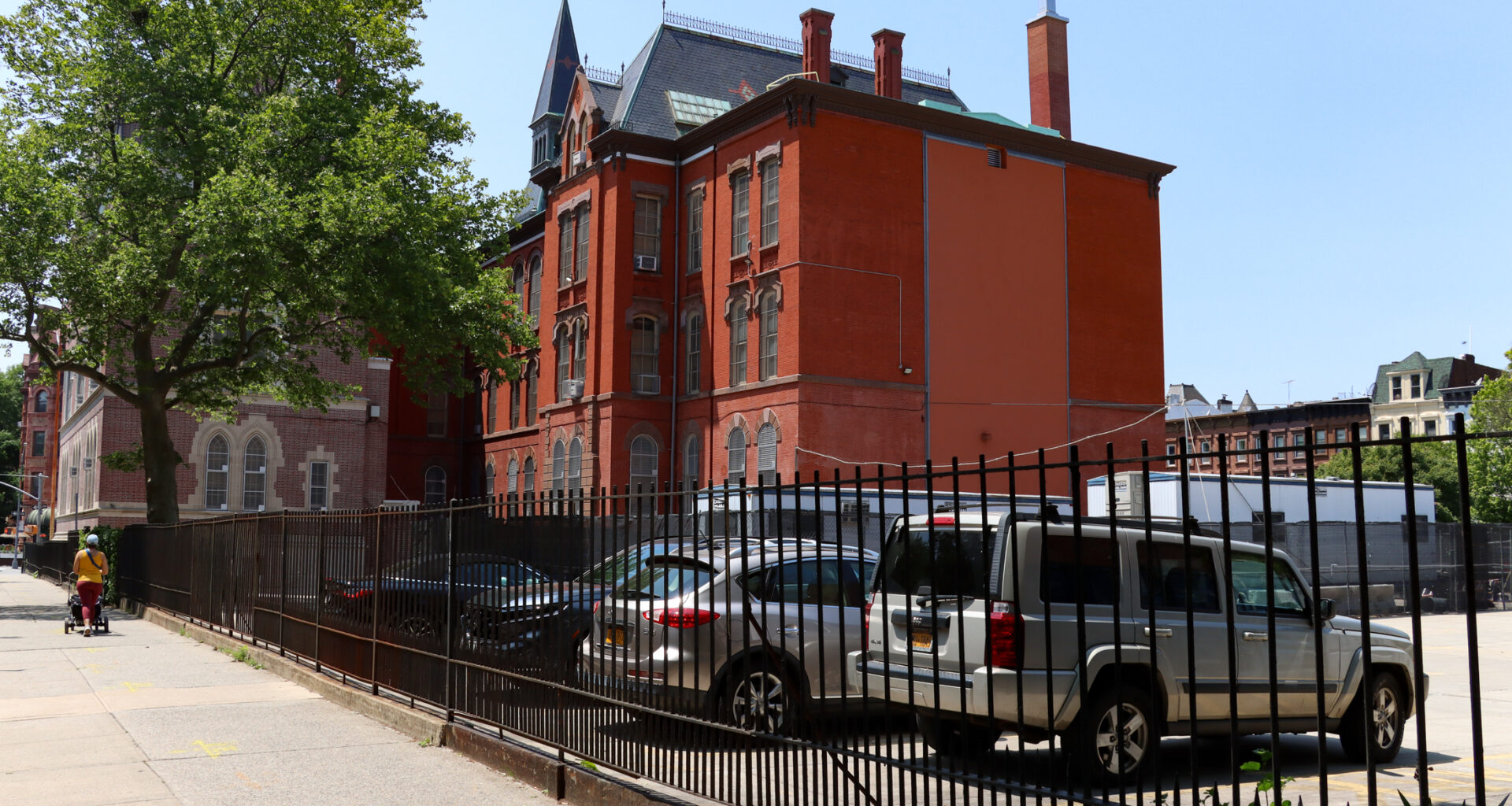

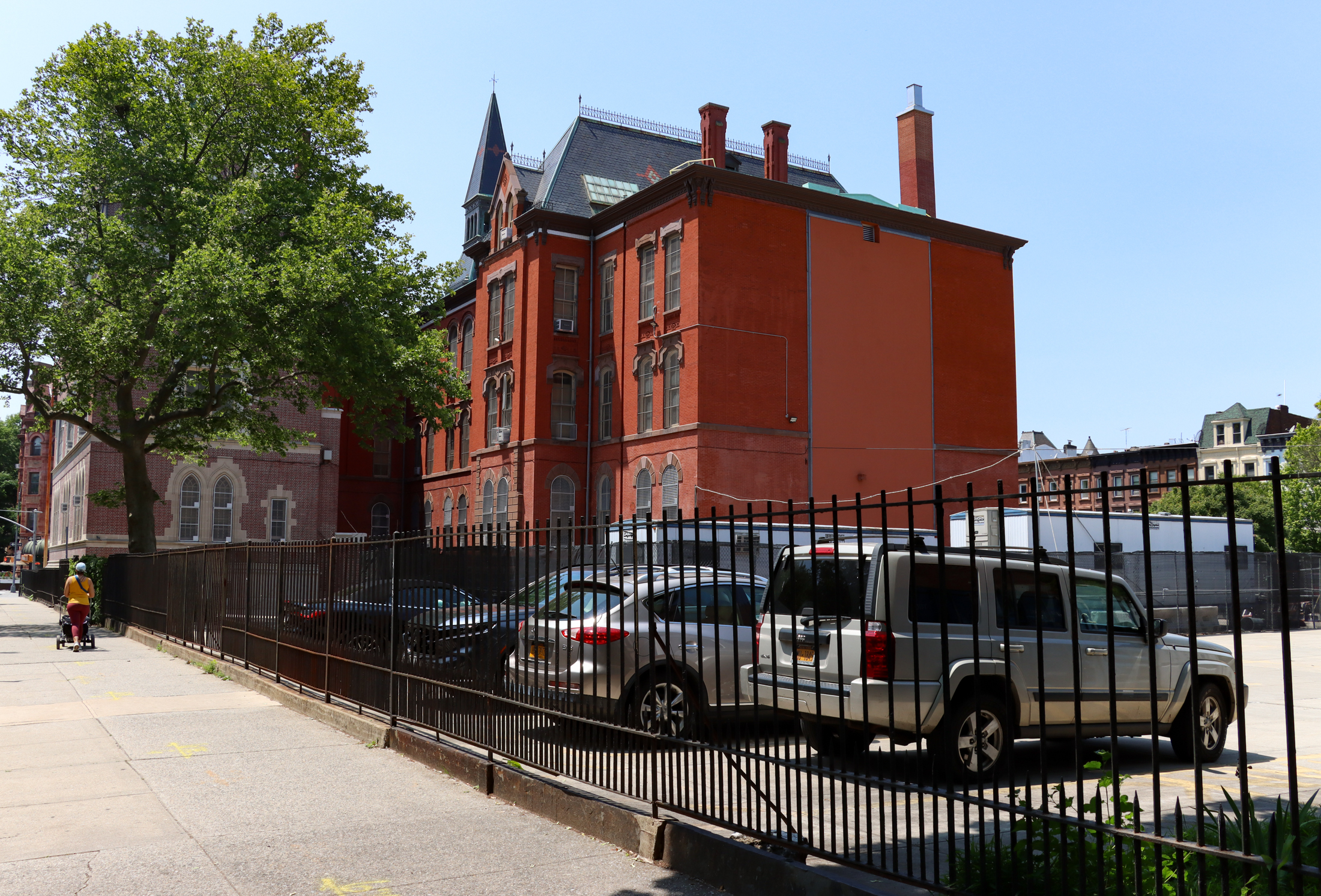
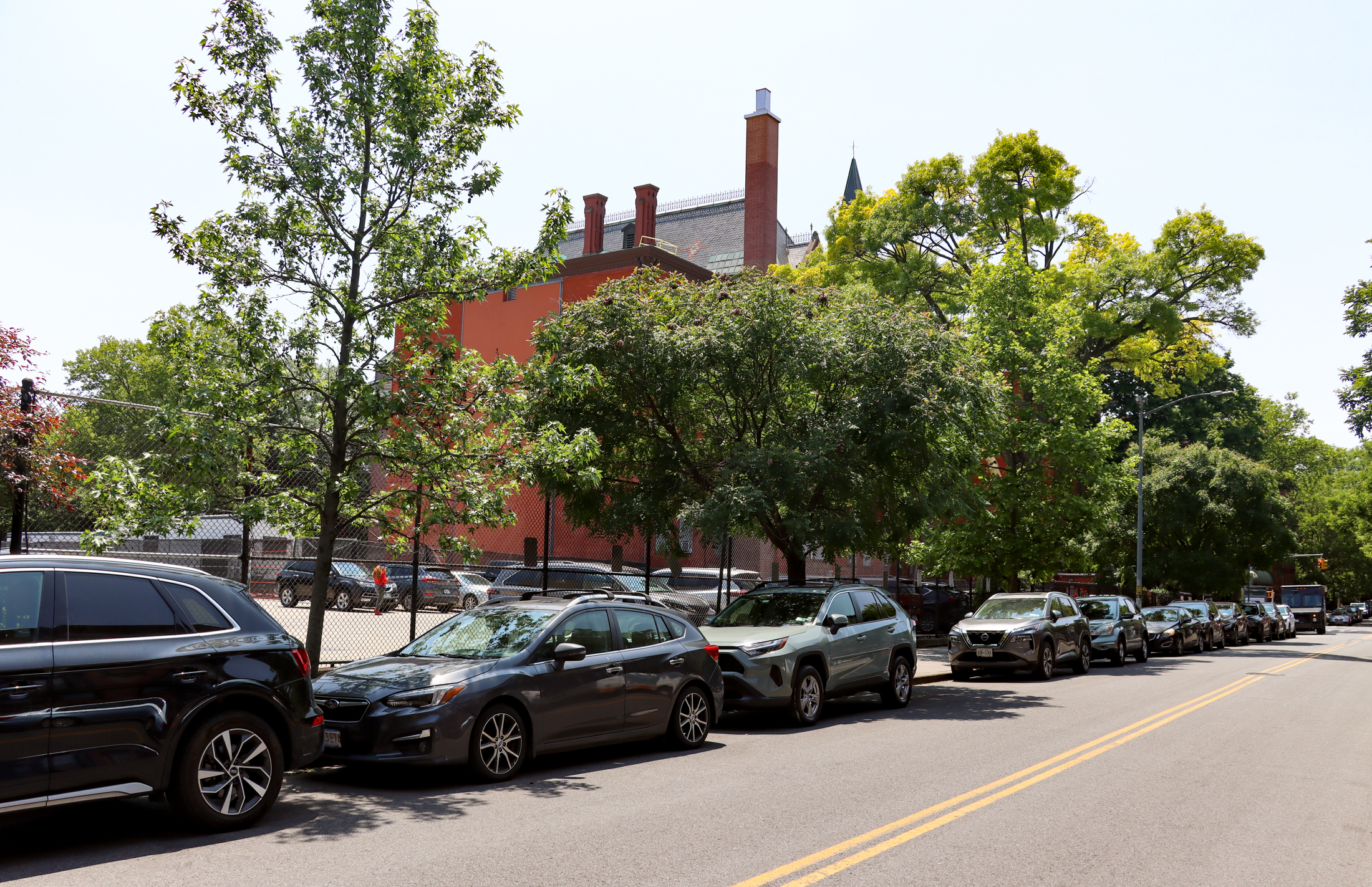
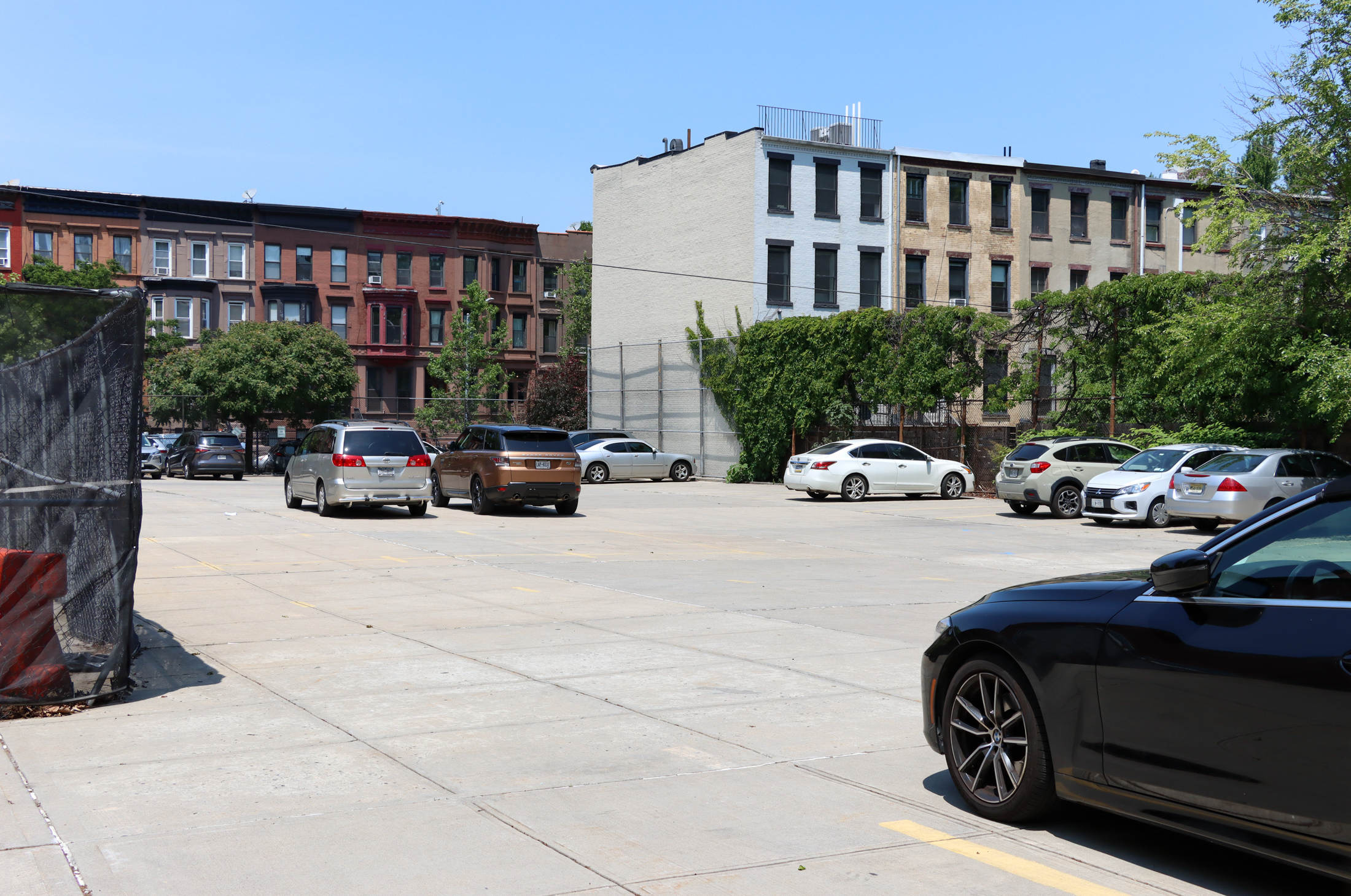
The parking lot attached to Girls High School pictured in June 2025. Photo by Susan De Vries
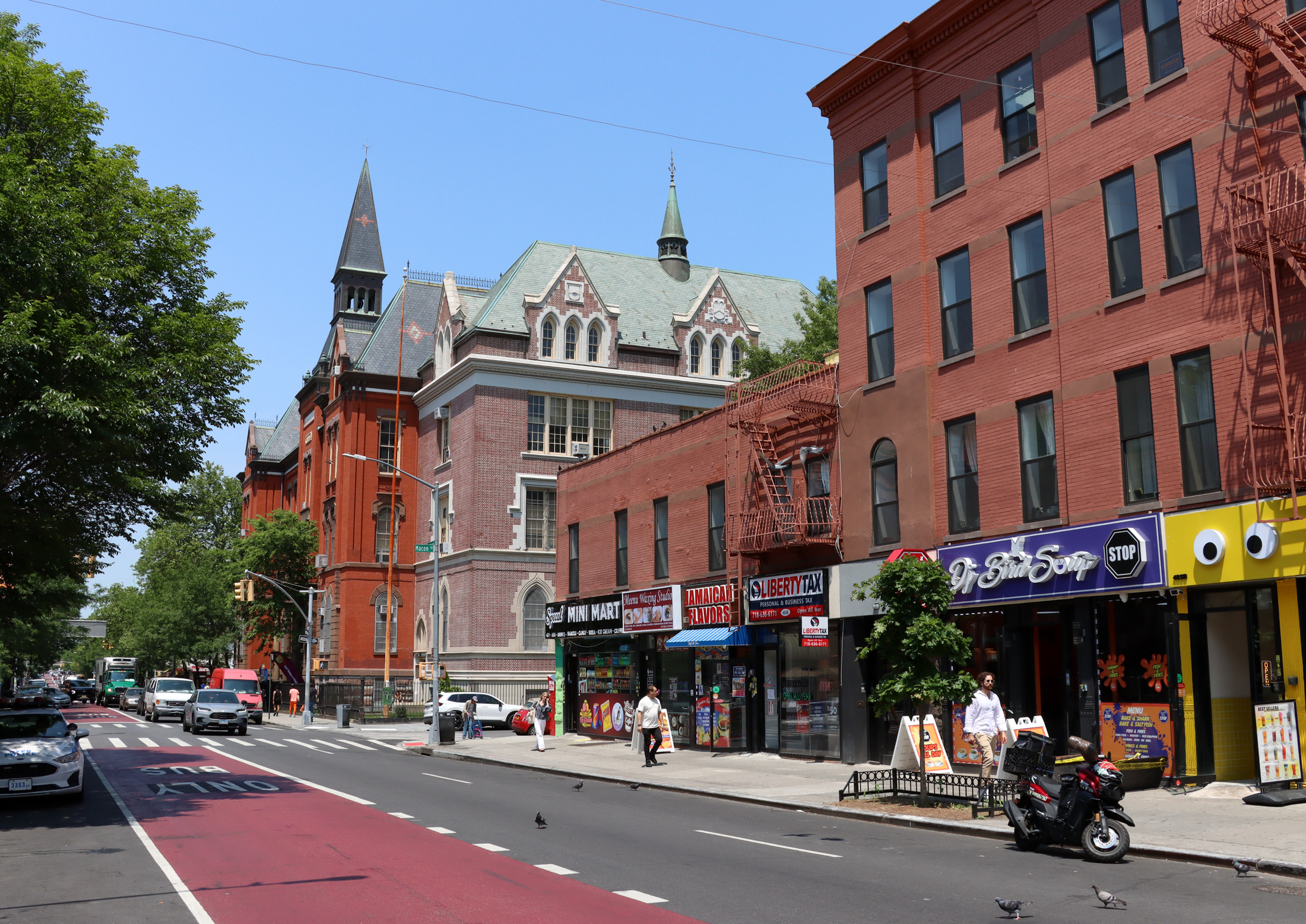
Bed Stuy residents are planning to pack a Brooklyn courtroom Wednesday in a fight over the future of a large parking lot behind the landmarked Girls High School on Nostrand Avenue.
Locals will face the city in court for a second time in the case, in which they are asking Kings County Supreme Court Judge Lisa Lewis to reverse the 2025 rezoning of the school site at 457 Nostrand Avenue and restart the public review process. The rezoning paves the way for an up to 15-story affordable apartment building to rise on the school’s parking lot.
Sixteen locals are named in the legal action accusing the city of bypassing its rules and sidelining them in the site’s rezoning, which was wrapped up in the sweeping Atlantic Avenue Mixed Use Plan. The historic Girls High School sits outside the main area of the rezoning, three blocks to the northeast of the corridor.
Through the Atlantic Avenue rezoning, the city upzoned the entire school site and got permission to sell the parking lot to a developer to build a fully subsidized and 100-percent affordable housing development that could rise up to 155 feet and include 240 apartments.
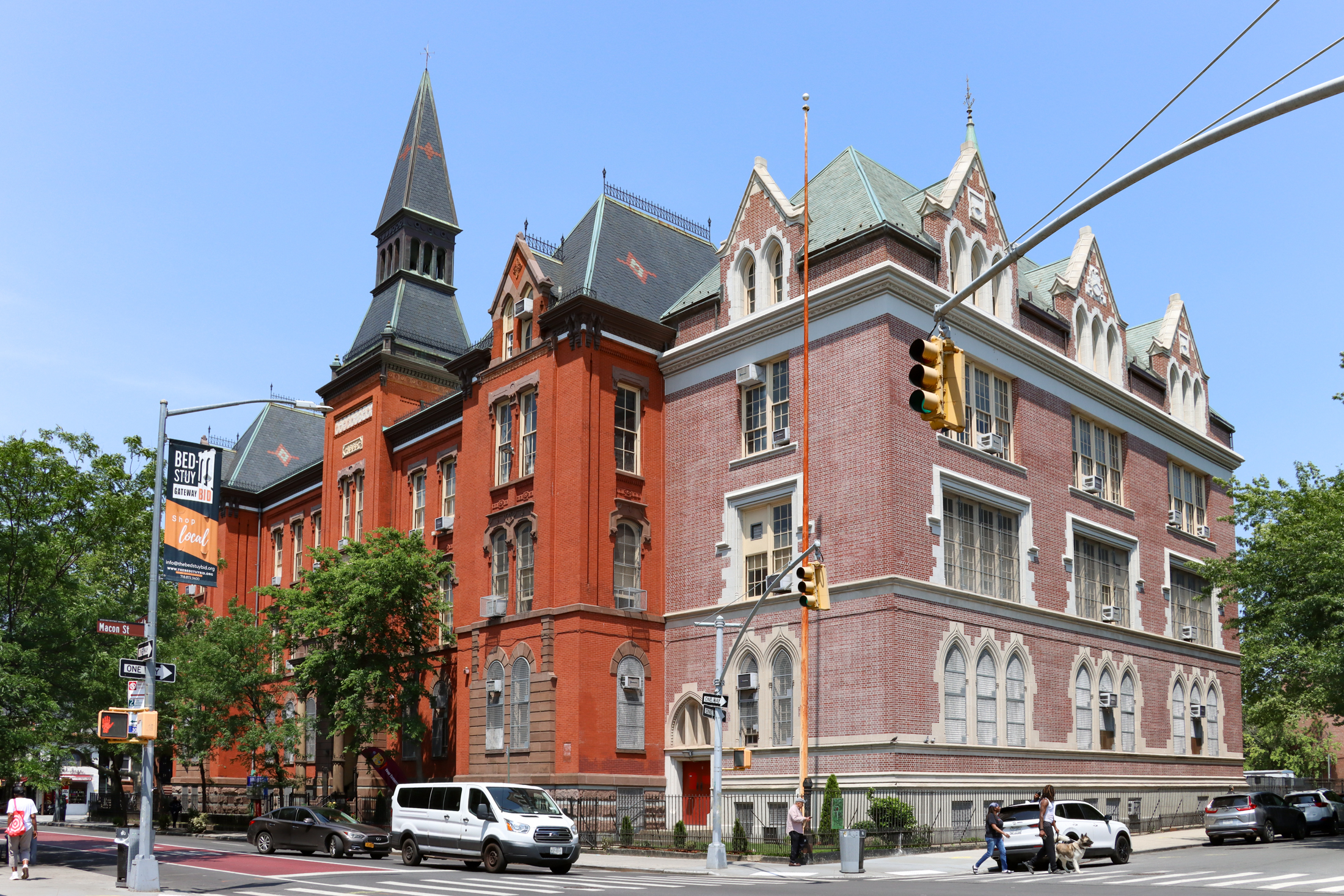 The school in June 2025. Photo by Susan De Vries
Filings show the city will seek proposals for the site for a 100 percent affordable income-targeted and rent-stabilized mixed-use project including 240 apartments and 25,000 square feet of space for NYC Public Schools. At least half of the units will be set aside for Extremely Low- and Very Low-Income households, which is between 0 and 50 percent of Area Median Income, court documents say.
While the city has said it would be 100 percent affordable, it hasn’t specified what rents will be for the remaining 50 percent of apartments, with an HPD rep telling Brownstoner last year they would serve “a range of income levels.” They said future public engagement would help to shape the affordability levels set out in the RFP.
Locals allege they were left out of planning
The residents argue they were denied the mandated opportunity to shape plans for the future of the publicly owned site. The city disputes that claim, arguing it followed the required process and that additional community engagement will occur before any development moves forward.
Locals have pitched alternative visions, including the creation of a community center and a public garden, or a smaller contextual development that doesn’t overshadow the historic and architecturally significant school building. Any plan, they say, should somehow preserve parking and add additional space for Girls’ High current occupant, The Adult Learning Center.
At a March 25 hearing, Lewis asked the city’s lawyers and the group of locals, represented pro se by Bed Stuy resident Ramón Chicón, to file paperwork detailing the rezoning timeline and process, which will be reviewed at the June 3 hearing.
Following the March hearing, the residents requested a temporary restraining order to stop the city from taking any action on the site while the case is ongoing, but that was rejected as the city said no work is expected before 2029.
Those behind the legal action are “residents, small-business owners, and community leaders who live across from, next to, and within a few 100 feet of the site, including members of the original steering committee that secured Bedford’s landmark designation,” court filings say.
The group alleges the city violated its own rules by failing to follow required land-use and environmental review procedures by adding the site to the rezoning proposal after the environmental scoping process had closed. They say this left Community Board 3 residents without a meaningful opportunity to participate in planning for the future of the historic site. There was little community outreach done in Bed Stuy, they argue, and many nearby residents didn’t learn about the proposal until the day the City Council voted on it, which they say violates the city’s Uniform Land Use Review Procedure.
The group also argues that because the school is individually landmarked and sits within the Bedford Historic District, the city was required to explore potential historic-resource impacts earlier in the environmental review process.
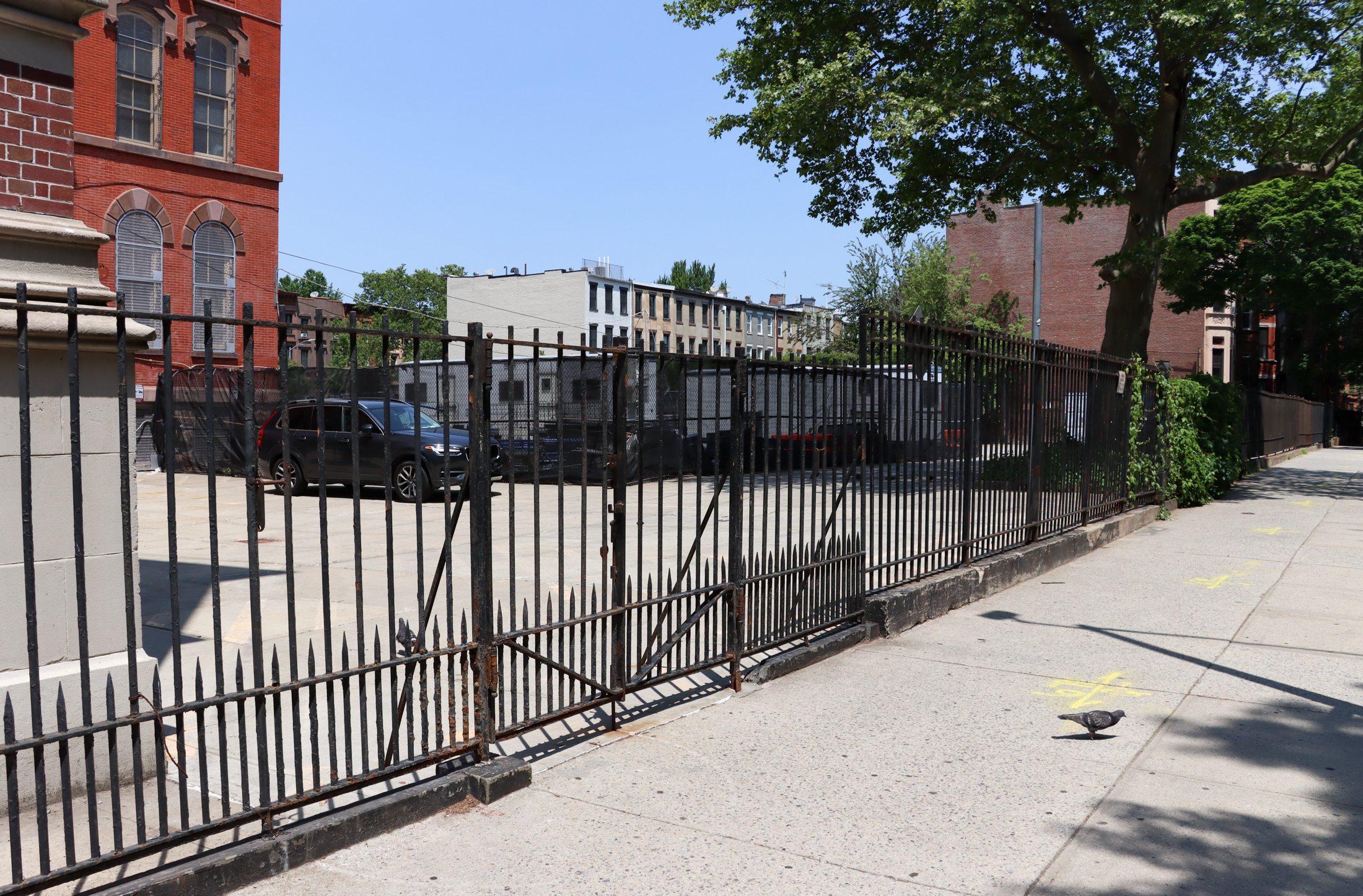
The residents “do not claim a veto over housing policy, only enforcement of the safeguards the Charter, ULURP, and CEQR provide to prevent late-added projects on public land in landmark districts being pushed through on corridor-level generalities and procedural box-ticking,” court documents state.
However, the city has pushed back on those claims, arguing the rezoning went through “extensive review,” including environmental reviews, and residents had multiple opportunities to weigh in through hearings held at the community board, borough president, City Planning Commission, and City Council levels.
A central issue in the case is when the Girls High School site was added to the larger Atlantic Avenue Mixed Use Plan and whether that timing allowed residents to truly participate in planning.
The Department of City Planning issued a draft scope of work for the broader rezoning in 2023, which didn’t include the school site. During the scoping process, DCP received comments including from Council Member Chi Ossé, who called for the inclusion of 457 Nostrand Avenue as public land suitable for affordable housing development. The city added the site to the final scope of work published on October 11, 2024, legal documents show. The rezoning was certified by the City Planning Commission on October 15, 2024.
Residents argue the addition of the site at the end of the scoping period meant “Community Board 3 residents were effectively excluded from planning and scoping for 457 Nostrand,” and that the subsequent “perfunctory CB3 contact violated ULURP and CEQR.”
Most of the earlier outreach connected to the plan took place in Community Board 8, the group points out, and there were “no comparable CB3-based visioning sessions, scoping-stage meetings, or workshops in the immediate vicinity of 457 Nostrand.”
“A single, late CB3 hearing after the plan was effectively set, and after CB8 enjoyed a full visioning process, is not the meaningful community-board participation the Charter and CEQR were designed to guarantee,” the filings state.
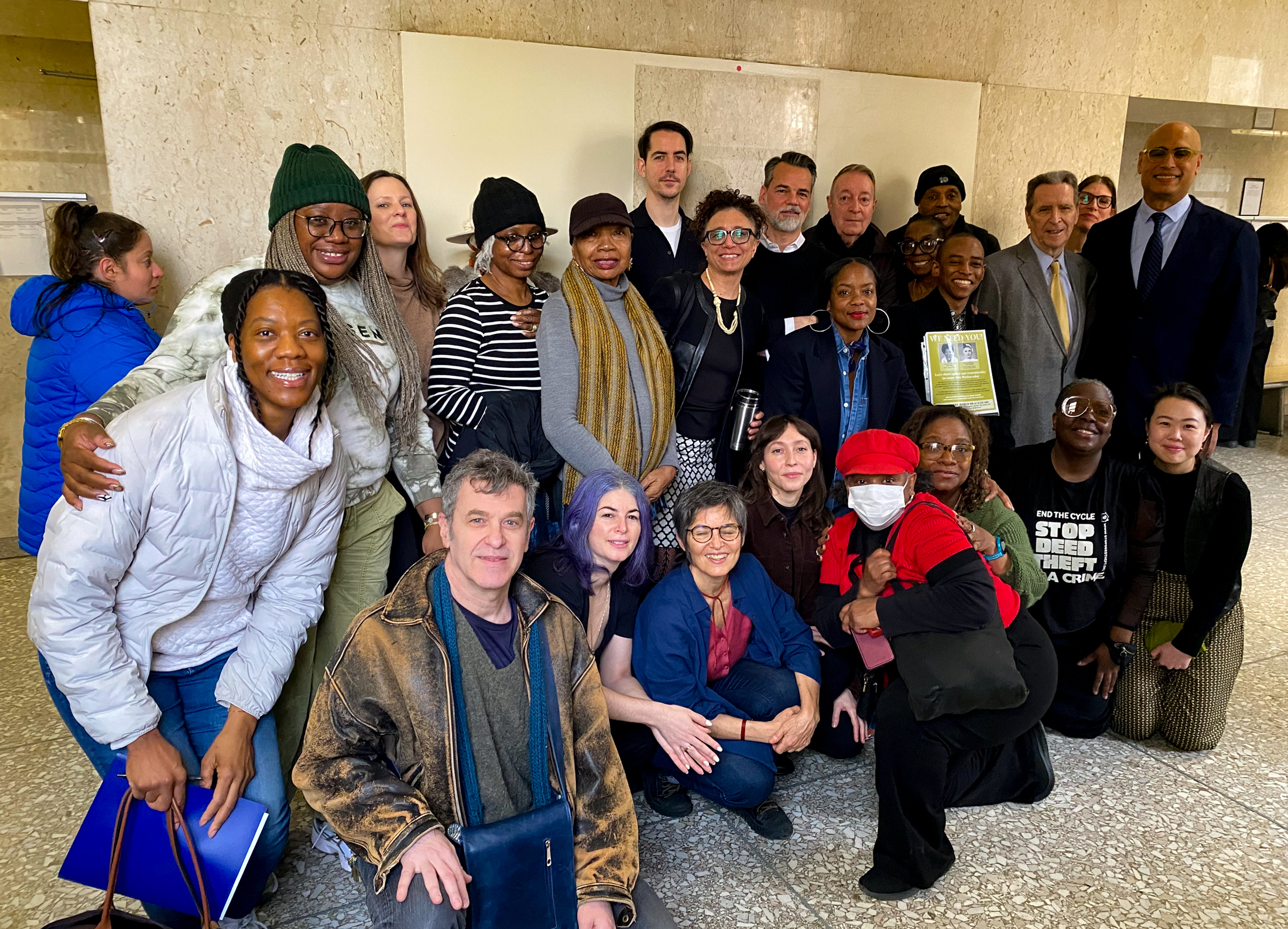 Local residents first presented their case to the court in March. Photo by Anna Bradley-Smith
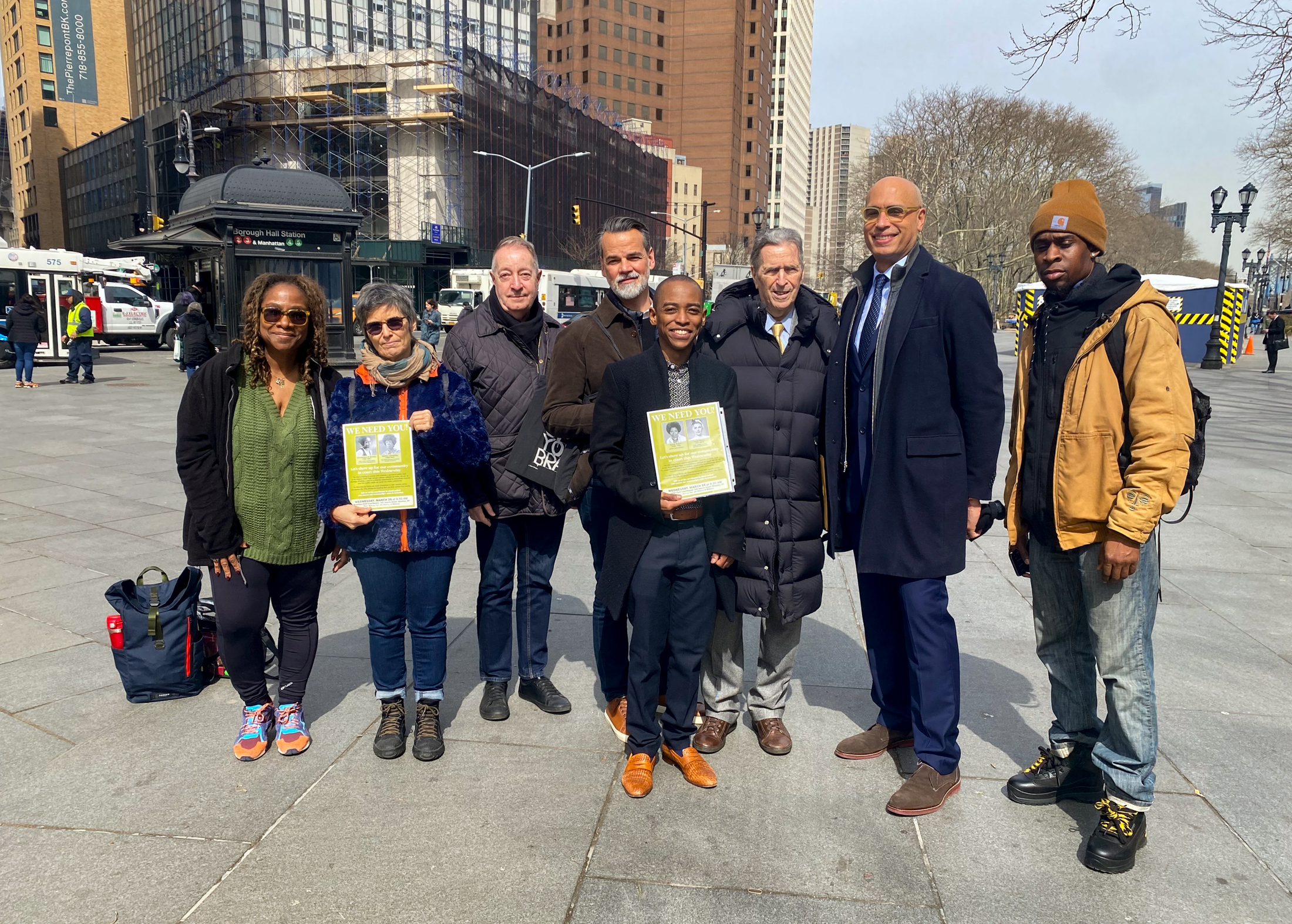 The residents will be back in court on Wednesday. Photo by Anna Bradley-Smith
The group argues the process meant there was no real opportunity for alternative visions for the site to be considered, and Community Board 3 was ultimately asked (in a meeting the group said in court filings was without quorum) to vote on the proposal without adequate input from locals.
Other ideas for the site could have included a smaller development under the previous zoning, shifting density to other nearby non-landmarked sites, or creating a community facility that included parking for the school, they said.
“Alternative concepts could have created a community center celebrating the legacy of Girls High School alumnae, including figures like Shirley Chisholm, so that new construction would reinforce rather than diminish the site’s civic and cultural role,” the filings state. The group argues that, as longtime residents of the area, they were entitled to be involved in the future planning for city-owned land in their landmarked neighborhood.
“How amazing would that be for that land right there, which is a very historic site, both culturally and historically, to be utilized as a fresh food market, a space for people to be able to gather and hold block meetings, hold community meetings, hold community gatherings, and also educational things as well,” local resident and architect Omar Walker previously told Brownstoner.
The history of the site and its role in the community
Before the rezoning, the parking lot, which stretches between Halsey and Macon streets and is used by staff and students at the Brooklyn Adult Learning Center, sat in an R6A and R6B zoning district. It was rezoned to R7-2, which allows for taller and denser development.
It was one of five publicly owned sites included for disposition and subsidized 100 percent affordable housing development included in rezoning. Three of the sites, including 457 Nostrand Avenue, sit outside the main corridor of the rezoning.
 Image from the Atlantic Avenue Mixed-Use Plan via NYC Planning
The site was not always a parking lot. A wing of the historic school building was destroyed in a 20th century fire and was never rebuilt. The space was later converted into surface parking.
Locals and staff at the Brooklyn Adult Learning Center, which operates out of the historic school building, argue the lot is an important resource for the school, which offers classes for adult learners, including GED programs. Staff say the school is already at capacity and has been denied requests to expand, and the lot has been a place they can hold events such as resource and health fairs.
City claims full public review, with more ahead
The city has fired back at the claims there wasn’t adequate public engagement on the site’s future, and argues the project underwent full public review as part of the Atlantic Avenue Mixed Use Plan.
According to court filings, plans for the site were presented to Community Board 3’s Land Use Committee on November 13, 2024, and the board held a public hearing on December 2, 2024. Community Board 3 ultimately voted 22 to 6 in favor of the project with conditions that included reducing building height, increasing affordability, and exploring underground parking.
The city argues that, beyond the community board process, hearings were also held for the rezoning by the borough president, the City Planning Commission, and City Council. A city-sponsored town hall was also held in April 2025.
“The Land Use Actions, sought to facilitate the AAMUP, underwent extensive public review. Both the zoning map amendment application and disposition application at issue in this proceeding were subject to public review pursuant to ULURP,” the city said in court filings.
The city also noted that there is plenty of opportunity for public input on the project ahead. Department of Housing Preservation and Development will hold community engagement in 2027, filings say, including public workshops to gather feedback on the project’s design and housing options.
Any future development would also require approval from the Landmarks Preservation Commission because the project would rise on a landmarked site within a historic district. The LPC process would require further public hearings.
Council Member Chi Ossé, who advocated for the site’s inclusion in the rezoning, told Brownstoner via email that allegations the community was excluded from the planning process were “simply not true.”
During the 2023 scoping process, he said, “City Planning worked with Council to identify city-owned sites that would be ideal for housing in both Districts 35 and 36. After those initial rounds of workshops, our office, Council Member Hudson’s office, and City Planning continued to discuss the rezoning in more detail. This project went through an extensive public process.”
He added that “specific community engagement sessions for the 475 Nostrand site are still upcoming. There will be more engagement opportunities about this site, specifically in 2027. The project will not begin until community engagement is complete.”
Ossé said the reasoning behind including the site is that it is large enough to support a new affordable housing development, and is a city-owned parking lot “utilized only by staff and students of 457 Nostrand.”
He said that building on city-owned land allowed the community to have a say in what they wanted to see on the site, including the level of affordability, community needs and, in this case, space for the Adult Learning Center. It also allowed the city to mandate the building be 100 percent affordable, he said.
“Black working families are being pushed out of Bed Stuy in real time. What we want to see, what we fought for, is 240 fully income-restricted affordable units on city-owned land. Half for very low-income New Yorkers, studios in the range of $850, two-bedrooms in the range of $1,200, in Bed Stuy, and merely two blocks from the A/C train,” he said.
“These prices truly reflect the needs of our community, and this is what happens when the city controls the land we’re looking to build housing on. We don’t have to negotiate with a developer trying to maximize profit. Instead, we’re negotiating for our constituents and the Black families who built this neighborhood and deserve to stay in it.”

In order to build a 100 percent affordable development with 50 percent of the apartments set aside for those earning under 50 percent of AMI, developers would need to make heavy use of government subsidies for the project to pencil out.
In regard to the building’s appearance, Ossé said he and his office “personally want this building to fit the character of the neighborhood.” He added that the new development would not affect the historic school building, would rise only on the adjacent parking lot, and would be subject to LPC approval.
Ossé said no issues were identified during the environmental review that would impact nearby residents. He added that “we are aware that, because the surrounding streets are vulnerable and in need of trench repairs, any new construction would exacerbate the issue. Our office wants to reemphasize that the City did not find this to be a concern.”
He said his office allocated $1.757 million to the Department of Transportation for the Hancock Trench Repair project, which includes streets surrounding 475 Nostrand Avenue, and said the office was taking “proactive steps to ensure trench repairs are completed.”
[Photos by Susan De Vries unless noted otherwise]
Related Stories
Email tips@brownstoner.com with further comments, questions or tips. Follow Brownstoner on Twitter and Instagram, and like us on Facebook.