
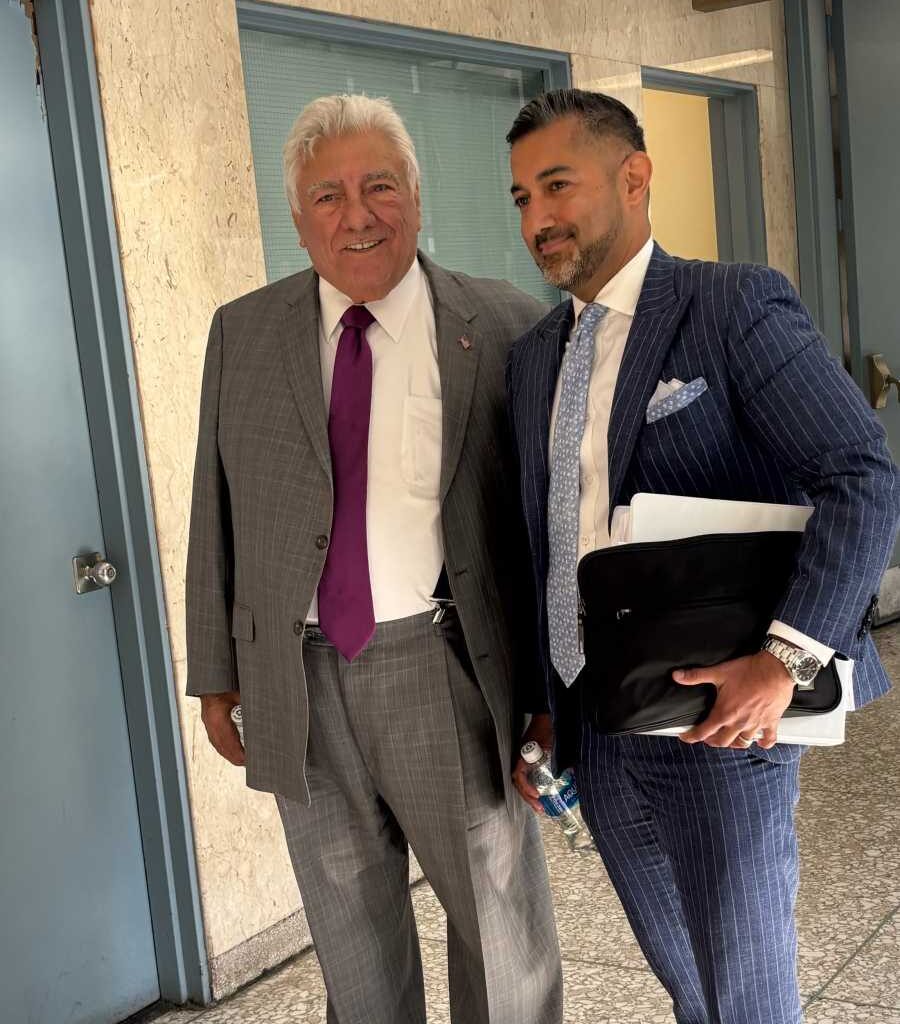
Former Brooklyn Democratic Party boss Frank Seddio revealed on the stand in Brooklyn Supreme Court on Wednesday that a businessman accused of extensive real estate fraud has been making legal filings and sending emails using his court system credentials and digital signature.
That real estate investor, Yechiel “Sam” Sprei, who was arrested last month for allegedly working with a sitting judge to swindle millions from investors in a property sale scheme, is Seddio’s client in a separate case involving allegations of the misappropriation of escrow funds.
The shocking revelation came in a sanctions hearing over Seddio’s conduct as a lawyer in the latter civil case. Seddio’s influence looms large over Brooklyn legal and political institutions as a former state Assembly member, Surrogate’s Court judge, and chair of the Brooklyn Democratic Party.
Two international investors are locked in a federal and state case against Sprei over claims that they got caught in a scheme that started when they put $2 million into escrow with a Brooklyn lawyer, Mark David Graubard, to prove they had enough funds for a deal with Sprei.
After the investors began asking for their money back, they ran into strange roadblocks.
Sprei hired Seddio to file a case against the investors in the Brooklyn Supreme Court. The investors allege that in the year of litigation, Seddio and his clients commenced actions aimed at prolonging and delaying the lawsuit at every turn — allegations that Brooklyn Supreme Court Justice Francois Rivera called on Seddio to testify about this week.
In his first day on the stand, lawyers for the investors grilled Seddio over a message that was sent from his attorney email account on January 29, which directed David Graubad not to give the escrow money back unless the investors agreed not to sue Sprei. Seddio initially claimed the email was ghostwritten.
“I did not send the email,” Seddio said at first. “It was sent to my email, and I don’t know who sent it.”
When further pressed by the investors’ attorney, Lauren Zimmerman, about who could have sent the email other than his law firm employees — whom Seddio ruled out — he suggested: “the only other person I could think of… was Sam Sprei.”
On the second day of testimony, Wednesday, Seddio claimed that his assistant had informed him “very recently” that, in addition to ghost writing from Seddio’s professional email address, Sprei had been making legal filings impersonating Seddio through his state court system-authorized e-filing credentials.
When asked for evidence that Sprei had used his account, Seddio responded with an epithet, telling the court under oath, “You’ll see a number of emails that are almost retarded in the way they were written by Mr. Sprei.” The use of “retarded” is widely considered an ableist slur.
Seddio said that up to this point, he had not shared Sprei’s use of his password-protected credentials to law enforcement or anyone outside his law office, for that matter, but that he would be willing to take the next appropriate steps. He denied instructing him to make any legal filings on his behalf.
A legal representative for Sprei declined to comment on the allegations made by Seddio or on the charges in the federal criminal case against Sprei.
Repercussions of Frank Seddio’s claims about Sprei
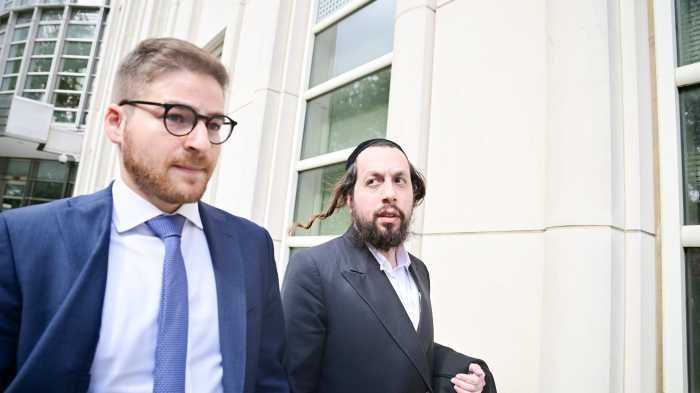 Right, Brooklyn real estate businessman Sam Sprei was arrested for fraud on May 13.Photo by Lloyd Mitchell
Rebecca Roiphe, a New York Law School professor on legal ethics, said that if the allegations were found to be true, Sprei could face criminal consequences under false filing or fraud under state law.
Though Roiphe had not come across a comparable case to the bizarre circumstances of Seddio and Sprei’s relationship, if there are any hypothetical consequences for Seddio’s role in not safeguarding his credentials, it would come from an investigation carried out by the Brooklyn appellate court’s attorney grievance committee.
Seddio said that he has changed his password to his e-filing credentials and clarified to amNY after the hearing that Sprei no longer has access. That doesn’t mean that he has ceased contact with his client.
Seddio said that the night after his first day of testifying, he had a phone call with Sprei about another legal matter he’s continuing to represent him in.
A few days earlier on Sunday, Seddio testified, he had also talked with his client, during which Sprei claimed to have made a $3 million offer to the international investors’ counsel in order to settle both the federal and state cases over the missing $2 million, but they rejected it.
“An offer was made of $3 million, and you turned it down,” Seddio told Zimmerman. “The only issue was that I would not be allowed out of the case.”
Zimmerman claimed that Sprei’s account of the offer was not correct and asked Seddio why his client would be trying to settle the matter on his behalf.
“I assume it’s that Mr. Sprei played such a role in this entire disaster,” Seddio said.
During the rest of the cross-examination, Zimmerman questioned Seddio over a number of correspondences and legal filings in the case that her clients deemed to be examples of “frivolous conduct.” He said he had no way of knowing how many legal filings Sprei had made in his name.
When asked how many of the eight frivolous acts he’s claiming Sprei committed using his credentials, Seddio responded, “All of them.”
Judge Rivera adjourned the cross-examination before the defendant’s attorneys could finish their questioning. Seddio’s testimony in the case will continue after a break on July 27.