
Nearly six million upstate New York residents depend on four regional bus systems to get to work, appointments and daily errands, but a new report from the state comptroller’s office finds those systems are not always delivering on time, and in some cases, are not publicly tracking whether they do at all.
The report examines on-time performance across the Capital District Transportation Authority, the Niagara Frontier Transportation Authority, the Central New York Regional Transportation Authority and the Rochester-Genesee Regional Transportation Authority, offering what officials call the clearest public accounting yet of how each agency measures up.
“We found out that their performance was different depending on the authority,” said Matthew Golden, assistant comptroller at the New York state comptroller’s office. “Some of them are doing great. Some of them are not meeting their goals. And some of them don’t have public goals at all.”
Rochester leads the pack
Of the four systems, Rochester’s Regional Transit Service under RGRTA stands out as the top performer. The agency sets an on-time goal of 88% — the highest among the four — and has maintained consistent results over a decade of tracked data.
Buffalo struggling to meet its own bar
Buffalo’s NFTA operates with a lower on-time target of 84%, but has had difficulty meeting even that threshold, according to the report. Riders say the gap is noticeable.
“It does get discouraging because you know they’re supposed to be there at a certain time,” said Mario Cox, an NFTA rider.
In a statement, NFTA said it “takes On-Time-Performance seriously and we work continuously to exceed national industry standards,” citing harsh winters and ongoing construction as operational challenges.
Syracuse has no public benchmark
CENTRO, which serves more than one million residents across five counties in the Syracuse area, has no publicly available on-time performance goal — leaving riders with no standard to hold the agency to. That absence surprised state Assemblyman Bill Magnarelli, D-Syracuse.
“I hope that CENTRO will start doing that,” Magnarelli said. “And as a matter of fact, I think they are.”
Capital Region tops ridership but lags on timeliness
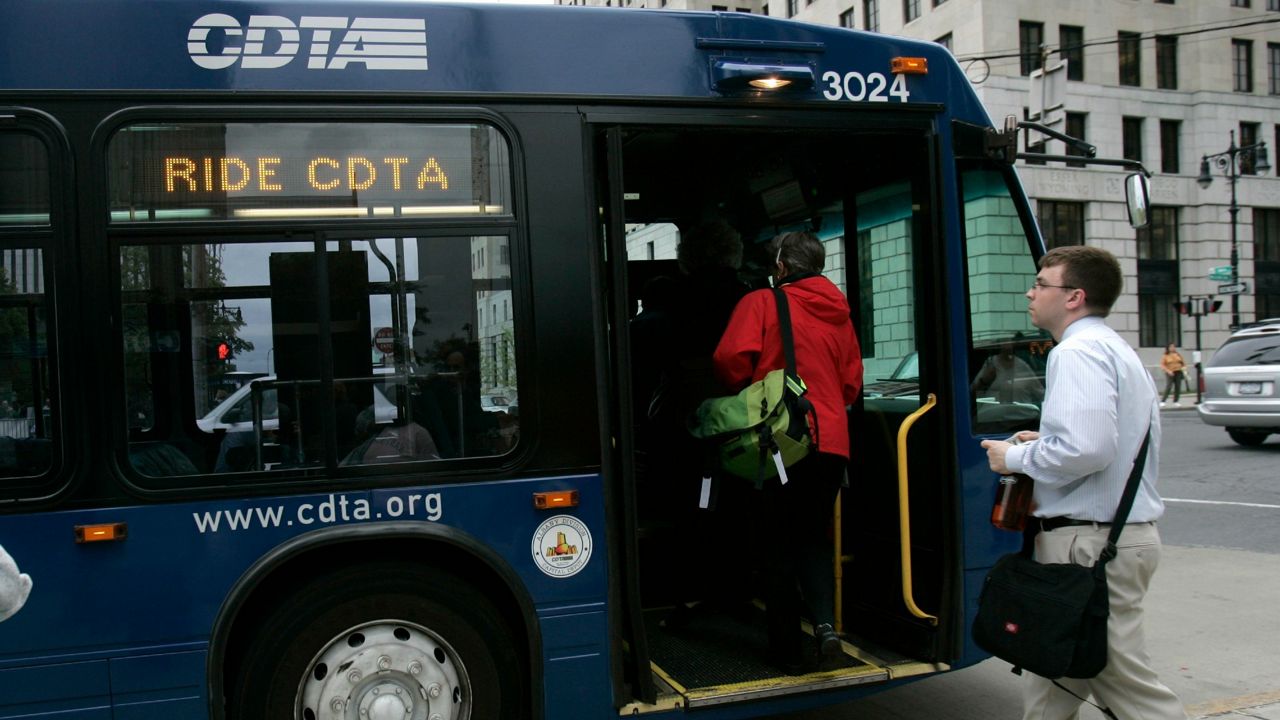
CDTA, which recorded more than 16 million trips last year to lead all four agencies in total ridership, has consistently fallen below its own 80% on-time target. For regular riders like Gail Greggs, the report confirmed what she already suspected.
“It makes me uncomfortable to find out that maybe I may be late for work or for an appointment,” Greggs said.
CDTA said in a statement that it is “implementing a number of initiatives through our Transit Development Plan that are improving on-time performance while helping us operate more efficiently.”
Comptroller warns against easy fixes
Golden said the report’s concern extends beyond whether buses are running late — it also scrutinizes how agencies respond to the problem. He cautioned against agencies improving their numbers by cutting bus stops, which would make service harder to access.
“What we wouldn’t want to see is them just eliminating bus stops and making it more difficult for people to get on a bus in order to make the buses run on time,” Golden said.
Broader stakes for transit funding
The findings come as transit advocates push for greater state investment in public transportation. A report from the New York Public Transit Association estimates New Yorkers could save more than $10,000 a year by forgoing car ownership in favor of public transit. Magnarelli said he has advocated for increased state funding for mass transit to improve reliability and grow ridership.