
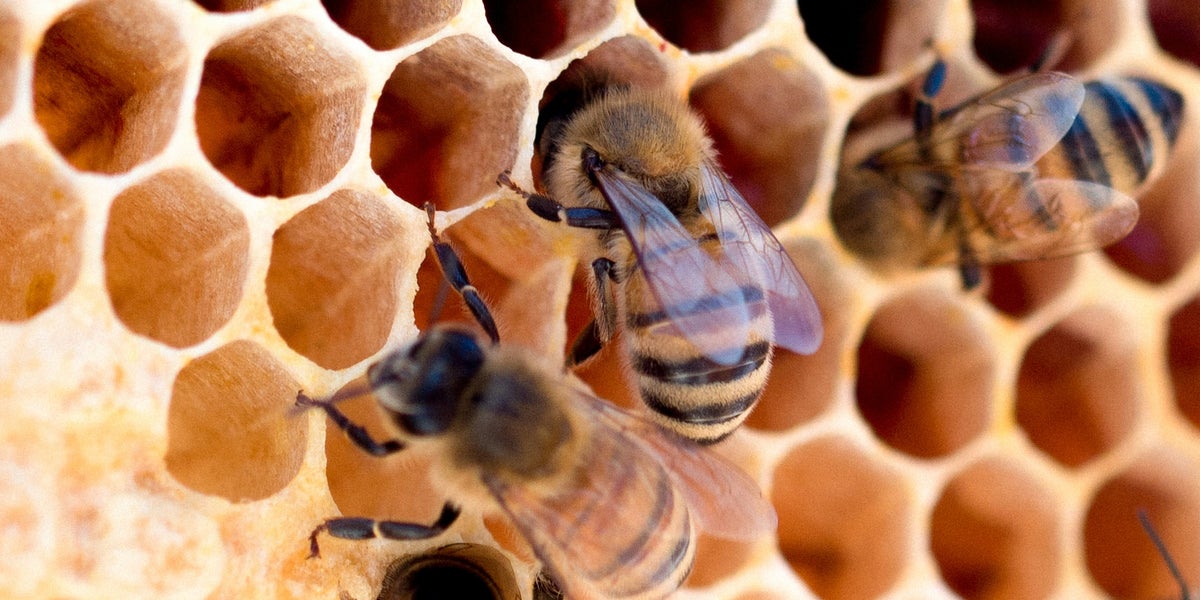
Bees have been around for at least 120 million years, when, Scientific American said, our own ancestors were “rat-like” creatures.
You’d think that’d give us plenty of time to learn about them. But so much information about their lives – like how exactly they fly, and why they can live underwater – has only been revealed relatively recently.
A new study, published in Nature, looked into how they choose their queens (the sole breeding females in the hive), too.
And it may not be as simple as giving them the famous specialised “royal jelly” secretions, which many non-queen bee larvae are also fed briefly, though this certainly seems to be a part of the picture.
The hive may have a “Buckingham Palace” process
According to BBC Wildlife Magazine, a bee’s destiny as either a worker or a queen is determined by how it’s raised.
“A worker bee is reared in one of the many thousands of identical, hexagonal, wax-walled compartments of the honeycomb,” they write. “A queen, on the other hand, develops in a spacious brood chamber called a queen cell, which bulges out from the honeycomb.”
The researchers of this new study said that the physical structure of the hive matters in the process of making a queen, adding that these bees might have “royal cribs”.
“The old idea was relatively simple: take an egg, move it into a queen cell, feed it royal jelly, and you get a queen,” said Boris Baer, entomologist and director of the Centre for Integrative Bee Research (CIBER) at the University of California, Riverside, whose laboratory contributed to the work.
“What we found is that there’s an entire machinery behind this process. It’s much more sophisticated than we imagined.”
Using a variety of tracking, testing, and imaging techniques, researchers found that the “peanut-shaped” queen cell is less dense and more pliable, capable of maintaining more heat and moisture. Its waxy walls have different chemical signals and fatty acids.
To test whether the cell itself made a difference, researchers put developing queen bees into these cells and worker cells and fed them the same diet of royal jelly. Queen bees were less likely to die and grew larger in the peanut-shaped cells than those in regular worker bee ones.
“You can think of it as something like Buckingham Palace,” said Baer.
Is that all?
Nope – of course, a palace needs staff.
This study suggested that worker bees which helped to raise the queen were younger and maintained a higher average body temperature on average than those raising other bees.
This seemed to help the queen bees grow faster and larger.
“There is a dedicated group of bees focused entirely on raising the queen, and if they don’t get it right, the colony cannot reproduce,” said Baer.
The study also found that bees seemed to selectively gather material for the coming queen from across the hive, enriching and transforming it carefully before use.
“This work highlights how much sophistication exists inside insect societies,” Baer said.
“Honeybee colonies are not simply collections of individuals. They function as integrated biological systems capable of engineering their own environments.”
Related…