
Photo-Illustration: Curbed; Photo: Getty
Once upon a time, everyone in the city belonged to one big area-code family. It wasn’t until 1984 that demand for new numbers had the telecom gods dividing New York into a town of 212s (Manhattan) and 718s (everyone else). Since then, there has been a rapid descent into area-code cacophony. First came 917 for cell phones and pagers, in 1992, followed by the 646 and 347 overlays for Manhattan and the outer boroughs in 1999. Next, the outer-borough 929 arrived in 2011 and Manhattan’s 332 in 2017. And then things got quiet. Maybe too quiet. Because the city is, once again, running out of phone numbers. “People are using more than one phone, or using apps that require a second number,” says David Day, founder of number-brokering service 212areacode.com. “You also get spam callers picking up a lot of numbers.”
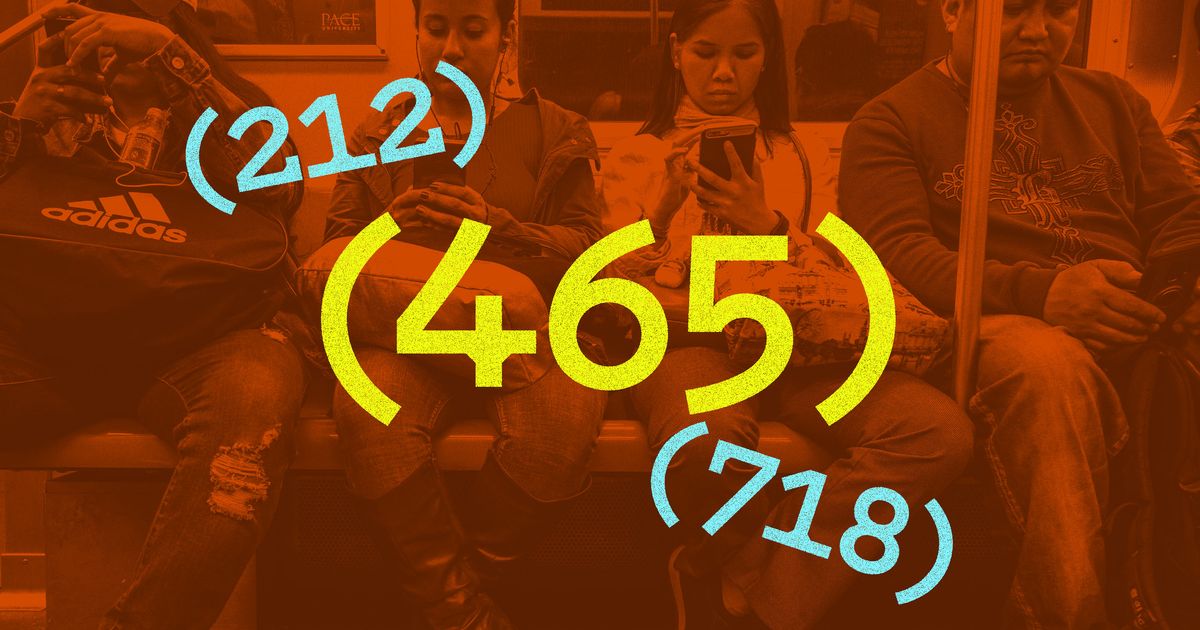
But later this month, on June 18, New York’s eighth area code will hit the scene. Those in Brooklyn, the Bronx, Queens, Staten Island, and Marble Hill requesting a new line may be assigned a nine-digit number beginning with the not-very-memorable 465. Who thought of that one?
The short answer: the people at One Tower Center Boulevard, Suite 800, in New Brunswick, New Jersey. That’s the headquarters of the North American Numbering Plan Administrator — an “impartial, nongovernmental entity” overseen by the FCC and the telecom industry — which creates and issues phone numbers. Last year, NANPA issued 48,784,000 numbers, typically in blocks of 10,000, to telecom providers such as AT&T and Spectrum that, in turn, issued them to end users.
NANPA also monitors phone-number reserves. It surveys telecom providers and, twice a year, publishes a report forecasting when each area code will run out of numbers. Several years ago, an alarm went out — the outer boroughs were expected to run out of numbers by the end of 2026. NANPA sprang into action, working with the New York State Department of Public Service (an agency regulating utilities) and telecom providers to come up with a relief plan — and the 465 area code was born.
Why 465? Back in 1947, when the national area-code system launched, 212 went to New York City because it was the easiest prefix to dial on a rotary phone. These days, NANPA is not allowed to assign new area codes based on ease of use or sentimentality. It had to assign whatever number came next in its inventory of 180 available prefixes, avoiding those that matched any of the middle three digits of a phone number (a.k.a. the central office code) already assigned to New Yorkers in the outer boroughs and Marble Hill. Which is why New York got stuck with 465 rather than one of the jazzier unused area codes such as 420 or 999.
A 465 phone number, of course, will immediately identify one as fresh off the boat or Greyhound bus. The drop will probably send a lot of business to Day, who has been selling 212 numbers since 2009. He says he always enjoys a sales surge when a new area code hits the city. “People will be saying, ‘465? What’s 465? Is that Ohio?’”
He typically buys used 212 numbers — sometimes hundreds at a time — from local businesses closing up shop and resells them on his website at prices ranging from $150 for a random 212 to $3,500 for a number ending with three zeros. He also maintains a small inventory of premium numbers such as 212-666-4444, which he’s offering for just $35,000. “It’s easy to dial and exudes a certain status for a business that wants to advertise. If they use it on a bus stop it’s a lot more memorable,” he says.
A lot of Day’s sales come from new businesses entering the market. A national law firm opening a New York City office, for example, might buy a block of 212s to hide its newcomer status. Individuals buy 212s purely out of vanity, meanwhile, or to ensure their calls are taken. “Spam calls don’t generally have 212 numbers,” says Day. Old-school 917s and 718s, starting at $75, meanwhile, are growing in popularity. Nothing says veteran New Yorker, after all, like a 917 cell number.
The Department of Public Service says the new 465 area code, with its 7.92 million phone numbers, should last roughly 11 years. And when all the area codes are used up? One industry proposal would expand phone numbers from 10 to 11 digits by introducing four-digit area codes. 212, for example, could be 2120. And then, for a brief time at least, we could all go back to an era where there’s just one area code for the entire city. If we’re all still using phones, that is.